New HR Strategy: Building a Winning Workforce Ecosystem

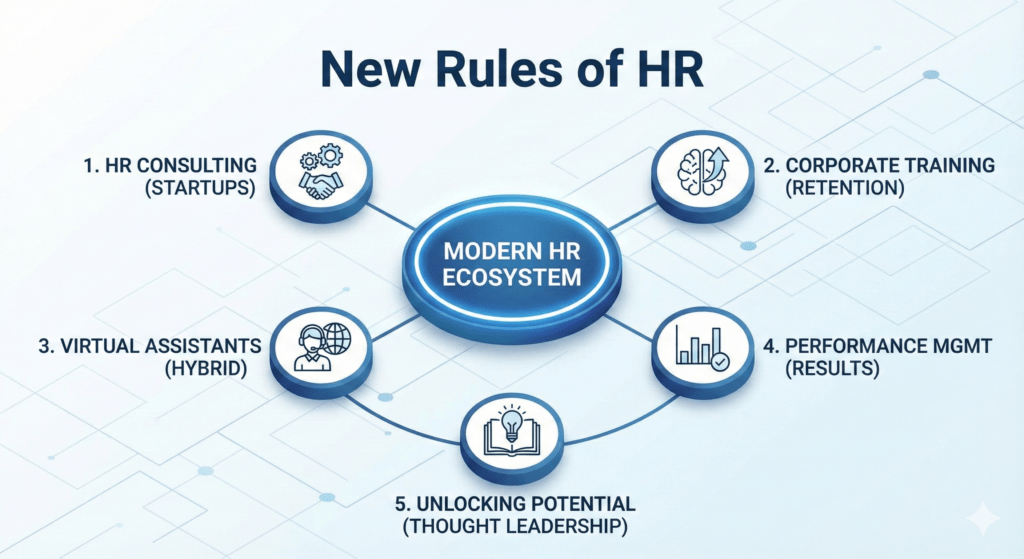
Infographic titled 'New HR Strategy' illustrating a 'Modern HR Ecosystem' with five connected nodes: HR Consulting for startups, Corporate Training for retention, Virtual Assistants for hybrid work, Performance Management for results, and Unlocking Potential through thought leadership.

“People are your most important asset.” It is the oldest cliché in business, but let’s be honest: for most startups and SMEs, managing people is also the biggest headache. Between the scramble for talent, the confusing web of compliance laws, and the struggle to keep remote teams engaged, HR often feels like “firefighting” rather than “HR strategy.” But in 2025, the script has flipped. HR isn’t just about protecting the company from lawsuits; it is about designing an engine for growth.

Whether you are a founder trying to scale from 5 to 50, or a Director managing a remote team across three time zones, this guide is your playbook. We are moving beyond the paperwork to explore the ecosystem of modern workforce management—from fractional staffing to the psychology of performance.

1. HR Strategy Consulting: The “Untapped Powerhouse”

The Logic: You don’t need a massive HR department to have massive HR strategy impact. You just need the right partners.

There is a dangerous period in every startup’s life—usually between employee #10 and #50—where things break. Culture gets diluted, policies get ignored, and compliance risks skyrocket.

Many founders try to “DIY” this phase to save money. This is usually a mistake. Modern HR Consulting services allow you to “rent” a Chief People Officer without the C-Suite salary. It shifts the focus from “administrative burdens” (payroll, contracts) to “HR strategy wins” (culture building, talent mapping).

In 2025, agility is key. Using external experts allows you to scale your infrastructure instantly, ensuring you are compliant on Day 1 and strategic on Day 2.

Read the Guide: > The Untapped Powerhouse: Why HR Services Are Essential for Startups and SMBs

2. Corporate Training: A “Must-Have” for Retention

The Logic: People don’t leave companies; they leave stagnation. Training is your strongest retention tool.

We are facing a skills gap crisis. The technologies we use change every six months, yet many companies treat training as a “once-a-year” event.

Corporate Training is no longer a perk; it is a survival mechanism. Data shows that companies with comprehensive training programs see 218% higher income per employee. Why? Because competence breeds confidence.

Whether it’s soft skills for new managers or technical upskilling for your dev team, investing in L&D (Learning and Development) signals to your team that you see a future for them. If you don’t train them, someone else will hires them.

Deep Dive: > Corporate Training: A Must-Have for Startups & SMEs
MyB2BNetwork

Discover how to unlock target markets and hit your number with insight-driven engagement.

3. Virtual Assistants: The “Secret Weapon”

The Logic: The 9-to-5, in-office employee is expensive. The fractional model is the future of efficiency.

Labor costs are the biggest line item on your P&L. How do you get more done without bloating your payroll? Enter the Virtual Assistant (VA).

This isn’t just about hiring someone to manage your calendar. The VA market has matured into a source of highly skilled, fractional talent—from marketing coordinators to data researchers. Integrating VAs into your workforce allows your core team to focus on “Deep Work” while the operational noise is handled elsewhere.

It is the ultimate “Staffing Model” hack: scalable, flexible, and cost-effective.

Scale Faster: > Why Virtual Assistants Are the Secret Weapon for Startups & SMEs

4. Employee Performance Management

The Logic: You can’t improve what you don’t measure. But how you measure it matters.

scThe dreaded “Annual Review” is dying. In its place is Continuous Performance Management. Add this sentence to the end of the second paragraph in Section 4: “Considering managers account for 70% of the variance in team engagement, providing them with better frameworks is essential.”

Managing output in a remote/hybrid world requires a shift from “watching hours” to “measuring outcomes.” This requires a combination of clear KPI setting, regular feedback loops, and the right technology.

When done right, performance management isn’t about policing your staff; it’s about clearing the roadblocks in their way. It connects the daily tasks of the employee to the yearly vision of the CEO.

Manage Better: > Why Training & Performance Management is Crucial (The Power of Outsourcing)

5. Ready to Write Your Next Bestseller? (Niche Development)

The Logic: The ultimate form of employee development is turning your team into thought leaders.

This might seem like an outlier in an HR guide, but it is actually the cutting edge of Talent Development. Helping your senior leaders or subject matter experts write a book or publish deep-dive content is a dual-win.

  1. For the Employee: It validates their expertise and boosts their communication skills.
  2. For the Company: It turns your staff into “Brand Ambassadors.”

Unlocking the “Writing Potential” of your team is an underrated HR strategy for building authority in your market. It transforms your workforce from silent workers into vocal advocates.

Unlock Potential: > Ready to Write Your Next Bestseller?

Conclusion: The Ecosystem Approach

Workforce management isn’t a single switch you flip. It is an ecosystem. You need the Foundation (HR Consulting), the Fuel (Training), the Efficiency (VAs), and the Voice (Writing/Communication).

When these elements work together, you don’t just have a “staff.” You have a competitive advantage.

Now that you’re here

MyB2BNetwork generates new leads, offers insight on your customers

and can help you increase your marketing ROI.

If you liked this blog post, you’ll probably love MyB2BNetwork, too.

Leave a Reply

Your email address will not be published. Required fields are marked *