Strategic Outsourcing Framework: The SMB Growth Guide

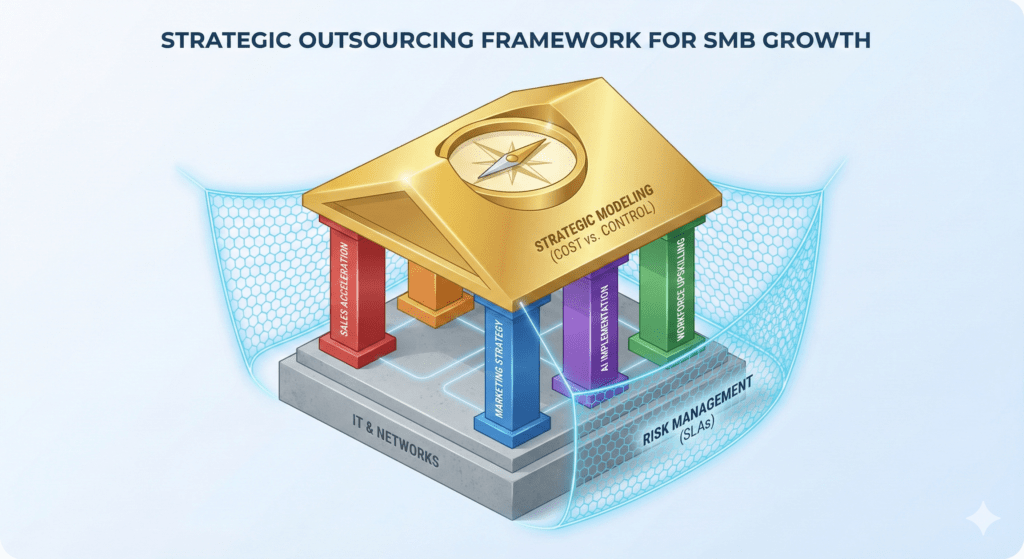
Strategic Outsourcing Framework diagram showing a central SMB growth hub connected to nodes for AI, Sales, IT, and Risk Management, illustrating a unified business ecosystem.

The old definition of strategic outsourcing was simple: “Find someone cheaper to do the boring stuff.”

In 2026, that definition is dead.

For high-growth SMBs and startups, outsourcing is no longer about cost arbitrage; it is about Speed to Capability. It is about realizing that you cannot be world-class at everything. You can be a world-class product company, but if you try to also be a world-class HR firm, a world-class IT security firm, and a world-class marketing agency all at once, you will fail.

This guide presents a Strategic Outsourcing Framework—a blueprint for building a “lean core” business that leverages external partners to scale faster, safer, and smarter than the competition.

1. The Decision: Strategic Outsourcing (Cost vs. Control)

The Logic: Before you sign a contract, you must pick a model.

The “Build vs. Buy” dilemma is the first hurdle. Do you want total control (In-House) or total flexibility (Outsourced)?

  • Project-Based: Good for finite tasks (e.g., Logo Design).
  • Managed Services: Good for ongoing functions (e.g., IT Support).
  • Staff Augmentation: Good for speed (e.g., Adding 3 devs to a sprint).

Choosing the wrong model is why outsourcing fails. You need to map your needs to the right structure before you even look for a vendor.

Choose Your Model: > Outsourcing Models: Solve Your Cost vs. Control Trade-Off

2. The Accelerator: AI Implementation

The Logic: Don’t build the AI; rent the expertise.

Artificial Intelligence is moving too fast for an internal team to keep up. By the time you hire a Data Scientist, the technology has changed. Outsourcing AI Implementation allows you to “leapfrog” the learning curve. You get immediate access to experts who have already made the mistakes on someone else’s dime, allowing you to deploy chatbots, predictive analytics, or automation tools in weeks, not years.

Speed to Market: > Outsourcing AI: The Fastest Route to World-Class Expertise

3. The Revenue: Sales Acceleration Engines

The Logic: Fixed costs kill startups. Variable costs scale them.

Hiring a full sales team is expensive and risky. If they don’t perform, you are stuck with the overhead. Outsourced Sales Services (SDRs, Lead Gen, Closers) turn your sales department into a variable cost. You can scale up the team during a product launch and scale it down in the off-season. It is the ultimate “Growth Engine” for risk-averse scaling.

Scale Your Revenue: > The Growth Engine: Why Sales Services Are Essential

4. The Compass: Marketing Strategy Guidance

The Logic: Stop throwing spaghetti at the wall.

Marketing is a maze of channels: SEO, PPC, Social, Email, Influencer. An SMB founder cannot master them all. Outsourcing isn’t just about execution; it’s about Strategy. A fractional CMO or a specialized agency acts as your guide, telling you which channels to ignore so you can focus your budget where it actually converts.

Navigate the Maze: > The Marketing Maze: Why Startups Need a Guide
MyB2BNetwork

Discover how to unlock target markets and hit your number with insight-driven engagement.

5. The Safety Net: Risk Management (SLAs)

The Logic: Trust is good. Contracts are better.

How do you ensure quality when you aren’t in the room? The answer is the SLA (Service Level Agreement). This is the most critical document in outsourcing. It defines “Success” legally. It sets penalties for downtime, deadlines for deliverables, and standards for quality. Without an SLA, you are just hoping for the best. With one, you are managing risk.

Secure Quality: > SLA: The Contractual Safety Net for Outsourcing Quality

6. The Foundation: IT Infrastructure & Networks

The Logic: You can’t trade on a broken network.

Your server uptime, your cybersecurity, and your cloud architecture are the bedrock of your business. Outsourced Network Services (MSPs) provide 24/7 monitoring that an internal IT guy can’t match. They ensure that the foundation is solid so that the rest of the business (Sales, Marketing, Ops) can build on top of it without fear of collapse.

Build the Base: > Building a Strong Foundation: Outsourced Network Services

7. The Talent: Workforce Upskilling

The Logic: Outsourcing isn’t always about replacing people; it’s about improving them.

Sometimes the best move isn’t to hire out, but to bring experts in to train your team. Outsourced Training Services inject new DNA into your company. Whether it’s sales coaching or cybersecurity awareness, using external pros ensures your internal team learns the latest industry standards, not just “how we do things here.”

Upskill Your Team: > Outsourcing Training Services: Unlocking Expertise

8. The Exit: Future-Proofing Strategy

The Logic: Always know where the exit is.

The biggest fear buyers have? “Vendor Lock-In.” What if the agency goes bankrupt? What if their quality drops? A strategic framework includes an Exit Strategy. It ensures you own your code, your data, and your accounts. It defines the “handover protocol” before the work even begins. Addressing this upfront builds immense trust and ensures you remain the captain of the ship.

Plan for Freedom: > Outsourcing Exit Strategy: A Blueprint for Vendor Lock-In

Conclusion: The Ecosystem Approach

In 2026, the “Lone Wolf” company is extinct. The winners are the “Pack Leaders”—the companies that know how to orchestrate a network of partners.

By applying this framework—balancing Cost vs. Control (Section 1), securing SLAs (Section 5), and leveraging AI (Section 2)—you transform outsourcing from a tactical expense into a strategic superpower.

Now that you’re here

MyB2BNetwork generates new leads, offers insight on your customers

and can help you increase your marketing ROI.

If you liked this blog post, you’ll probably love MyB2BNetwork, too.

Leave a Reply

Your email address will not be published. Required fields are marked *