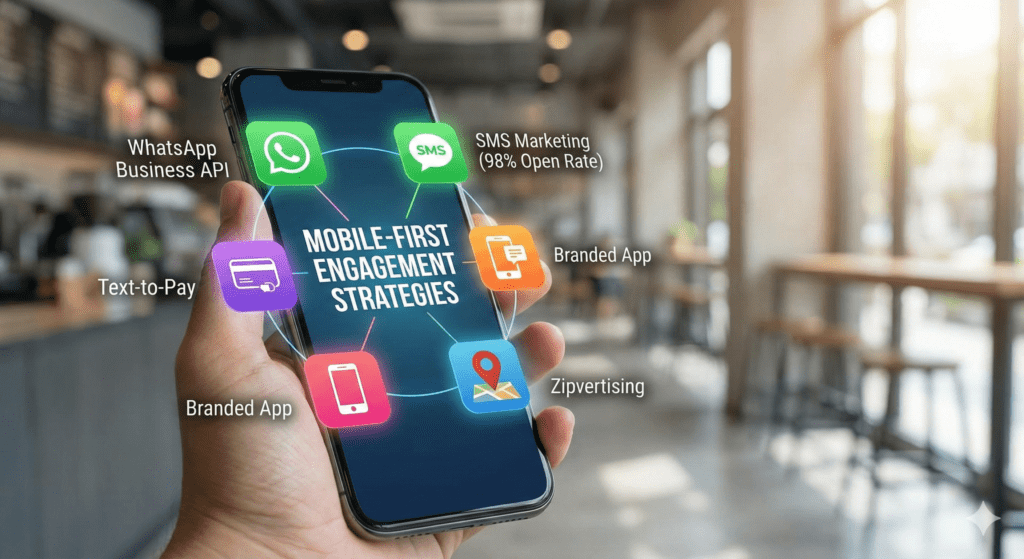
If you are relying solely on email newsletters to reach your customers, you are shouting into a void. The average professional receives 121 emails a day; most are never opened. In contrast, the mobile phone is the most personal real estate on earth. To win in 2026, you must move from “broadcasting” to “conversing.” You need strategies that bypass the spam folder and land directly on the lock screen. This guide explores Mobile-First Engagement—the suite of tools, from WhatsApp APIs to hyper-local advertising, that allows brands to communicate with customers instantly, intimately, and transactionally.
What is a Mobile-First Engagement Strategy? A Mobile-First Engagement Strategy prioritizes channels native to mobile devices—such as WhatsApp, SMS, and branded apps—over desktop-based web browsing. It focuses on high-speed, low-friction interactions like text-to-pay and geofenced advertising to drive immediate consumer action.
The Chat Revolution – WhatsApp & Automation
Target Audience: Marketing Managers, Customer Support Leads
Chat is no longer just for friends; it is the operating system of global business. If your brand isn’t conversational, it’s invisible.
1. The Dominant App (WhatsApp Marketing)
In many international markets (LATAM, EMEA, APAC), email is secondary. WhatsApp is the primary business tool. Marketing here isn’t about “blasts”; it’s about presence. It’s where deals are negotiated and orders are tracked.
- The Strategy: Treat WhatsApp as your “Always-On” customer service counter.
- Deep Dive: Unlock the global standard for communication: Leverage the Power of WhatsApp Marketing.
2. Automation at Scale (WhatsApp Business API)
Typing replies on a phone works for a freelancer, not a scaling SMB. To grow, you need the WhatsApp Business API. This allows you to deploy chatbots, automate order updates, and manage thousands of conversations simultaneously without losing the “human” touch.
- The Strategy: Automate the FAQ, humanize the escalation.
- Deep Dive: Move from manual texting to enterprise automation: WhatsApp Business Messaging: A Game Changer for Startups & SMEs.
The Speed of Money – SMS & Frictionless Payments
Target Audience: Sales Directors, Retail Owners
When you need immediate action—a flash sale, an appointment reminder, or a payment—speed is everything. These clusters focus on the “Urgency” channels.
3. Direct Response (SMS Marketing)
While email struggles for a 20% open rate, SMS boasts a staggering 98% open rate. It is the nuclear option of marketing. Because it is so intrusive, it must be used sparingly and strategically for high-value alerts.
- The Strategy: Use SMS for time-sensitive offers that expire in under 24 hours.
- Deep Dive: Master the high-engagement channel: Leverage the Power of SMS Marketing.
4. Text-to-Pay (Fintech Fusion)
The biggest drop-off point in sales is the checkout page. “Text-to-Pay” removes the friction of logging into a portal or reading credit card numbers over the phone. You send a secure link; the customer clicks and pays via Apple/Google Pay.
- The Strategy: Reduce your “Accounts Receivable” days by making it effortless to pay you.
- Deep Dive: Close the deal instantly: Text-to-Pay: A Seamless Solution for Businesses.