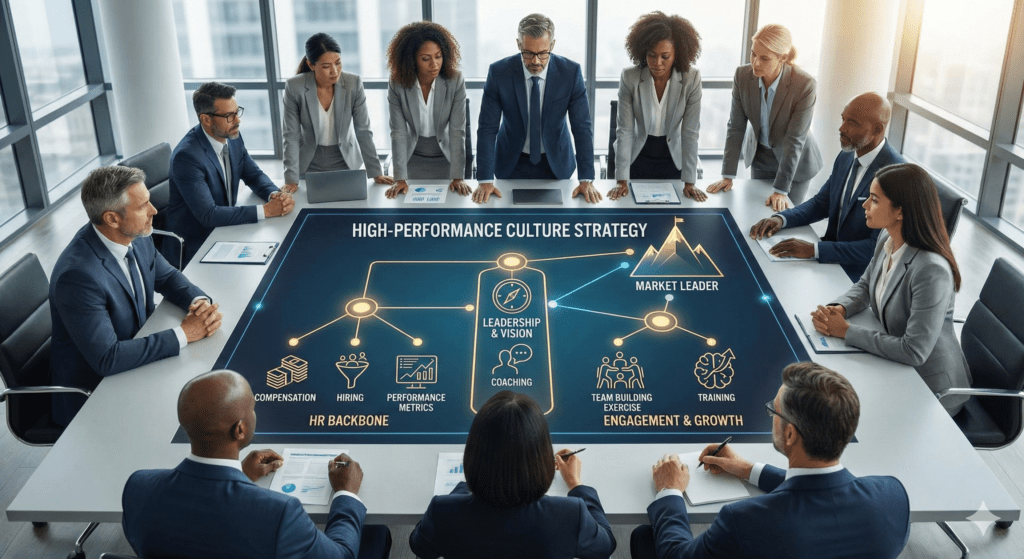
When a startup scales from 10 to 100 people, the first thing to break is rarely the product code—it’s the “people code.” Communication silos form, compensation gets messy, and your best leaders burn out. Building a High-Performance Culture isn’t about office perks; it is about engineering an ecosystem where A-players thrive and B-players are coached up. It requires a deliberate strategy that aligns hiring, compensation, and leadership development into a unified machine.
This guide acts as your “Chief People Officer” in a box. We dissect the seven critical pillars of talent strategy that transform a chaotic startup into a disciplined market leader.
What is a High-Performance Culture? A High-Performance Culture is an organizational environment defined by clear accountability, continuous feedback, and strategic alignment between individual goals and company vision. It is characterized by high employee engagement, transparent compensation models, and a commitment to continuous leadership development.
The Head of the Snake – Leadership & Vision
Target Audience: CEOs, Founders, Board Members
A culture of excellence starts at the very top. If your leaders are stagnant, your company is dying.
1. Executive Growth (Coaching)
It is lonely at the top. Founders often struggle to transition from “doers” to “leaders.” Executive coaching isn’t remedial; it is a performance enhancer for your C-Suite. It provides the external perspective needed to spot blind spots before they become roadblocks.
- The Strategy: Shift from “managing work” to “leading people.”
- Deep Dive: Unlock the potential of your C-Suite: Empowering Your Executive Team Through Coaching.
2. Future Readiness (Succession Planning)
Is your leadership team building the company of 2030, or fighting the fires of 2025? “Future Readiness” is about anticipating market shifts and preparing your leaders to navigate them. It involves rigorous succession planning to ensure the bus factor doesn’t kill your momentum.
- The Strategy: Don’t just hire for today’s role; hire for tomorrow’s challenge.
- Deep Dive: Assess your leadership resilience: Is Your Leadership Team Ready for Tomorrow’s Challenges?.
The HR Backbone – Structure & Mechanics
Target Audience: HR Directors, VP of Operations
Vision inspires, but structure retains. You need fair pay, clear metrics, and efficient hiring funnels to keep the machine running.
3. HR Structure (Compensation Models)
Nothing kills morale faster than perceived unfairness in pay. As you scale, “handshake deals” must be replaced by structured compensation bands. If your compensation model is a black box, you will lose your top talent to competitors who offer transparency.
- The Strategy: Align pay with performance, not just tenure.
- Deep Dive: Fix the headache before you lose talent: Is Your Compensation Model a Headache?.
4. Hiring Logistics (Staffing Efficiency)
“We need to hire 20 devs by Q3.” This request can crush an internal HR team. Outsourcing the logistics of staffing—sourcing, screening, and scheduling—allows your internal team to focus on the final “Culture Fit” interview, rather than drowning in resumes.
- The Strategy: Treat recruitment like a sales funnel.
- Deep Dive: Stop letting hiring drain your resources: Is Your Staffing Process a Drain on Your Resources?.