In the current tech landscape, writing code is the easy part. The hard part is building the right thing, building it to scale, and keeping it stable while shipping features daily. Many startups fail not because they lack developers, but because they lack an engineering culture. They skip prototyping, ignore automated testing, or treat DevOps as an afterthought. This is where End-to-End Software Product Engineering shifts the paradigm.
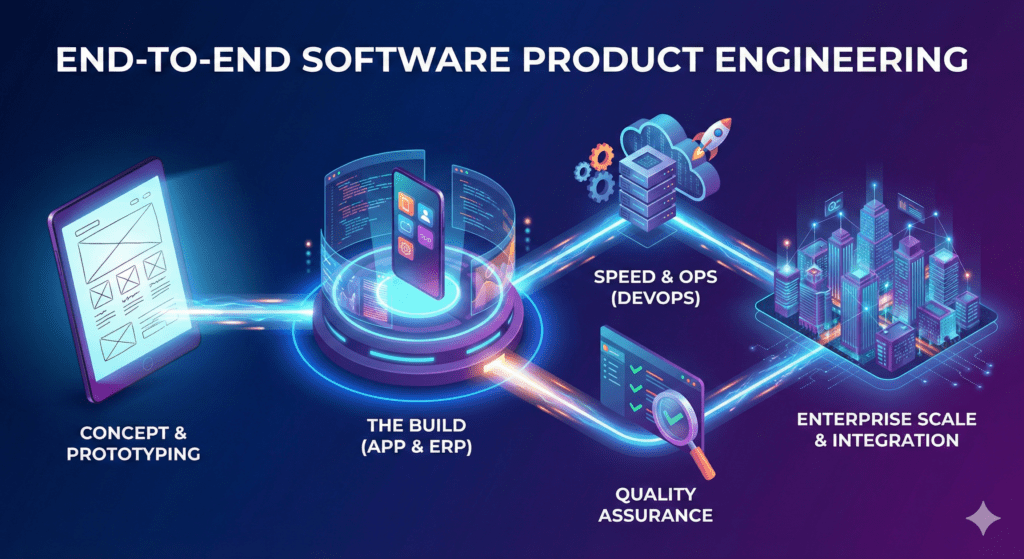
Instead of hiring isolated freelancers for disparate tasks, a product engineering hub provides a unified pipeline. It connects the vision (Prototyping) to the execution (App Dev) and the infrastructure (DevOps) required to win.
This guide details the seven stages of a mature software lifecycle and how to optimize each one.
What is End-to-End Software Product Engineering? End-to-End Software Product Engineering is a holistic approach to software development that encompasses the entire product lifecycle. Unlike simple “coding,” it integrates initial prototyping, MVP development, quality assurance (QA), DevOps infrastructure, and post-launch optimization into a single, continuous workflow to ensure scalability and market fit.
The Blueprint – Validation Before Code
Target Audience: Founders, Product Managers
The most expensive mistake in software is building a product nobody wants. The engineering process begins before the first line of code is written.
1. The Concept (Prototyping Services)
You wouldn’t build a house without a blueprint. Software prototyping allows you to visualize the user flow and validate the logic with stakeholders before spending your development budget. It transforms abstract ideas into clickable reality.
- The Strategy: Validate the “What” before you pay for the “How.”
- Deep Dive: Save your budget for what works: Why Software Prototyping Services Are Essential for Startups.
The Build – Mobile & Enterprise Core
Target Audience: CTOs, Enterprise Architects
Once the blueprint is set, construction begins. This phase splits into two distinct paths: consumer-facing speed (Apps) and internal business logic (ERPs).
2. The Build (Outsourced App Development)
Whether it’s iOS or Android, modern app development requires a stack that can handle scale. “Hiring app developers” is not enough; you need a team that understands architecture, state management, and security compliance.
- The Strategy: Focus on “Native Performance” or “Cross-Platform Speed” (Flutter/React Native) depending on your user base.
- Deep Dive: Streamline your launch: Streamline Your Startup with Outsourced App Development.
3. Enterprise Scale (Custom ERP Development)
Off-the-shelf software (SaaS) often fails complex businesses. Custom ERP (Enterprise Resource Planning) development builds the digital nervous system of your company, connecting inventory, HR, and finance into a bespoke dashboard that fits your workflow, not the other way around.
- The Strategy: Build for your unique operational advantage.
- Deep Dive: Stop fighting spreadsheets: Transform Your Business with Custom ERP Software Development.
The Factory – Speed, Quality & Ops
Target Audience: VP of Engineering, DevOps Leads
A car engine is useless without a transmission. In software, your code is the engine, but DevOps and QA are the transmission that delivers power to the road.
4. Speed & Ops (DevOps Services)
You can’t ship code if your pipeline is broken. DevOps bridges the gap between “It works on my machine” and “It works in production.” Automated CI/CD (Continuous Integration/Continuous Deployment) pipelines allow you to release features daily without breaking the build.
- The Strategy: Automate the boring stuff so developers can focus on features.
- Deep Dive: Fix your deployment pipeline: Is Your Startup Struggling with DevOps Challenges?.