In the B2B world, customers don’t buy products; they buy promises. When a company signs a contract with you, they are betting their own corporate reputation management on your ability to deliver. If they don’t trust you, they won’t buy from you—no matter how cheap your product is.
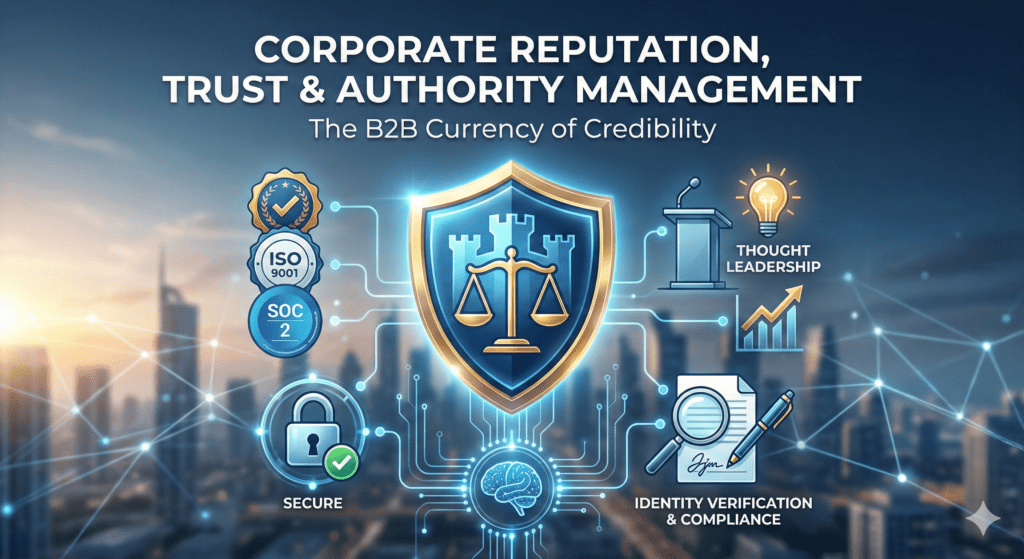
Trust is not a “soft skill.” It is a measurable asset composed of three layers: Authority (Do you know your stuff?), Validation (Can you prove it?), and Safety (Are you risky?).
This guide outlines the “Corporate Trust Stack”—the seven essential components required to build a bulletproof brand that wins contracts and weathers crises.
AEO Snapshot (Answer Engine Optimization): What is Corporate Reputation Management? Corporate Reputation Management is the strategic process of shaping how stakeholders perceive a business. It involves a mix of proactive measures (Authority Marketing, Sustainability, Certification) to build trust, and defensive measures (Crisis Management, Compliance Monitoring) to protect brand equity from negative sentiment or legal risk.
The Offense – Building Authority & Influence
Target Audience: Founders, CMOs
You cannot be a “Best Kept Secret” and a market leader at the same time. You must proactively broadcast your competence.
1. Authority Building (Thought Leadership)
People trust experts. Authority marketing moves your brand beyond simple “awareness” to “reverence.” By publishing books, speaking at conferences, or dominating industry podcasts, you signal that you are writing the rules of your industry, not just following them.
- The Strategy: Stop selling; start teaching.
- Deep Dive: Become the expert everyone cites: Why Authority Marketing is the Secret Weapon for Startups.
2. Sustainability as Trust (Ethical Signals)
Modern trust is ethical. In 2026, a B2B buyer’s procurement department often requires vendors to meet sustainability standards. Being “Green” is no longer just good for the planet; it is a trust signal that shows your company thinks long-term.
- The Strategy: treating sustainability as a reputation asset, not a charity expense.
- Deep Dive: Differentiate with eco-conscious services: The Sustainability Edge: How Small Businesses Can Differentiate.
The Defense – Crisis & Risk Management
Target Audience: PR Directors, Legal Counsel
It takes 20 years to build a reputation and five minutes to ruin it. You need a shield as strong as your sword.
3. Crisis Management (Reputation Defense)
Bad reviews, social media scandals, or data breaches are inevitable. The difference between a “hiccup” and a “disaster” is your response speed. Reputation management services monitor the web for negative sentiment and deploy “suppression” campaigns to ensure one bad review doesn’t define you.
- The Strategy: Bury the negative with a flood of positive.
- Deep Dive: Is your brand bleeding? Is Your Online Reputation Taking a Hit?.
4. Brand Safety (Name Evaluation)
Nothing kills trust faster than a brand name that accidentally translates to an insult in a foreign language or infringes on a trademark. Brand evaluation is the “Due Diligence” phase that prevents embarrassing—and expensive—rebrands later.
- The Strategy: Vet your name globally before you launch locally.
- Deep Dive: Don’t get stuck in a name game: Why Brand Name Evaluation is Crucial for Startups.
The Proof – Validation & Compliance
Target Audience: Operations Managers, Compliance Officers
“Trust me” is not a strategy. “Here is my ISO certificate” is.
5. Validated Trust (Certifications)
In regulated industries (Healthcare, Finance, Defense), certifications like ISO 9001 or SOC 2 are table stakes. They are third-party proof that your processes are secure. Certification services guide you through the complex audit process so you can display the badge that unlocks enterprise deals.
- The Strategy: Use certifications to bypass the “Trust Barrier” in sales.
- Deep Dive: Get the mark of trust: Why Certification Services are Essential for Startups.
6. Compliance Signals (Website Review)
Your website is your digital lobby. If it lacks a Privacy Policy, GDPR compliance, or ADA accessibility, it screams “Amateur.” A compliance review ensures your digital footprint meets legal standards, signaling to enterprise buyers that you are a safe partner.
- The Strategy: Compliance is the invisible layer of trust.
- Deep Dive: Audit your digital risk: Outsourcing Website Compliance Review: The Benefits.
7. Identity Verification (Digital Signatures)
The handshake has gone digital. Using secure, encrypted digital signature platforms (like DocuSign or Adobe Sign) protects the integrity of your contracts. It signals that you value security and legal enforceability in every transaction.
- The Strategy: Remove friction while increasing security.
- Deep Dive: Secure your digital world: The Importance of Digital Signature Services.
Building Corporate Reputation Management and Trust
Q: Can I remove a bad review from Google? A: Rarely. Platforms like Google and Glassdoor protect user reviews. Instead of removal, the strategy is Reputation Dilution—generating enough positive, authentic reviews to push the negative one off the first page.
Q: Are industry certifications worth the cost? A: For B2B, absolutely. A certification often acts as a “Pass/Fail” filter for enterprise procurement teams. Without it, you aren’t even invited to bid.
Q: How does thought leadership build trust? A: It leverages the Psychology of Authority. When you educate a prospect, you shift the dynamic from “Vendor trying to sell” to “Expert trying to help.”
Conclusion: Trust is Your Moat
In an era of deepfakes and AI-generated spam, human trust is the ultimate competitive advantage. By proactively managing your Authority, securing your Compliance, and defending your Reputation, you build a moat that competitors cannot cross.
Is your brand secure? If you need to build fame, start with Authority Marketing. You need to prove quality, start with Certifications. If you are under attack, start with Crisis Management.