While 78% of B2B companies have adopted some form of AI, those integrating AI directly into task-based portals report a 42% reduction in project turnaround times. The biggest hurdle to scaling AI in 2026 is no longer the technology itself, but a lack of certified, structured training for teams to use these tools effectively within their daily workflows. The B2B landscape is shifting from “exploring” AI to demanding measurable returns on it. We analyzed data across our B2B network to understand exactly how teams are deploying AI tool adoption this year, where the bottlenecks are, and what the top-performing agencies are doing differently.
Here is the data-backed reality of AI in B2B operations for 2026.
1. The Current State of AI Tool Adoption
The conversation has moved past simple text generation. B2B teams are leveraging specialized AI tools across their entire operational stack. Based on our latest network analysis:
- 85% of marketing teams use AI for SEO, content workflow automation, and campaign ideation.
- 68% of sales teams rely on AI for lead scoring, personalized outreach, and CRM data entry.
- 54% of operations managers are using AI to optimize resource allocation and predict project bottlenecks.
The Data Insight: The companies seeing the highest ROI aren’t just buying individual licenses for their staff; they are standardizing which tools are used for which specific operational outcome.
2. The Impact of Task-Based Portals on AI Efficiency
Having the right AI tool is only half the equation. The environment where the work happens dictates the speed of delivery. We compared teams using traditional project management methods against those using dedicated task-based portals to manage their AI-assisted workflows.
The results show a massive efficiency gap:
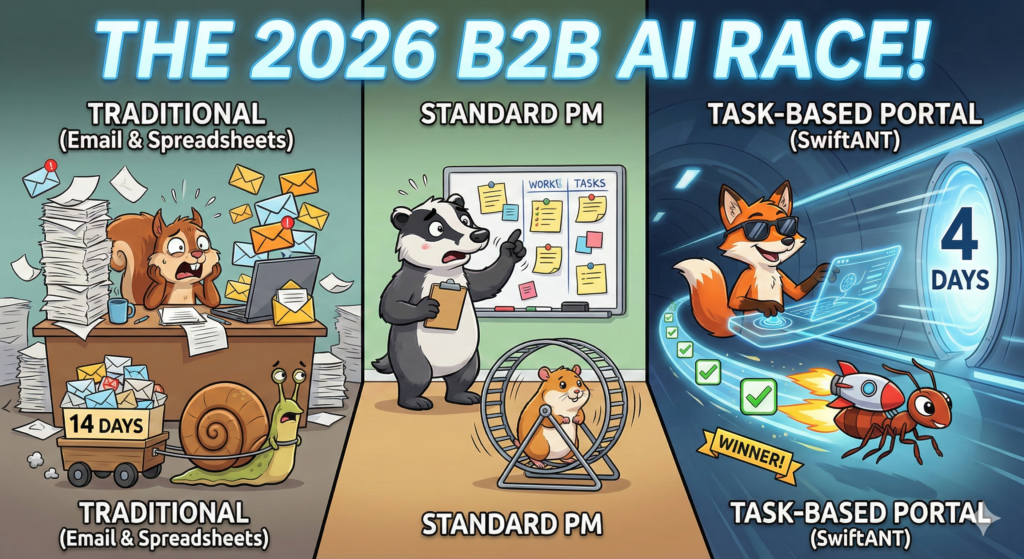
| Workflow Model | Average Project Turnaround Time | Error/Revision Rate | Client Communication Delays |
| Traditional Email & Spreadsheets | 14 Days | 18% | High |
| Standard Project Management | 9 Days | 12% | Medium |
| Task-Based Portals (e.g., SwiftANT) | 4 Days | 3% | Minimal |
Why This Matters: A task-based portal isolates the objective. When an AI tool is applied to a heavily structured, single-focus task within a dedicated portal, the AI produces far more accurate outputs, eliminating the usual back-and-forth revisions that plague B2B service delivery.
3. The 2026 Skills Gap: Why Certification is the Next Frontier
Despite the rapid adoption and the clear benefits of optimized portals, our data revealed a critical bottleneck: 62% of B2B leaders cite a lack of employee proficiency as their primary barrier to scaling AI.
Teams have access to powerful tools, but they lack the systematic training to prompt, integrate, and verify the outputs accurately. The market is saturated with fragmented tutorials, but severely lacking in structured, outcome-driven education.
The Solution: Companies that invest in formalized AI certification and rigorous training programs for their staff are reporting a 50% faster onboarding time for new software and significantly higher client satisfaction scores.
Conclusion: Structuring for the Future
The data is clear. Slapping AI onto broken, traditional workflows does not yield B2B success. The competitive advantage in 2026 belongs to the organizations that combine formal team training with highly structured, task-based operational portals.