Every board meeting today features the same question: “What is our AI strategy?” For many companies, the panicked response is to buy a random set of AI tools, hand them to an untrained team, and hope for a productivity miracle. This approach almost always ends in a costly, confusing mess. Real AI transformation is not about replacing your workforce with algorithms. It is about strategic integration. It requires a clear understanding of your tech stack, a defined ROI metric, and the right outsourcing partners to get you to market before your competitors.
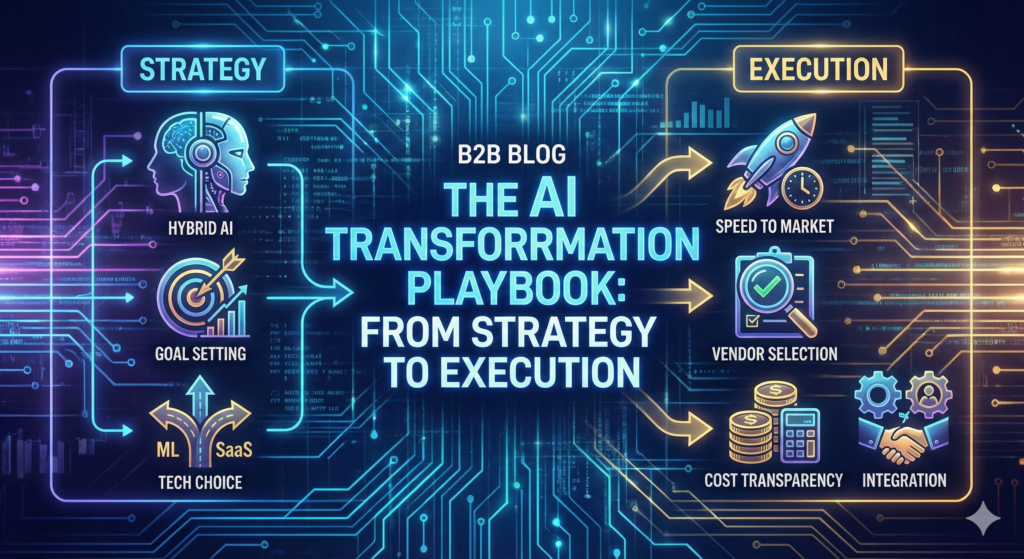
This playbook is your execution roadmap. We deconstruct the AI implementation journey into seven actionable stages—from choosing between custom Machine Learning and AI-as-a-Service, to deciphering the budget black box and vetting the perfect development partner.
What is B2B AI Transformation? B2B AI Transformation is the strategic integration of artificial intelligence into a company’s core operations to drive measurable ROI. Rather than replacing human workers, successful transformation relies on a “Hybrid AI” model that pairs human expertise with AI efficiency. It requires clear goal-setting, careful technical selection (Custom ML vs. SaaS), and rigorous vetting of outsourced AI development services.
The Strategy – Goals & Human Leverage
Target Audience: CEOs, Founders, Operations Directors
Before you write a single line of code or pay for an API, you must define what “success” actually looks like for your business.
1. The Strategy (Hybrid AI)
The biggest myth in tech right now is that AI will run your business on autopilot. The reality is that AI is an exoskeleton for your best people. A “Hybrid AI” strategy focuses on augmenting your human talent, taking over repetitive data tasks so your team can focus on high-level relationship building and complex problem-solving.
- The Strategy: Optimize for human-in-the-loop workflows, not complete automation.
- Deep Dive: Stop the implementation headaches: Stop AI Headaches: Hybrid AI is the Smart Scale Strategy.
2. Goal Setting (Value Metrics)
“Implementing AI” is not a goal. Reducing customer churn by 15%, cutting report generation time by 40 hours a week, or increasing lead qualification speed by 300% are goals. Tying your AI project to specific, measurable business KPIs ensures you are investing in solutions, not just shiny objects.
- The Strategy: If you can’t measure the baseline today, you shouldn’t apply AI to it tomorrow.
- Deep Dive: Define your success parameters: AI Outsourcing: Define Project Goals with Value Metrics.
The Tech & The Budget – Building the Stack
Target Audience: CTOs, VPs of Engineering, CFOs
AI is not a monolith. You have distinct choices regarding how you build your intelligence layer and how much you should realistically pay for it.
3. Technical Choice (Custom ML vs. AIaaS)
Should you train your own proprietary algorithm, or plug into an existing off-the-shelf API like OpenAI or Anthropic? “AI-as-a-Service” (AIaaS) gets you to market in weeks for thousands of dollars. Custom Machine Learning (ML) protects your IP and handles highly specialized data, but takes months and costs significantly more.
- The Strategy: Buy the baseline (AIaaS) and build the differentiator (Custom ML).
- Deep Dive: Make the right architectural choice: Custom ML vs. AI-as-a-Service Guide.
4. Cost Transparency (Deciphering the Budget)
The AI pricing model is a black box for most founders. You aren’t just paying for development hours; you are paying for data cleaning, API token usage, server compute costs, and ongoing model maintenance. Understanding the Total Cost of Ownership (TCO) prevents you from abandoning a project halfway through.
- The Strategy: Budget 30% for development and 70% for data preparation and maintenance.
- Deep Dive: Stop guessing your costs: AI Outsourcing Budget: Deciphering the Cost Black Box.