Q: Why does this question keep coming up in procurement meetings?
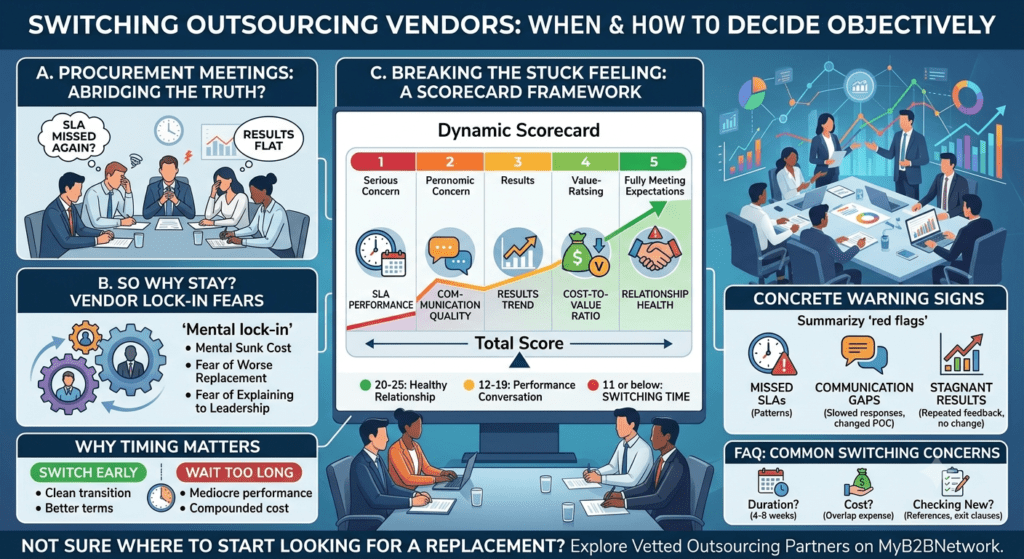
Because most teams already know the answer, and they’re avoiding it. The vendor missed another SLA last quarter. The account manager stopped responding within a day. Results have been flat for two review cycles running. Nobody wants to say “we should switch,” because switching sounds expensive, slow, and risky.
Q: So why do so many companies stay anyway?
Vendor lock-in fear. It’s rarely written into a contract. It’s a mental one: the sunk cost of onboarding, the fear of a worse replacement, the dread of explaining a vendor change to leadership. That fear keeps buyers stuck with underperforming partners longer than the numbers justify.
Q: What actually breaks that stuck feeling?
A clear framework. Not a gut feeling about whether the relationship “feels off,” but specific, named signals you can point to. Switching outsourcing vendors stops being a scary leap once you have concrete evidence, and a scorecard that says so in writing.
Q: What does this piece actually cover?
It defines what a real vendor switch decision looks like, why the timing question matters more than people think, the concrete warning signs worth tracking, and a simple scorecard you can run on your current vendor this week. It ends with where to find a replacement vendor in the U.S. if the scorecard says it’s time.
What Does It Mean to Switching Outsourcing Vendors?
Q: What is a vendor switch, exactly?
Switching outsourcing vendors means formally ending or significantly reducing work with a current outsourcing partner and moving that work to a new provider, based on a documented decline in performance, fit, or value. It’s different from simply renegotiating a contract, because it involves a real transition, not just a price adjustment.
Q: Is this the same as just being unhappy with a vendor?
No. Plenty of vendor relationships have rough patches that get resolved. A switch decision is specifically about a pattern, not a single bad month. It usually follows repeated, documented issues across at least two review cycles, not one frustrating call.
Why Does Knowing When to Switch Matter for Businesses?
Q: What’s actually at stake if a company waits too long?
Cost, mostly, and it compounds quietly. A vendor stuck at mediocre performance doesn’t just fail to improve. It actively drags down whatever business outcome it was hired to support, while the invoice stays the same or creeps up at renewal.
Q: What does the data say about this?
Gartner’s sourcing and procurement research has found that underperforming vendor relationships, left unaddressed, tend to get worse rather than plateau. There’s little incentive for the vendor to improve once switching feels unlikely. IDC’s outsourcing research points to a similar pattern: companies with structured performance reviews catch decline earlier and switch with far less disruption than companies that wait for a crisis.
Q: Why does timing matter more than the switch itself?
Because a company that switches early, on its own terms, can plan a clean transition. A company that waits until the relationship collapses ends up switching in a scramble, usually at a worse moment, with less leverage.
What Warning Signs Suggest It’s Time to Switch?
Q: What are the clearest, most concrete red flags?
Three patterns show up again and again in vendor post-mortems:
- Missed SLAs, more than once. A single missed deadline is a bad week. Two or three missed SLAs across consecutive review periods is a pattern, and patterns don’t self-correct without pressure.
- Communication gaps that widen over time. Response times slow down. Your point of contact changes without notice. Status updates get vaguer instead of more specific. This is often the earliest signal, well before performance numbers visibly drop.
- Stagnant results despite repeated feedback. You’ve raised the same issue in two or more review meetings, and nothing measurable has changed. That’s not a communication problem anymore. It’s a capability or priority problem.
Q: Are there softer signals worth watching too?
Yes, and they’re easy to dismiss individually:
- The vendor stops proactively flagging risks and only reports good news
- Your team starts doing informal workarounds to compensate for gaps in the vendor’s work
- Renewal conversations focus entirely on price, with no discussion of performance improvement
Any one of these alone isn’t a reason to switch. Two or more, sustained over a quarter, usually is.
How Can You Score Your Current Vendor Objectively?
Q: What’s a simple way to move past gut feeling?
Run your current vendor through a short scorecard, and score it honestly, not aspirationally. Rate each area from 1 (serious concern) to 5 (fully meeting expectations):
- SLA performance — Has the vendor consistently hit agreed deadlines over the last two review periods?
- Communication quality — Are responses timely and proactive, rather than reactive and vague?
- Results trend — Are outcomes improving, holding steady, or declining since the engagement started?
- Cost-to-value ratio — Does the value delivered still justify the current spend, compared to market rates?
- Relationship health — Does the vendor flag risks honestly, or only surface problems once they’re urgent?
Q: How do you read the score once you’ve rated it?
A total of 20-25 means the relationship is healthy. Keep monitoring on schedule. A score of 12-19 means it’s worth a direct performance conversation, with a defined improvement window, often 60 to 90 days. A score of 11 or below is a strong signal to start evaluating replacement vendors, even while the current relationship continues.
What Tools Help You Track Vendor Performance Over Time?
Q: Do you need specialized software to track this?
Not necessarily, but consistency matters more than the tool. A shared vendor performance tracker, reviewed on a fixed schedule, catches decline far earlier than memory or ad hoc complaints.
Q: What’s commonly used for this?
- Vendor management platforms like SAP Ariba or Coupa, which track SLA adherence and spend data in one place for larger procurement teams
- Simple shared scorecards, built in a spreadsheet and reviewed quarterly, which work well for smaller teams without a dedicated procurement platform
- Structured review cadences, ideally monthly for high-stakes vendors and quarterly for lower-risk ones, so decline gets caught early instead of at renewal
The specific tool matters less than the habit of scoring on a schedule, not just when frustration boils over.
FAQ
What is switching outsourcing vendors, and why does it matter for B2B businesses?
It’s the formal decision to move outsourced work from an underperforming vendor to a new provider, based on a documented pattern rather than a single bad experience. It matters because waiting too long compounds cost and disruption, while switching early, on your own terms, keeps the transition manageable.
How do I choose the right new vendor within my budget?
Start with the gaps your current scorecard revealed, and prioritize candidates who directly address those specific weaknesses, not just vendors with the lowest quote. Request references from clients in a similar industry, and ask pointed questions about SLA history before signing anything.
What checks should I do before switching to a new outsourcing vendor?
Review the new vendor’s SLA track record with existing clients, confirm their transition or onboarding process in writing, and check contract terms for exit clauses, so you’re not repeating the same lock-in problem with a new partner.
How long does a vendor switch typically take, and what does it cost?
A well-planned transition usually takes four to eight weeks for most outsourced functions, longer for complex technical work. Budget for some overlap expense while both vendors are briefly engaged during handoff, typically two to four weeks of parallel cost.
Not Sure Where to Start Looking for a Replacement?
Finding a vetted alternative shouldn’t mean starting your vendor search from zero. MyB2BNetwork connects procurement and ops leaders with pre-screened outsourcing partners across categories, so you can compare real options instead of cold-searching. Explore vetted outsourcing partners on MyB2BNetwork.