Ask three agencies to quote the same website and you might get $2,500, $12,000 and $48,000. That spread is why website development outsourcing cost is one of the most searched and least understood numbers in B2B buying. The quotes aren’t always dishonest. They usually price different scope, different seniority and different risk.
Location is the biggest single lever. Published 2026 rate guides put offshore developer rates anywhere from $20 to $200+ per hour, depending on country and seniority. Hourly rate alone, though, never tells you the final bill.
This guide gives you a plain price table by country and scope, explains what pushes a quote up or down, and ends with five questions to ask before you accept any proposal. It’s written for startup founders, SMB owners and marketing heads who need a defensible budget, not a sales pitch.
One caveat up front: every figure below is a planning band drawn from named 2026 sources, in USD. It is not a quote. Real prices move with scope, platform and team.
What Is Website Development Outsourcing Cost?
Website development outsourcing cost is the total you pay an external agency, freelancer or offshore team to design, build and launch a website, plus the ongoing costs that keep it running. It covers the build quote and the extras that rarely appear on page one of a proposal.
Those extras matter. SmartDev’s 2026 analysis argues that total cost of ownership adds 25–150% to base hourly rates once coordination, rework and tooling are counted. Websnp estimates that hosting, maintenance, SEO and content typically add 15–25% of the build cost every year.
Why Does Website Development Outsourcing Cost Matter for Businesses?
It matters because the website is usually the first asset buyers judge you on, and an underbudgeted build tends to get paid for twice: once cheaply, then again to fix or rebuild it. A realistic number protects your runway and your launch date.
It also lets you compare quotes fairly. When you know the normal band for your scope and region, an outlier at either end becomes a question to ask rather than a surprise to absorb.
How Much Does Outsourced Website Development Cost by Country and Scope?
Outsourced website development typically runs from under $1,000 for a simple brochure site in lower-cost markets to $300,000+ for a complex custom build onshore. The table shows planning bands by region and scope.
| Region | Typical hourly rate | Brochure site (5–10 pages) | E-commerce store | Custom web app |
|---|---|---|---|---|
| India / South Asia | $20–$50 | $800–$8,000 | $2,000–$15,000 | $8,000–$40,000+ |
| Eastern Europe (Poland, Ukraine, Romania) | $35–$70 | $1,500–$15,000 | $5,000–$30,000 | $15,000–$100,000+ |
| Latin America (Mexico, Brazil, Colombia) | $30–$60 | $1,500–$12,000 | $5,000–$30,000 | $15,000–$90,000+ |
| North America / Western Europe (onshore benchmark) | $80–$200 | $5,000–$15,000 | $15,000–$60,000 | $25,000–$300,000+ |
How the table was built: hourly rates follow Wisemonk’s 2026 regional guide. Brochure ranges follow ProjectCostEstimator (Eastern Europe, Latin America), eCarter (India) and GoodFirms-based agency surveys cited by Presta (onshore). E-commerce and custom-app figures draw on eCarter, Imaginovation and Websnp. Eastern Europe and Latin America e-commerce and custom-app cells are my estimates, scaled from published hourly-rate gaps, not quoted from a single source.
Read the table as a floor-to-ceiling guide. Cheaper regions don’t automatically mean cheaper projects, because the same build quoted at a lower rate can need more management time.
What Pushes Website Development Outsourcing Cost Up or Down?
Five things move a quote most: where the team sits, how senior it is, how much you want built, what it must connect to, and what support you need after launch. I call this the 5-Lever Price Model.
- Location. Regional rates set your cost floor, as the table shows.
- Seniority. Senior engineers and designers cost more per hour but often need fewer revision cycles.
- Scope. Custom design versus a template is the biggest multiplier, according to Websnp. Imaginovation adds that e-commerce functionality adds 40–60% to base development cost.
- Integrations. Each API connection to Stripe, HubSpot or Salesforce adds hours. Merge’s 2026 pricing guide says e-commerce features like inventory and checkout can double or triple the base price.
- Support. Hosting, security patches and content updates are recurring costs, not one-off ones.
Platform choice shifts the numbers too. WordPress, Shopify, WooCommerce, Webflow and fully custom stacks each carry different build and maintenance costs.
Which Is Cheaper: Fixed-Price or Hourly Outsourcing?
Fixed-price is usually cheaper and safer for a well-defined build, while hourly suits scope that will change. SmartDev reports that time-and-materials contracts often carry a 15–25% higher rate than fixed-price ones, because the vendor takes on less revenue risk.
- Fixed price works for brochure sites and standard stores with signed-off designs.
- Time-and-materials works for evolving products, with a monthly cap to keep spend predictable.
- Retainer works once the site is live and needs steady improvements.
What Five Questions Should You Ask Before Accepting a Quote?
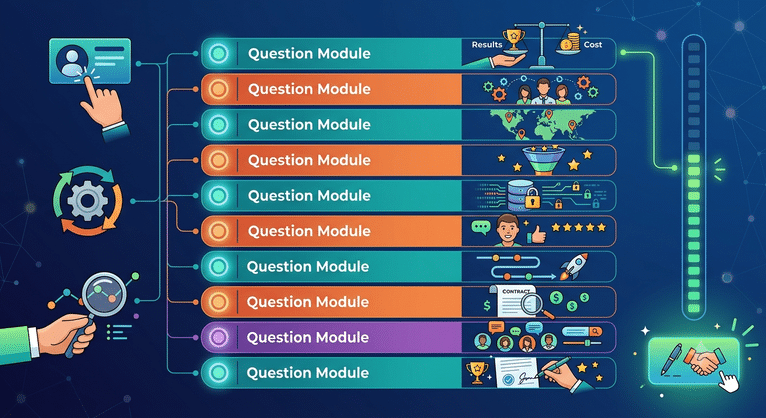
Ask these five questions before you sign, because the answers explain most of the gap between competing quotes.
- What exactly is in scope, and what costs extra? Get pages, templates, revision rounds, integrations and content creation listed in writing.
- Who will actually build it, and at what seniority? Ask for named roles and the blended hourly rate behind the fixed price.
- Is the price fixed, capped or hourly, and what triggers a change order? Vague change terms are where budgets quietly double.
- What do third-party tools and post-launch support cost? Ask about licences, plugins, hosting, security updates and the yearly maintenance fee.
- Who owns the code, design files and accounts at handover? Insist on assignment at creation, and see our guide on how to protect your IP when outsourcing for the clauses to request.
FAQ
What is website development outsourcing cost and why does it matter for B2B businesses?
It is the full price of having an external team design, build and run your website, including hosting, maintenance and integrations. It matters because the visible build quote can understate the real total by 25–150%, according to SmartDev’s analysis, so budgeting only for the headline number invites overruns.
How do I choose the right website development vendor within my budget?
Pick your scope first (brochure, store or custom app), then shortlist vendors in the region whose rate band fits it. Compare at least three fixed-price proposals with identical scope, and weigh portfolio relevance and team seniority above the lowest number.
What checks should I do before outsourcing website development?
Review live sites the vendor built, speak to two past clients, and confirm secure-development practices such as those in NIST’s Secure Software Development Framework (SP 800-218). Check performance and accessibility standards, including Google’s Core Web Vitals and W3C’s WCAG, and put ownership, change-order and support terms in the contract.
How long does website development outsourcing typically take and what does it cost?
eCarter’s 2026 guide puts small sites at 2–4 weeks, corporate sites and stores at 4–8 weeks, and custom applications at 2–5 months. Costs follow the table above, from roughly $800 to $8,000 for brochure sites in lower-cost markets up to six figures for complex custom builds.
Get Accurate Quotes With MyB2BNetwork
Planning bands get you to a sensible budget; real quotes get you to a decision. MyB2BNetwork connects founders, SMB owners and marketing heads with vetted website development partners and can gather comparable quotations against your exact scope, so you’re comparing like with like.
Browse the B2B outsourcing marketplace to shortlist partners, or read our study on vendor response time to see how quickly vendors actually reply before you commit to one.
How to Hire, Source, or Outsource Website Development in the U.S.
Companies across the U.S., from SaaS startups in Austin to fintech firms in New York and B2B firms in San Francisco, commonly outsource web builds to nearshore or offshore partners to stretch budgets. Two decisions matter most.
Choosing a vendor within budget. Match scope to tier first. A realistic range through an outsourced partner is roughly $3,000–$15,000 for a brochure site, $10,000–$60,000 for e-commerce and $25,000 or more for a custom application. Typical timelines are 2–4 weeks, 4–8 weeks and 2–5 months respectively. MyB2BNetwork can get accurate quotations for your exact scope.
Checks before outsourcing. Request live portfolio examples, two client references and written SLAs for fixes and uptime. Ask for SOC 2 or ISO 27001 evidence if the vendor will touch customer data, and check PCI DSS handling for online payments. Confirm privacy practices against CCPA, and ask how the vendor tests accessibility against WCAG, since a build that fails accessibility checks can create legal exposure. Red flags include no named team, no change-order terms and refusal to assign IP at creation.