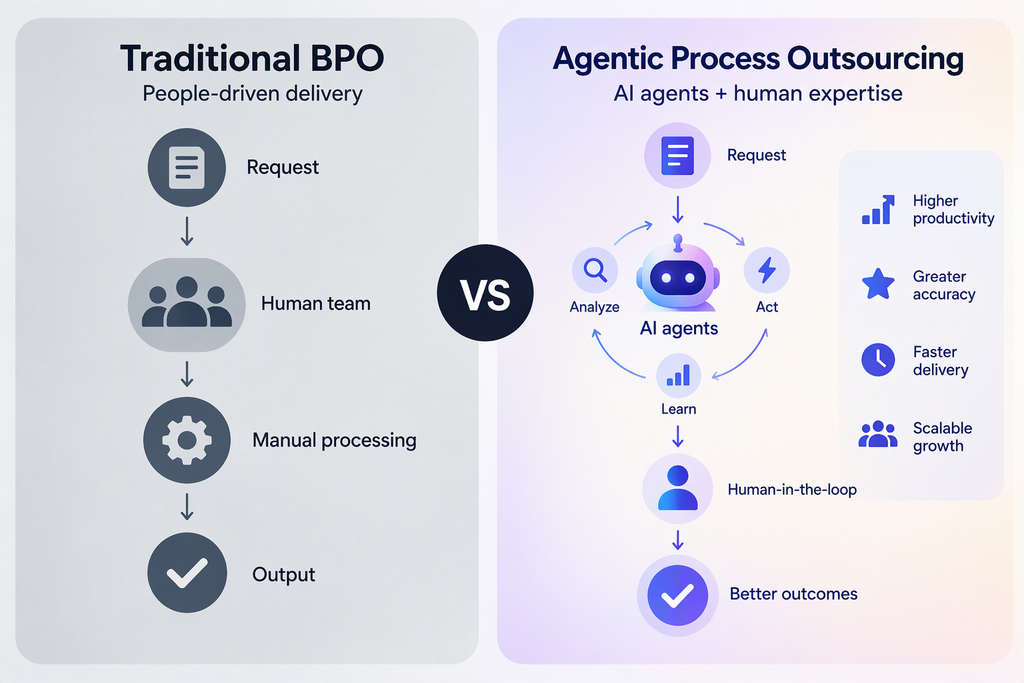
Agentic process outsourcing (APO) is a model in which AI agents, supervised by human specialists, complete business processes for you under contracts priced on outcomes rather than headcount. It differs from traditional BPO in who does the work, how you pay, and who is accountable when something goes wrong.
Providers are already rebuilding around it. Gartner’s August 2026 research says leading providers are pivoting from “your mess for less” BPO to AI-powered delivery hubs, and it advises buyers to plan sourcing around outcome-based models.
Treat the pitch with care. Gartner predicts over 40% of agentic AI projects will be canceled by the end of 2027 because of escalating costs, unclear value or inadequate risk controls, and it estimates only about 130 of the thousands of agentic AI vendors are real.
This guide is for COOs, CX leaders and procurement managers. It explains what changes in cost, control and risk, and gives you the 4-Gate APO Evaluation Model, a fill-in template and six questions for any provider claiming to offer APO.
What Is Agentic Process Outsourcing (APO)?
Agentic process outsourcing (APO) is outsourcing in which a provider’s AI agents carry out multi-step work, such as resolving a billing dispute across Salesforce and SAP, while people handle exceptions and oversight. It is usually contracted on outcomes, like cost per resolved case, rather than on seats or FTEs.
An agent differs from a chatbot or an RPA script because it can plan steps, call tools and adapt when a step fails. Gartner uses the term “agent washing” for vendors that rebrand chatbots and RPA as agentic AI, so the label alone proves nothing.
In practice, most APO offers are hybrids. Agents handle repeatable volume, and a smaller human team runs quality, escalations and improvement.
Why Does Agentic Process Outsourcing Matter for COOs, CX Leaders and Procurement?
It matters because it changes how outsourcing is priced and who carries performance risk. HFS Research expects FTE-based commercial models to fall from 42% to 28% of deals over three years, while outcome-based and shared-revenue models rise from 20% to 39%, as reported by Analytics India Magazine in October 2026.
IDC’s Services FutureScape predicts that by 2029, 50% of Global 2000 enterprises will demand contracts priced on cost per resolved outcome. Forrester similarly notes that FTE-based pricing loses relevance as AI takes over routine work.
For CX leaders, Gartner predicts agentic AI will resolve 80% of common customer service issues without human intervention by 2029 (a March 2025 forecast, not a measured result). For procurement, the catch is that HFS reports many buyers still resist outcome-based pricing, and Gartner says adoption has been uneven because of measurability and accountability challenges.
How Does Agentic Process Outsourcing Differ From Traditional BPO?
APO replaces headcount-based delivery with agent-delivered work, so the unit you buy shifts from a seat to a completed outcome. The table compares the two models on the dimensions procurement cares about most.
| Dimension | Traditional BPO | Agentic process outsourcing (APO) |
|---|---|---|
| Staffing | Teams scaled by hiring, training and shifts; capacity tied to headcount | Agents scale on demand; a smaller human team handles exceptions, QA and improvement |
| Pricing | FTE or seat-hour rates, or fees per transaction | Per resolved outcome, per transaction with agent usage, or a hybrid with a platform fee |
| SLAs | Response time, handle time, quality scores from sampled reviews | Resolution accuracy, escalation rate, and an auditable log of every agent action |
| Accountability | Provider manager answers for team performance | Must be defined by contract, including who owns agent errors |
| Risk | People risk: attrition, training gaps, staff-level data handling | Model risk: wrong actions, prompt injection, data leakage, vendor lock-in |
The pricing row hides a trade-off. Outcome-based pricing moves performance risk to the provider, but IDC notes that risk comes back as price. Everest Group says the hard question is who owns the outcome, and IDC warns that a provider selling the measurement layer without portability could re-create lock-in.
What Stays Human in APO, and Who Is Accountable When an Agent Errs?
Humans keep the work that needs judgment, authority or empathy, and accountability moves from managing people to governing a system. Expect these five things to stay human:
- Exception handling for cases the agent cannot resolve confidently.
- Approvals above a value or risk threshold, such as large refunds or credit decisions.
- Regulated sign-offs where a named person must be answerable.
- Empathy-critical interactions, like escalated complaints or sensitive health or financial cases.
- Agent supervision, including QA sampling, retraining and process improvement.
Accountability changes because an agent’s error has no manager to coach. Your contract should name one provider owner for outcomes whether an agent or a person did the work, and it should require audit logs for every agent action. The NIST AI Risk Management Framework (Govern, Map, Measure, Manage) and ISO/IEC 42001 give both sides a shared vocabulary for those requirements.
How to Implement Agentic Process Outsourcing: The 4-Gate APO Evaluation Model
Run agentic process outsourcing as four gates (Scope, Control, Commercials and Risk), and do not pass a gate until its evidence is in writing. A single-process pilot commonly takes 8 to 12 weeks [VERIFY], which keeps the commitment small while you test the provider’s claims.
| Gate | What to decide | Example entry | Your entry |
|---|---|---|---|
| 1. Scope | One process, monthly volume, agent versus human split | Tier-1 billing disputes, 12,000 a month, 60% agent-resolved target | |
| 2. Control | Human approval thresholds, audit logs, escalation path | Refunds over $500 need human approval; logs kept 12 months | |
| 3. Commercials | Outcome definition, baseline, price, budget cap | Price per resolved case, baseline from last 90 days, monthly cap | |
| 4. Risk | Security attestations, data handling, exit terms | SOC 2 Type II and ISO 27001 reports; 90-day exit with data return | |
| Check-ins | Cadence and owners | Weekly metrics review; monthly executive review | |
| Decision date | Go/no-go criteria and date | Day 60: scale, fix or stop |
Six Questions to Ask a Provider Claiming to Offer APO
- Which steps do agents perform in production today, and which do people perform? Ask for volumes and client references, not demos, to screen out agent washing.
- How do you define an outcome, and who sets the baseline? Insist on a baseline built from your own recent data.
- Who is contractually accountable when an agent makes an error, and what are the remedies?
- What logs and audit trails do I get for each agent action, and can I export them?
- Which attestations do you hold (SOC 2, ISO 27001, ISO/IEC 42001), and how do you test for prompt injection and data leakage?
- What happens at exit? Clarify who owns prompts, workflows and training data, and whether you can port them.
FAQ
How much does agentic process outsourcing cost compared with BPO?
Expect hybrid pricing: a platform or minimum fee plus per-outcome charges. Public price benchmarks are scarce, so compare at least three quotes against your current cost per resolved case, and see the budget tiers in the U.S. section below.
How long does an APO transition take?
A one-process pilot typically runs 8 to 12 weeks, and scaling to several processes often takes 6 to 12 months [VERIFY]. Process documentation and system access are the usual bottlenecks, not the agents themselves.
Is APO safe for regulated data?
It can be, if the provider holds current SOC 2 Type II and ISO 27001 reports and keeps humans on regulated decisions. Read the reports and scope statements rather than trusting logos, and map controls to the NIST AI RMF.
When should I stay with traditional BPO? Stay when volumes are small or erratic, processes are undocumented, or decisions are legally sensitive. Agents tend to amplify a messy process, which is one reason Gartner expects many agentic projects to be canceled.
Find an Agentic Process Outsourcing Partner With MyB2BNetwork
Choosing between BPO and agentic process outsourcing is easier when you can compare vetted providers side by side. MyB2BNetwork connects COOs, CX leaders and procurement teams with vetted outsourcing partners and helps you compare quotations before you commit.
Start with your scope and the four gates above, then use the six questions in every provider conversation. For contract terms, read how to protect your IP when outsourcing, and use our vendor response time study to test how a provider behaves before you sign.
How to Hire, Source, or Outsource Agentic Process Outsourcing in the U.S.
Budget. Public APO pricing is scarce, so treat these as planning placeholders [VERIFY]: a single-process pilot of roughly $25,000 to $100,000; production for one process of roughly $10,000 to $50,000 per month in platform and outcome fees; and multi-process programs often reaching six to seven figures a year. MyB2BNetwork can provide accurate quotations for your scope.