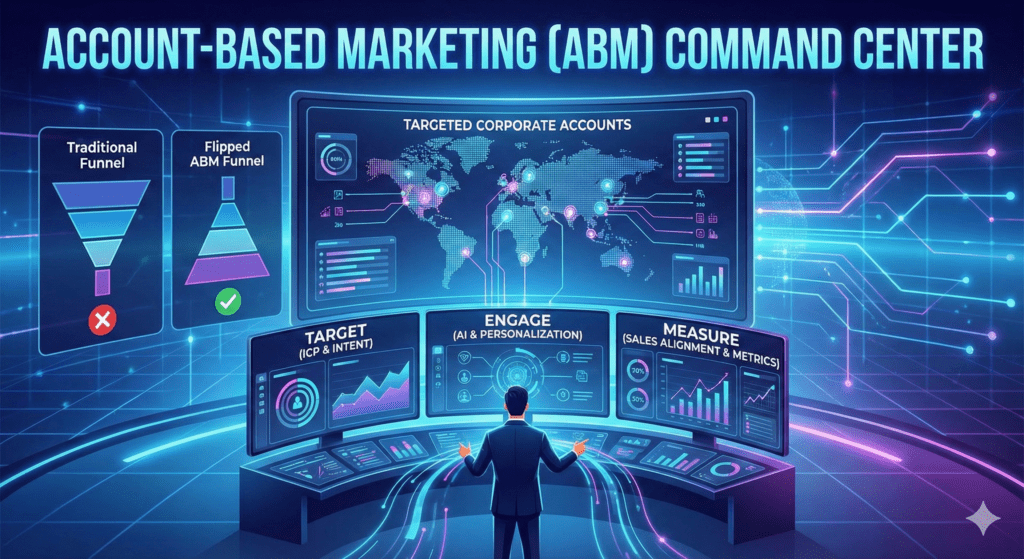
Traditional inbound marketing is a numbers game: cast a massive net, catch a thousand small fish, and hope a whale gets tangled inside. For high-ticket B2B companies, this approach is expensive, inefficient, and creates endless friction between Sales and Marketing. Account-Based Marketing (ABM) flips the funnel. Instead of marketing to the masses and filtering down to a few qualified leads, ABM identifies your highest-value target accounts first, and then builds hyper-personalized campaigns designed specifically for them.
But ABM isn’t just a tactic; it is an organizational shift. It requires pristine data, tight sales alignment, and modern AI automation to scale.
This hub serves as your ABM Command Center. We break down the exact methodology to transition your revenue engine from high-volume spam to high-precision account penetration.
What is Account-Based Marketing (ABM) in B2B? Account-Based Marketing (ABM) is a focused B2B growth strategy where Marketing and Sales teams collaborate to create highly personalized buying experiences for a mutually identified set of high-value accounts. Rather than generating broad leads, ABM treats individual target accounts as markets of one, utilizing intent data, 1:1 personalization, and specific metrics like “account engagement” to drive high-ticket revenue.
The Target – Precision Over Volume
Target Audience: CMOs, Demand Gen Leaders, RevOps
You cannot run an campaign if you don’t know exactly who you are going after. Precision targeting is the bedrock of the entire methodology.
1. Targeting (Crafting Your ICP)
Your Ideal Customer Profile (ICP) is not just “companies with $10M in revenue.” A true B2B ICP analyzes technographics (what software they use), firmographics, and internal pain points to determine who actually needs your product today. Without a ruthless ICP, your ABM budget will bleed out.
- The Strategy: Disqualify bad fit accounts before you spend a dime on marketing.
- Deep Dive: Define your perfect buyer: Crafting an Ideal Customer Profile for B2B Success.
2. Data Fuel (Intent Data)
How do you know which accounts in your ICP are ready to buy right now? Intent data tracks the digital footprint of target accounts (e.g., what keywords they are searching, what competitor sites they are visiting) before they ever fill out a form on your site. It is the intelligence that fuels modern ABM.
- The Strategy: Reach out when they are researching the problem, not after they have selected a vendor.
- Deep Dive: Capture in-market buyers: ABM Intent Data: 10 Smart Tactics.
The Execution – Hyper-Personalization at Scale
Target Audience: Content Marketers, ABM Campaign Managers
Once you have your list of accounts showing intent, you have to engage them. This is where strategy turns into action.
3. The Methodology (Tactical Frameworks)
Moving to ABM can feel overwhelming for SMBs who don’t have enterprise-level budgets. But the core methodology relies on strategy, not just software. Whether you are running 1:1 (Strategic ABM), 1:Few (ABM Lite), or 1:Many (Programmatic ABM), you need a structured game plan.
- The Strategy: Start with a pilot program of 50 target accounts before scaling.
- Deep Dive: Build your foundation: Marketing ABM: 3 Game-Changing Strategies for SMBs.
4. Personalization (One-to-One Marketing)
Generic email blasts are dead. ABM requires one-to-one marketing—sending a specific email, to a specific stakeholder, addressing the specific pain point their company is facing this quarter. It’s resource-intensive, but it yields the highest ROI in B2B marketing.
- The Strategy: Treat the target company like a “Market of One.”
- Deep Dive: Execute hyper-targeted outreach: Unlocking B2B Growth with Strategic One-to-One Marketing.
5. AI & Automation (Scaling the Unscalable)
How do you write highly personalized emails and create custom landing pages for hundreds of accounts without hiring an army of marketers? Modern ABM relies on Artificial Intelligence. AI analyzes account data, drafts contextual messaging, and automates the initial outreach sequences.
- The Strategy: Use AI for the heavy lifting (research/drafting), but keep humans for the final polish.
- Deep Dive: Modernize your tech stack: AI, Automation, and Intent in ABM: The 2025 Guide.
The Win – Alignment & Measurement
Target Audience: VP of Sales, CROs, Data Analysts
It is not a marketing initiative; it is a revenue initiative. It requires marketing and sales to speak the same language and look at the same scoreboard.
6. Sales Alignment (Outbound Assist)
If Marketing warms up a target account and Sales ignores them to make cold calls, the system breaks. It requires “Smarketing” (Sales + Marketing alignment). Marketing provides the air cover (ads, content, intent data), while Sales provides the ground assault (personalized social selling and outbound calls).
- The Strategy: Hold joint weekly pipeline meetings focused strictly on target account movement.
- Deep Dive: Sync your revenue teams: Outbound Assist: Boost B2B Social Impact.
7. Measurement (ABM Metrics)
You cannot measure ABM with traditional inbound metrics. If you optimize for “website clicks” or “cost per lead” (CPL), you will fail. ABM optimization tracks Account Penetration, Pipeline Velocity, Target Account Engagement, and Deal Size.
- The Strategy: Stop measuring the volume of leads. Start measuring the quality of engagement.
- Deep Dive: Upgrade your dashboard: 13 ABM Metrics to Elevate Your B2B Strategy.
Deciphering ABM for SMBs
Q: Is ABM only for large enterprise companies? A: No. While early ABM was restricted to massive budgets, modern tools (like intent data and AI automation) have democratized the process. SMBs can execute “ABM Lite” (1:Few) highly effectively.
Q: What is the difference between Lead Generation and ABM? A: Lead Generation focuses on volume (getting as many people as possible to download an ebook). ABM focuses on revenue (getting the specific decision-makers at 50 targeted companies to take a meeting).
Q: How long does it take to see ROI from an ABM program? A: ABM is a marathon, not a sprint. Because you are targeting high-ticket, complex B2B sales, expect a 3 to 6 month pilot phase before seeing closed-won revenue. However, you should see an increase in “Account Engagement” within 30 days.
Conclusion: Align, Target, Win
The era of “spray and pray” B2B marketing is officially over. Buyers are too smart, and ad costs are too high. By adopting an Account-Based Marketing methodology, aligning your sales team, and leveraging intent data, you stop hoping for leads and start hunting for revenue.
Where is your revenue engine stalling? If you are targeting the wrong people, start with Crafting your ICP. If your outreach is falling flat, upgrade your AI & Automation. You don’t know who is ready to buy, look into Intent Data Tactics.