In the modern B2B content production landscape, it is not just marketing; it is your 24/7 sales team. But for most companies, feeding the content beast is a path to burnout.
The demand is relentless: daily social graphics, weekly articles, monthly whitepapers, and video for every product launch. If you are trying to do this with a single internal hire, you have already lost.
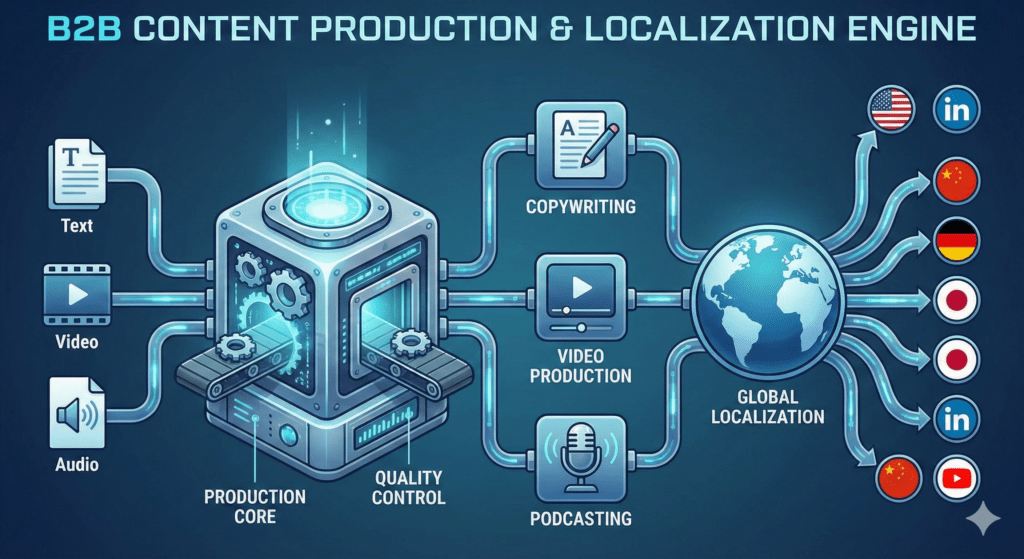
The solution is not to work harder; it is to build a Content Production & Localization Engine. This means moving from ad-hoc creation to a systematized assembly line of high-quality assets that can be repurposed, translated, and distributed globally.
This guide outlines the seven components of a scalable content engine that drives traffic, builds trust, and opens new markets.
What is a B2B Content Production Engine? A B2B Content Production Engine is a systematic framework for creating, editing, and distributing marketing assets at scale. It combines specialized talent (copywriters, designers, video editors) with operational workflows to produce consistent, high-quality content across multiple formats and languages, minimizing the burden on internal teams.
The Foundation – Written & Visual Core
Target Audience: Content Managers, Social Media Managers
Every campaign starts with words and images. These are your “high-volume” necessities. If these bottleneck, your entire marketing strategy stalls.
1. Written Content (The Quality Standard)
Copywriting is the DNA of your brand. Whether it’s a tweet or a technical whitepaper, the quality of your writing determines your authority. But “Copywriting” is not a monolith; you need different writers for different formats.
- The Strategy: Separate “Creative Writing” (Brand) from “Technical Writing” (Product).
- Deep Dive: Master the one skill that rules them all: Copywriting 101: The One Copywriting Guide to Rule Them All.
2. Visual Assets (Social Graphics)
The feed moves fast. To stop the scroll, you need volume. Relying on one designer to resize the same image for LinkedIn, Twitter, and Instagram is a waste of resources. Outsourcing the “production” layer of design frees your creative director to focus on the “Big Idea.”
- The Strategy: Create a “Visual Style Guide” and let an external team handle the daily volume.
- Deep Dive: Stop drowning in requests: Tired of Drowning in Social Media Graphics?.
3. Quality Control (Editing & Proofing)
You can spend thousands on ads, but one typo in your headline kills your credibility. Editing is the “Safety Valve” of your engine. It ensures that volume never comes at the expense of reputation.
- The Strategy: Never let the writer be the editor. Always have a second pair of eyes.
- Deep Dive: Polish your brand: Tired of Typos and Grammatical Errors?.