If you are launching campaigns, writing blog posts, or running ads without a documented B2B marketing strategy, you aren’t doing marketing—you are just making noise.
In the B2B landscape, the difference between a mid-level marketer and a marketing leader is the ability to use structured frameworks. Frameworks eliminate the guesswork. They force you to ask the hard questions about your pricing, your competitors, and your exact target audience before a single dollar is spent on promotion.
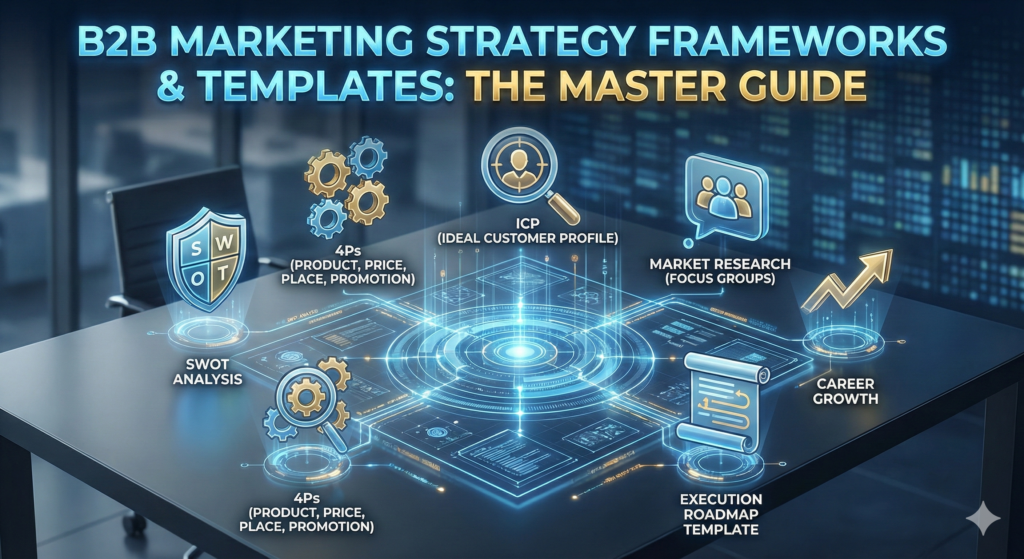
This hub is your strategic blueprint. We have aggregated the foundational business frameworks—from classic SWOT analysis to modern Ideal Customer Profiles—and paired them with the exact templates you need to build, document, and execute a winning go-to-market strategy.
What is a B2B Marketing Strategy Framework? A B2B marketing strategy framework is a structured model (such as SWOT, the 4Ps, or an ICP) used by businesses to define their market positioning, target audience, pricing, and promotional tactics. These frameworks provide a logical blueprint for decision-making, ensuring that tactical marketing efforts align with high-level corporate revenue goals.
The Diagnostics – Research & Fundamentals
Target Audience: Marketing Managers, Strategists, Founders
Before you can decide where you are going, you must have an unflinching understanding of where you currently stand.
1. Strategic Analysis (SWOT)
The SWOT Analysis (Strengths, Weaknesses, Opportunities, Threats) is the grandfather of all business frameworks for a reason: it works. It forces your leadership team to look internally at operational bottlenecks and externally at market shifts.
- The Strategy: Use SWOT as your reality check before launching any new product or campaign.
- Deep Dive: Get the foundational template: Mastering Strategic Planning with a SWOT Analysis Template.
2. The Fundamentals (The 4Ps)
Product, Price, Place, and Promotion. The “Marketing Mix” is the bedrock of commercial strategy. Many modern marketers obsess over “Promotion” (ads and social media) while completely ignoring the other three pillars. A brilliant ad campaign will not save a bad product with the wrong pricing model.
- The Strategy: Audit your entire marketing mix, not just your promotional channels.
- Deep Dive: Master the core fundamentals: Marketing Mix: The 4Ps of Marketing and How to Use Them.
3. Market Research (Focus Groups)
Assuming you know what your customers want is the fastest way to fail. Qualitative research bridges the gap between your assumptions and market reality. Conducting structured focus groups allows you to pressure-test your messaging and product features directly with your target demographic.
- The Strategy: Validate your strategy with real human feedback before scaling your budget.
- Deep Dive: Structure your research: Crafting Effective Focus Group Templates for Mid-Level Marketers.
The Audience & The Economics
Target Audience: Product Marketers, Revenue Operations (RevOps)
A framework is useless if it is pointed at the wrong people or relies on flawed math.
4. Targeting (The ICP)
If you are marketing to “everyone,” you are marketing to no one. An Ideal Customer Profile (ICP) defines the exact firmographic, technographic, and behavioral traits of the accounts that will yield the highest lifetime value for your business. It is the filter for your entire strategy.
- The Strategy: Disqualify bad-fit customers as rigorously as you pursue good-fit ones.
- Deep Dive: Define your most profitable buyer: Crafting an Ideal Customer Profile for B2B Success.