For a long time, “Enterprise IT” was a term reserved for the Fortune 500. It implied massive server rooms, armies of technicians, and million-dollar budgets.
But in 2026, the playing field has leveled. Startups and SMBs now have access to the same cloud power, security protocols, and strategic consulting as the giants. The challenge isn’t access; it’s complexity.
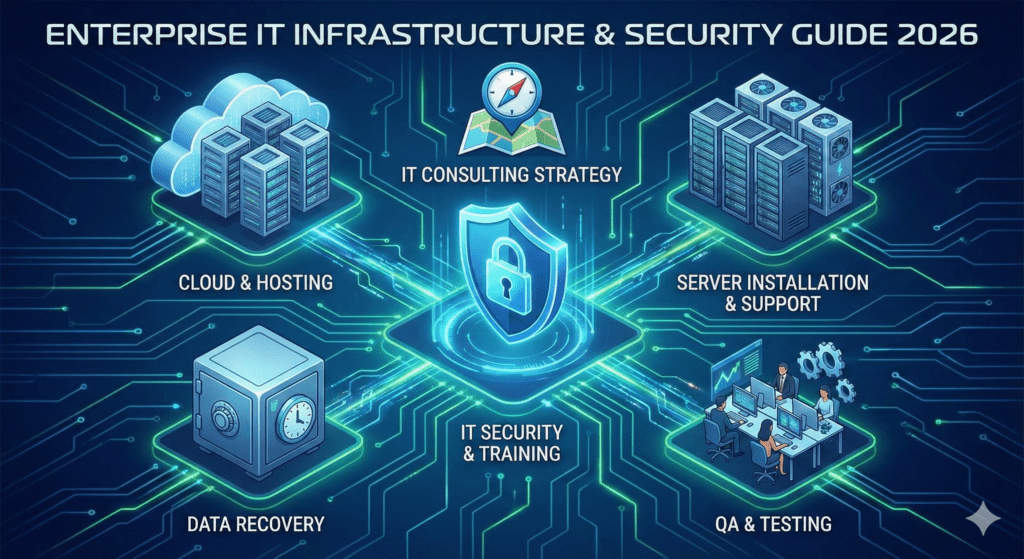
Your IT infrastructure is the invisible backbone of your company. When it works, you don’t notice it. When it breaks, your business stops. This guide walks you through the essential layers of a modern Enterprise IT stack—from the physical servers to the human firewall—and how to manage them without losing your mind.
1. The Fortress: Defense in Depth
The Logic: Security is not a software you buy; it is a culture you build.
Cyber threats don’t discriminate by size. In fact, hackers often target SMBs because they know the “doors” are left unlocked.
Building a fortress requires a two-pronged approach:
- Technical Defense: This involves firewalls, endpoint detection, and active monitoring. You need a partner who watches the gate 24/7 so you can sleep at night.
- The Human Firewall: You can have the best software in the world, but if an employee clicks a phishing link, you are compromised. Enterprise IT Security Training is critical to turn your staff from your biggest risk into your first line of defense.
Secure Your Business: > Why Startups Need IT Security Services
Train Your Team: > Why Small Businesses Can’t Ignore IT Security Training
2. The Engine: Cloud & Hosting Strategy
The Logic: Stop owning depreciation. Start renting innovation.
The days of buying massive servers that sit idle 80% of the time are over. Cloud Computing allows you to scale your processing power up (during Black Friday) and down (in January) instantly. It turns a massive capital expense (CapEx) into a manageable operating expense (OpEx).
But the cloud needs a home. Whether you are running a simple website or a complex SaaS app, your Hosting Service is the engine room. If it’s slow, your customers leave. Outsourcing this ensures you have 99.9% uptime without hiring a full-time SysAdmin.
Modernize Your Stack: > Why Cloud Computing is a Game Changer
Power Your Web Ops: > The Engine Room: Why You Need to Outsource Hosting
3. The Hardware: Server Installation & Support
The Logic: Sometimes, the cloud isn’t enough. Hybrid infrastructure is the reality for many.
While the cloud is trendy, many businesses—especially in manufacturing, healthcare, or logistics—still need on-premise solutions for speed or compliance.
Managing physical Server Installation is heavy lifting (literally and figuratively). It involves cabling, cooling, and constant patching. Outsourcing the “Hardware Ops” ensures your physical infrastructure is robust, secure, and integrated seamlessly with your cloud systems.
Manage the Metal: > The Power of Focus: Why Server Support is Best Outsourced