Global Expansion Strategy : Localization & Marketing Guide

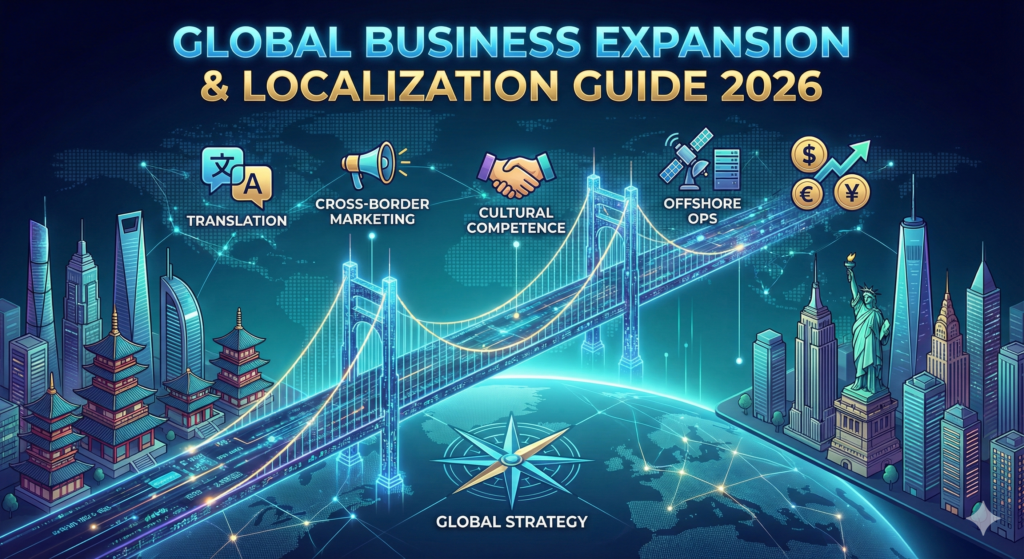
Digital globe illustration connecting business hubs in the US, Europe, and Asia, representing a seamless global expansion and localization strategy.

The internet made the world smaller, but it didn’t make it uniform. In 2026, scaling a startup or SMB often means looking beyond domestic borders. Whether you are a software house in India targeting US clients, or a US brand selling to Europe, the opportunity is massive. But the graveyard of failed expansions is full of companies that thought “Global Expansion” just meant translating their website.

True Localization is deeper. It’s about adapting your marketing, your sales psychology, and your internal culture to fit a new reality. This guide breaks down the roadmap to going global—from the mechanics of language to the nuances of offshore management.

1. The First Barrier: Translation & Interpreting

The Logic: If you can’t speak their language, you can’t sell them the solution.

Language is the most obvious barrier, but it is often handled poorly. Using automated tools for client-facing content is a recipe for disaster

Professional Translation Services go beyond word-for-word swapping. They capture intent.

  • Interpreting: Essential for real-time Zoom negotiations.
  • Localization: Essential for modifying software interfaces or marketing slogans so they make sense locally.

Bridge the Gap: > Why Translation and Interpreting Services Are Essential

2. Cross-Border Marketing Strategy

The Logic: What sells in New York might fail in Tokyo. One size does not fit all.

Cross-Border Marketing isn’t just about running ads in a different time zone. It’s about understanding local pain points. A “Robust Marketing Strategy” for global expansion involves detailed market segmentation. Are you adapting your pricing for purchasing power parity? Are your visuals culturally appropriate?

Without a localized strategy, you are just shouting into the void.

Unlock Global Growth: > Why Your B2B Business Needs a Robust Marketing Strategy

3. The Tactics: Attracting International Clients

The Logic: You have the skills. How do you get the world to notice?

For service providers (especially in Mobile App Development or IT), the goal is often “Exporting Skills.” But international clients are skeptical of offshore providers.

To Attract International Clients, you need to signal trust. This involves showcasing global certifications, using international case studies, and having a digital presence that screams “World Class,” not “Cheap Outsourcing.”

Get the Clients: > How to Attract International Clients for Mobile App Development

MyB2BNetwork

Discover how to unlock target markets and hit your number with insight-driven engagement.

4. The Target: Cracking the US Market

The Logic: The US is the whale. Here is how you catch it.

For many global B2B companies, the United States is the ultimate prize. But it is also the most competitive.

Targeting US Businesses requires a specific approach: aggression, speed, and social proof. US buyers value ROI-centric messaging over feature lists. Whether you are selling Social Media Optimization or SaaS, you need to speak the language of “American Productivity.”

Target the USA: > How to Target Businesses in the US for Social Media Optimization

5. The Culture: Cultivating Competence

The Logic: Business deals fail when cultures clash. Don’t be “that” company.

You can have perfect grammar and still be rude. Cultural Competence is the ability to understand the unwritten rules of a region.

  • In some cultures, saying “No” directly is offensive.
  • In others, small talk is a waste of time.

Investing in Cultural Sensitivity Training ensures your sales team doesn’t accidentally insult a prospect before the demo even starts.

Master the Soft Skills: > The Power of Outsourcing Cultural Sensitivity Training

6. The Operations: Offshore Communication

The Logic: Time zones and accents are friction. Friction kills momentum.

If you are managing a global team or working with offshore partners, Offshore Communication is your daily reality.

The challenge isn’t just the technology; it’s the protocol. Setting up asynchronous workflows (so work happens while you sleep) and clear reporting structures is vital for VPs managing distributed teams.

Conquer the Friction: > Conquer Offshore Communication: 3 Solutions for VPs

7. The Proof: Real-World Success

The Logic: Don’t just take our word for it. See it in action.

Theory is good, but execution is better. Looking at Case Studies of companies that have successfully navigated these waters provides a blueprint. For example, seeing how CN Technologies utilized a B2B network to break barriers proves that with the right partner, global scale is achievable.

Read the Case Study: > Breaking International Barriers: How CN Technologies Found Global Success

Conclusion: Global Expansion Strategy

Global expansion is a marathon. It requires the stamina to deal with Translation (Section 1), the agility to adapt your Marketing (Section 2), and the empathy to master Culture (Section 5).

But the reward is a business that isn’t limited by geography.

Now that you’re here

MyB2BNetwork generates new leads, offers insight on your customers

and can help you increase your marketing ROI.

If you liked this blog post, you’ll probably love MyB2BNetwork, too.

Leave a Reply

Your email address will not be published. Required fields are marked *