What Is E-E-A-T for B2B Marketing?
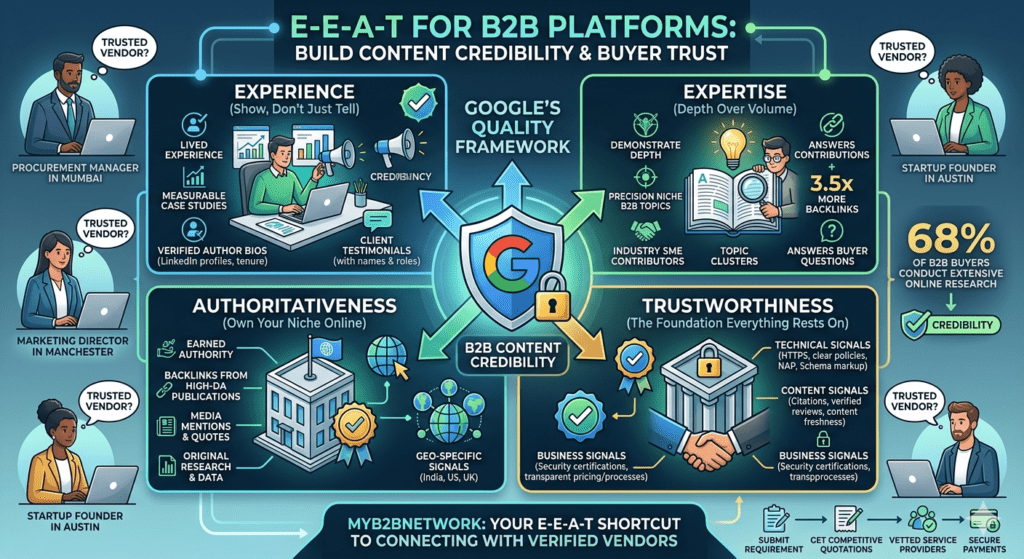
E-E-A-T stands for Experience, Expertise, Authoritativeness, and Trustworthiness — Google’s quality framework for evaluating content. For B2B platforms, it means demonstrating real-world credibility through verified claims, expert contributors, and transparent business practices that search engines and buyers can trust. Imagine this: a procurement manager in Mumbai, a marketing director in Manchester, and a startup founder in Austin are all searching for the same thing — a B2B vendor they can actually trust. They’re not just Googling products; they’re evaluating credibility before they ever fill out a contact form. That’s where E-E-A-T for B2B platforms becomes your most powerful competitive edge.
According to a 2024 BrightEdge study, 68% of B2B buyers conduct extensive online research before engaging a vendor — and content credibility is the #1 factor influencing shortlisting decisions. If your platform or content doesn’t signal trust, you’re invisible before the conversation even begins.
This practical checklist breaks down how to implement E-E-A-T across your B2B digital presence — and how platforms like MyB2BNetwork make it easier to connect with verified, trustworthy service providers.
Why Google’s Quality Framework Now Shapes B2B Decisions
Google’s addition of the first “E” (Experience) in late 2022 was a game-changer for B2B content. It’s no longer enough to cite facts — you must demonstrate lived experience. For B2B platforms, this means showcasing case studies, real client outcomes, and contributor bios that prove your team has been in the trenches.
Mid-level marketers, especially those managing social media marketing tools and multi-channel campaigns, often underestimate how deeply E-E-A-T impacts organic rankings. A LinkedIn post without author credentials, or a service page without a single verified review, can quietly tank your domain authority.
The good news? E-E-A-T is entirely buildable — if you know what to prioritize.
The Checklist: Building E-E-A-T Across Your B2B Platform
✅ Experience: Show, Don’t Just Tell
- Publish first-hand case studies with measurable outcomes (e.g., “Generated 3x qualified leads in 90 days for a SaaS client in the UK”)
- Add author bios to every piece of content with verifiable credentials, LinkedIn profiles, and industry tenure
- Feature client testimonials with company names and roles — anonymous quotes no longer carry weight
- Use before/after scenarios or project walkthroughs that demonstrate real-world applicationPro Tip: If you’re a mid-level marketer building authority, document your campaign experiments. A blog post titled “What Happened When We A/B Tested Our LinkedIn Outreach Sequence” signals experience far more powerfully than a listicle.
✅ Expertise: Depth Over Volume
Content quantity has never been more irrelevant. What matters now is demonstrable depth — content that answers questions your buyers are actually asking, not just keyword-stuffed articles that scratch the surface.
- Cover niche B2B topics with precision (e.g., “How Marketing Automation Affects Lead Scoring in SaaS B2B Pipelines”)
- Collaborate with industry SMEs (Subject Matter Experts) as guest contributors
- Build topic clusters around your core services — interlink blogs, whitepapers, and landing pages to signal semantic authority
- For marketers using B2B social platforms like LinkedIn or industry-specific communities, share content that sparks professional dialogue, not just impressions
According to Semrush’s State of Content Marketing Report, B2B content with expert bylines receives 3.5x more backlinks than unattributed content — a direct E-E-A-T multiplier.
✅ Authoritativeness: Own Your Niche Online
Authority isn’t self-declared — it’s earned through citations, backlinks, and third-party validation.
- Earn backlinks from high-DA publications (>70) in your industry — think industry associations, trade media, and established B2B directories
- Get your brand mentioned in round-up articles and expert quotes across relevant publications
- List your business on verified B2B platforms and directories — this signals legitimacy to both search engines and buyers
- Publish original research or data — even a small survey of 100 clients becomes a citable asset
- For companies targeting top B2B channels for marketers in India, the US, or the UK, geo-specific authority signals (local press mentions, regional directories) dramatically improve local search visibility
✅ Trustworthiness: The Foundation Everything Rests On
Trust is where most B2B platforms quietly fail. A slick website means nothing if buyers can’t verify who they’re dealing with.
Technical Trust Signals:
- HTTPS across all pages (non-negotiable)
- Clear privacy policy, terms of service, and cookie consent
- Visible contact information — physical address, phone, verified email
- Schema markup (Organization, Review, FAQ) to help search engines surface credibility signals
Content Trust Signals:
- Cite sources with links to high-authority references
- Display verified reviews and ratings prominently
- Maintain content freshness — outdated stats or broken links actively erode trust scores
- Add editorial review dates to all key content pieces
Business Trust Signals:
- Showcase security certifications or compliance badges (ISO, GDPR, SOC 2)
- Feature media mentions or press logos
- Offer transparent pricing or process pages — buyers who can’t find pricing often assume the worst
Turning Social Proof into Search Authority
One of the most underutilized E-E-A-T tactics for B2B platforms is converting social proof into indexable content. A glowing LinkedIn recommendation? Turn it into a case study. A positive client email? With permission, publish it as a testimonial with a structured data review tag.
For teams running social commerce strategies or using social media marketing tools to drive pipeline, this cross-pollination of social proof and SEO content creates compounding authority over time.
B2B marketers in competitive markets — from Bangalore to Berlin — who consistently grow their network online through verified, expertise-driven content are the ones dominating both search rankings and buyer mindshare.
Geographic Relevance: Getting Found Where Your Buyers Are
E-E-A-T isn’t just about global authority — it’s about local credibility too. If you’re targeting B2B buyers in India, the US, or the UK, your content and platform signals need to reflect regional relevance.
- Use geo-specific landing pages (e.g., “B2B Lead Generation Services in Jaipur” or “Marketing Automation for UK Enterprises”)
- Include local business schema with NAP (Name, Address, Phone) consistency across all listings
- Get listed on country-specific B2B directories and earn regional press mentions
- Reference region-specific case studies — a campaign that worked for a Mumbai fintech firm is far more persuasive to an Indian buyer than a generic global example
What Most B2B Platforms Get Wrong About Content Authority
Here’s a hard truth: many B2B platforms invest heavily in content production but skip the authority infrastructure that makes it rank. Publishing 50 blogs without author credentials, no backlinks, and zero schema markup is like building a skyscraper on sand.
The E-E-A-T checklist isn’t a one-time audit — it’s an ongoing operational standard. The platforms winning organic traffic today are those that treat content quality as a business process, not a marketing afterthought.
Think of E-E-A-T as your brand’s trust credit score. Every verified testimonial, every cited data point, every expert byline is a deposit. Every unattributed claim, every outdated page, every broken link is a withdrawal.
FAQ: What B2B Buyers Actually Ask About E-E-A-T
1. Does E-E-A-T directly affect my Google rankings?
E-E-A-T isn’t a direct ranking factor but shapes how Google’s quality raters evaluate your content — which influences algorithmic trust signals like backlinks, engagement, and crawl priority. High E-E-A-T content consistently outperforms thin content over time.
2. How long does it take to build content authority for a B2B platform?
Typically 3–6 months for noticeable organic gains, assuming consistent publishing, backlink acquisition, and technical SEO are in place. Authority compounds — the earlier you start, the faster it builds.
3. Can small B2B companies compete on E-E-A-T with larger brands?
Absolutely. Niche expertise often outranks broad authority. A focused B2B platform with deep, verified expertise in one industry vertical can outrank generalist competitors by owning specific topic clusters.
4. What’s the biggest E-E-A-T mistake B2B marketers make?
Publishing content without author attribution. Unattributed content signals low trust to both Google and buyers. Every piece of expert content needs a verifiable human face behind it.
5. How do verified vendor listings improve E-E-A-T for buyers?
Verified listings on platforms like MyB2BNetwork provide third-party validation — a signal that the business has been vetted. This reduces buyer risk perception and directly supports the “Trustworthiness” pillar of E-E-A-T.
Stop Guessing — Start Outsourcing with Verified Experts
Building E-E-A-T takes the right partners. Whether you need SEO content creators, marketing automation specialists, or IT and technology service providers to strengthen your B2B platform’s authority, finding vetted professionals shouldn’t be a research project in itself.
MyB2BNetwork simplifies outsourcing — submit a single requirement form and receive summarized, competitive quotations from pre-vetted service providers specializing in exactly what your platform needs. From scoping your project and validating quotations to scheduling meetings, supporting negotiations, and securing payments through escrow, we handle the heavy lifting so you can focus on growth.
[Submit your requirement on MyB2BNetwork] and connect with verified providers ready to elevate your B2B platform’s credibility today.