Lead Generation Process Flowchart Explained

Most B2B teams overcomplicate lead generation. They run campaigns across six channels, build elaborate automation sequences, and still wonder why pipeline stalls. The truth is, the most effective revenue engines are built on a clear, repeatable process—not complexity. Lead Generation Process: The Simplest Flowchart for the Most Effective Results strips away the noise and gives marketers a practical path from stranger to qualified opportunity.

For mid-level marketers using social media marketing tools, B2B social platforms, and multichannel outreach to grow your network online, having a defined process is the difference between predictable pipeline and random wins. MyB2BNetwork supports that clarity by connecting businesses with vetted lead generation specialists who execute proven systems without the guesswork.

Why most lead generation process breaks down before it begins

The biggest failure point is not strategy. It is the absence of a shared process between marketing and sales. When both teams operate with different definitions of a lead, a prospect, and a qualified opportunity, the entire funnel leaks.

A flowchart fixes this by making every stage visible, measurable, and transferable. Teams in India, the US, and the UK that document their process report significantly higher lead-to-close rates because everyone works from the same playbook.

The Simplest Flowchart That Actually Works

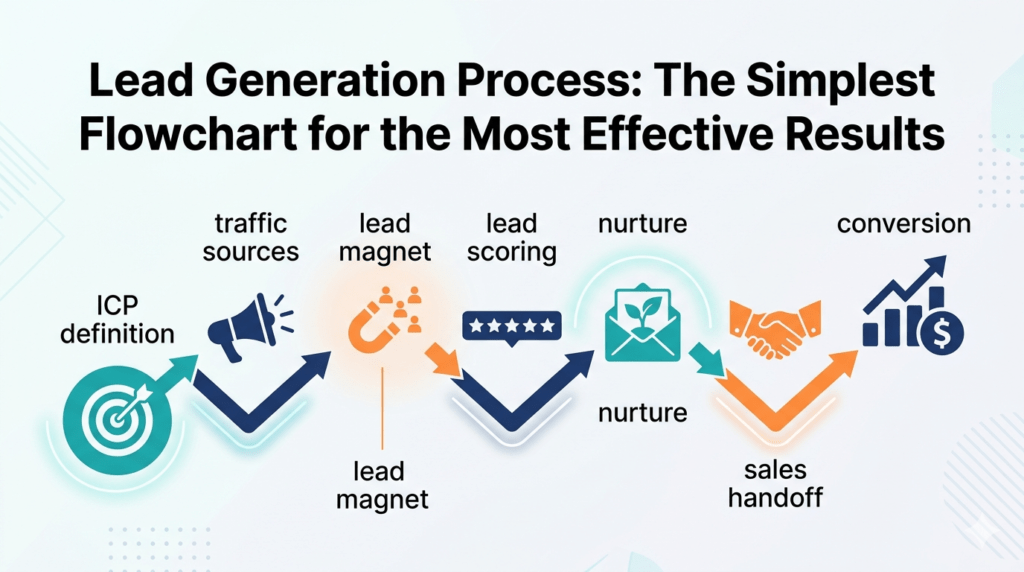
Here is the core Lead Generation Process that B2B teams can implement immediately:

Identify ICP

Choose Traffic Sources

Capture with Lead Magnet

Qualify with Lead Scoring

Nurture Unready Leads

Route SQLs to Sales

Convert and Measure

Optimize and Repeat

Each stage has a specific goal, a responsible team, and a measurable output. This makes the process auditable and improvable over time.

Step 1: Who Are You Actually Chasing?

Before any campaign launches, the process starts with a well-defined Ideal Customer Profile. This includes firmographic data like industry, company size, and geography, as well as behavioral signals like technology stack, hiring patterns, and content consumption.

Without ICP clarity, even the best social media marketing tools will drive the wrong visitors. Every lead generation investment gets sharper when the target is defined precisely. Ask: which companies buy fastest, stay longest, and refer the most?

Step 2: Where Attention Lives for Your Buyer

Traffic sources should match where your ICP spends time, not where your team is most comfortable. For enterprise B2B buyers, LinkedIn remains the strongest channel. For SMBs and startups, email, SEO, and community-led growth often outperform paid.

The best channels for marketers vary by region. Teams targeting buyers in India often perform well with LinkedIn combined with WhatsApp follow-up. US-based outreach tends to favor email sequences plus retargeting. UK buyers often engage with long-form content and event-driven marketing.

Social commerce strategies are increasingly relevant here too, especially for teams using B2B social platforms that support in-feed lead forms or direct inquiry flows.

Step 3: The Magnet That Makes Strangers Raise Their Hands

A lead magnet is the value exchange that earns contact details. The strongest magnets solve a specific problem, deliver immediate value, and are relevant to the buyer’s current stage.

High-converting B2B magnets include:

  • Industry benchmarks and research reports
  • ROI calculators
  • Checklists and templates
  • On-demand webinars
  • Free audits or assessments

The magnet should also connect to your ICP’s most pressing question. Generics like “subscribe for updates” no longer move the needle. Specificity wins.
MyB2BNetwork

Discover how to unlock target markets and hit your number with insight-driven engagement.

Step 4: Separating the Curious from the Committed

Lead scoring is the process of assigning value to each contact based on their behavior and profile fit. A contact who visited your pricing page three times, downloaded a case study, and opened five emails is not the same as someone who downloaded a top-of-funnel guide once.

Lead Generation Process treats scoring as a routing mechanism, not a vanity metric. High scores trigger sales outreach. Lower scores enter nurture sequences. This prevents sales teams from wasting time on premature conversations.

Modern CRM platforms and marketing automation tools make this scoring automatic when set up correctly—another reason outsourcing the technical build to specialists often pays for itself quickly.

Step 5: Nurture Paths That Keep Leads Warm

Not every lead is ready to buy today. In B2B, the average decision cycle ranges from weeks to months depending on deal size. Nurture sequences keep your brand relevant during that gap without being pushy.

Effective nurture mixes:

  • Educational emails tied to buyer pain points
  • Case studies specific to their industry
  • Invitations to webinars or live sessions
  • Retargeting ads on B2B social platforms
  • Personalized content based on behavior

The goal is to advance readiness, not force a timeline. When a nurtured lead finally raises their hand, they arrive warmer, more informed, and faster to close.

Step 6: When Marketing Hands Off to Sales

The handoff is where most B2B pipelines fall apart. Marketing sends over a batch of leads. Sales ignores them because they lack context. Deals go cold.

The fix is a service-level agreement between marketing and sales that defines exactly when a lead becomes a Sales Qualified Lead, what information accompanies the handoff, and how quickly sales must follow up. Five-minute follow-up on hot leads has been shown to improve conversion rates by over 900% compared to 24-hour delays.

This step also requires clear tooling—a CRM that logs every interaction so sales walks into a conversation already knowing the buyer’s history.

Step 7: Measurement That Drives Action

A process without measurement is just a guess. Lead Generation tracks metrics at every stage:

Stage Key Metric
Traffic Visitors from target ICP
Capture Lead magnet conversion rate
Scoring MQL to SQL ratio
Nurture Email open and click rates
Handoff Meetings booked per SQL
Conversion Close rate by source

These numbers reveal exactly where the process leaks and where investment should increase.

A Real Example Worth Learning From

A Delhi-based IT services firm ran campaigns across four channels with no shared process. Marketing celebrated high form fills. Sales ignored most of them. Revenue stagnated.

After implementing this flowchart, they defined their ICP tightly, built a two-stage scoring model, and created an SLA with sales requiring 30-minute follow-up on hot leads. In the first quarter, qualified pipeline increased by 214%. The team size stayed the same. The process changed everything.

This story repeats itself for teams across India, the US, and the UK when structure replaces chaos in lead generation.

The core process remains consistent, but several trends are making each step sharper:

  • AI-powered lead scoring now incorporates intent signals from third-party data, reducing manual scoring effort.
  • Conversational landing pages using chatbots qualify leads in real time rather than waiting for form submissions.
  • Video-first lead magnets convert significantly higher than text downloads in many B2B niches.
  • Account-based variants of this flowchart target entire buying committees rather than individual contacts.
  • Social commerce strategies on LinkedIn and similar B2B platforms are shortening the capture and qualification steps by enabling in-feed conversions.

Staying current with these shifts keeps the process competitive across the best channels for marketers globally.

How MyB2BNetwork Fits Here

MyB2BNetwork saves businesses time and money by connecting them with vetted providers for lead generation, marketing automation, CRM setup, and related services. If we do not provide the service directly, we connect you with specialist companies that do.

We simplify the process by providing multiple quotations from vetted sellers, ensuring you choose the best offer. We also support requirement scoping, quotation validation, meeting scheduling, negotiation support, tailored outsourcing, and secure milestone-based payments.

If you want to implement a clear, repeatable lead generation process that produces consistent pipeline, connect with verified service providers through MyB2BNetwork and outsource the marketing and automation support your team needs. Share your requirement once, compare vetted quotations, and choose the best-fit partner to help you generate more qualified leads faster.

Now that you’re here

MyB2BNetwork generates new leads, offers insight on your customers

and can help you increase your marketing ROI.

If you liked this blog post, you’ll probably love MyB2BNetwork, too.

Leave a Reply

Your email address will not be published. Required fields are marked *