In the B2B marketplace, your ideal buyers are not casually browsing; they are actively searching for solutions to specific, expensive problems. If your company does not appear at the exact moment they type their pain point into Google, you are invisible, and your competitors are closing the deal. Search Engine Marketing (SEM) is the most powerful lead generation engine ever created because it relies on intent. However, many growing businesses bleed their marketing budgets dry by pitting organic SEO and PPC, rather than weaving them into a unified, revenue-driving ecosystem.
Whether you are trying to rank a new software platform organically, optimize a bloated Google Ads budget, or navigate the complex new privacy laws reshaping digital targeting, this hub provides the exact frameworks you need.
Here is your master playbook for dominating the search engine results pages (SERPs), driving highly qualified B2B traffic, and converting clicks into sustained revenue.
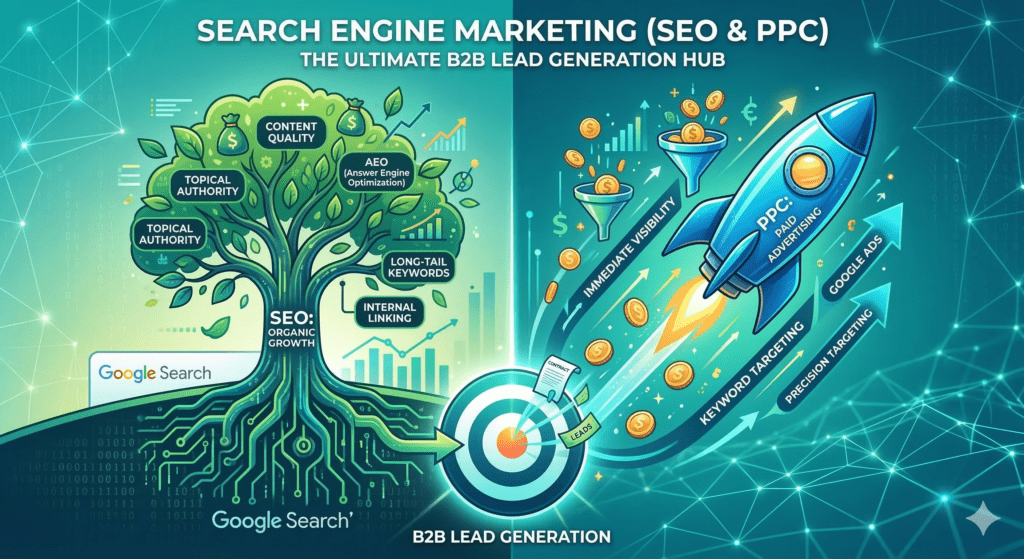
What is the difference between SEO and PPC in B2B Search Engine Marketing? In B2B Search Engine Marketing, SEO (Search Engine Optimization) focuses on earning organic, long-term visibility by creating high-quality, authoritative content that ranks naturally in search engines. PPC (Pay-Per-Click) is a paid advertising model that guarantees immediate visibility at the top of search results for specific keywords, but requires ongoing budget. A successful B2B strategy integrates both: PPC for immediate lead generation and testing, and SEO for sustainable, high-ROI organic growth.
The Strategic Foundation – Choosing Your Path between SEO and PPC
Target Audience: CMOs, Founders, Marketing Directors
Before you spend a single dollar on ads or write a single blog post, you need to align your search strategy with your current business reality. Do you need leads tomorrow, or are you building an asset for the next five years?
1. The Great Debate: SEO vs. PPC
A common mistake is treating SEO and PPC as isolated departments. B2B leaders need to understand when to deploy capital for immediate clicks and when to invest time in organic compounding. Often, the best strategy is using PPC to test keyword conversion rates before investing months into ranking for them organically.
- The Strategy: Map your timeline. Use PPC for short-term pipeline generation and SEO to lower your long-term Customer Acquisition Cost (CAC).
- Deep Dive: Define your playbook: SEO or PPC for B2B: Which Strategy is Right for You?
Mastering Organic Search (SEO)
Target Audience: Content Managers, SEO Specialists, Inbound Marketers
Organic search is a zero-sum game. The top three results capture the vast majority of the clicks. If your startup is buried on page two, you do not exist to your buyers.
2. Overcoming the Ranking Struggle
Many startups write excellent content but fail to rank because they ignore the technical foundation of their website or target keywords dominated by enterprise giants. Breaking out of the “sandbox” requires a hyper-targeted approach, focusing on long-tail, low-competition queries where your ideal customer is looking for highly specific answers.
- The Strategy: Stop fighting for vanity keywords; dominate the niche queries that actually convert.
- Deep Dive: Diagnose your organic visibility: Is Your Startup Struggling to Rank in Search Engines?
3. The SEO Sprint
Traditional SEO takes 6 to 12 months to show ROI, but modern search engines (including Answer Engines) process and rank high-authority, well-structured content much faster. Executing an “SEO Sprint” involves rapid content clustering, aggressive internal linking, and laser-focused AEO (Answer Engine Optimization) to push your pages up the rankings faster than the traditional timeline.
- The Strategy: Build concentrated topical authority through interconnected pillar pages and clusters.
- Deep Dive: Accelerate your rankings: SEO Sprint: Rank Your Content Fast in 2025 – A Beginner’s Guide
Dominating Paid Search (PPC)
Target Audience: Performance Marketers, RevOps, Demand Gen Managers
PPC is like a high-performance sports car: it goes incredibly fast, but if you don’t know how to drive it, you will crash spectacularly.
4. Rescuing Struggling Campaigns
Are your cost-per-click (CPC) rates skyrocketing while your conversion rates plummet? This usually happens when campaigns suffer from broad match keyword bloat, poorly aligned landing pages, or weak ad copy. A struggling PPC account doesn’t always need more money; it usually needs more negative keywords and better alignment.
- The Strategy: Audit your search terms report weekly to stop paying for irrelevant clicks.
- Deep Dive: Fix the leaks in your funnel: Is Your PPC Advertising Struggling to Deliver Results?