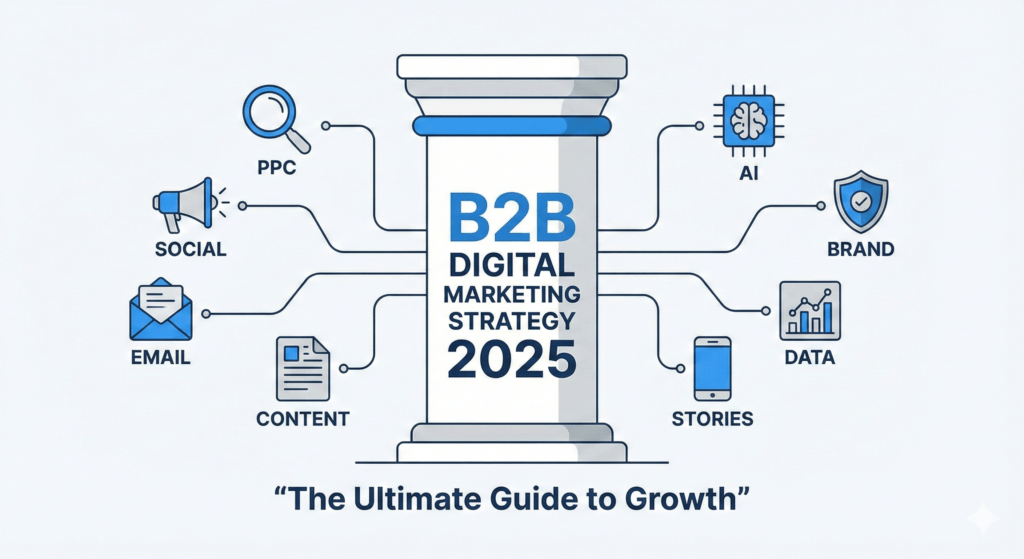
The B2B digital marketing landscape has shifted. It’s no longer just about generating leads; it’s about generating trust at scale. In 2025, the most successful strategies aren’t just “digital”—they are deeply human, powered by data, and amplified by technology.
If you are a marketing leader trying to connect the dots between paid ads, organic growth, and brand identity, this guide is your blueprint. We’ve broken down the essential components of a modern B2B digital marketing strategy, from the technical foundations of PPC to the creative nuance of brand storytelling.
1. Launch Your First B2B Digital marketing PPC Campaign
The Logic: Organic growth is the marathon, but PPC is the sprint. You need immediate visibility to feed data back into your broader strategy.
Pay-Per-Click (PPC) is often intimidating for B2B marketers because the stakes are high. With average Cost-Per-Lead (CPL) on platforms like LinkedIn hovering between $150–$350, a mistake can be expensive. However, paid channels are the fastest way to validate your messaging.
In 2025, successful PPC isn’t just about bidding on keywords; it’s about intent matching. You shouldn’t just pay for traffic; you should pay for answers. Are you solving a specific problem?
- Google Ads remain the king of “high-intent” capture (users searching for a solution now).
- LinkedIn Ads are unrivaled for targeting specific decision-maker job titles.
If you are ready to stop guessing and start capturing qualified leads, you need a tactical roadmap that minimizes wasted spend.
Read the Guide: >Launch Your First B2B PPC Campaign in 2025: A Step-by-Step Guide
2. Top Social Media Platforms for 2025
The Logic: Once you have a message, you need a distribution channel. But you can’t be everywhere at once.
“Be where your customers are” is classic advice, but in 2025, it’s about being where your customers are mentally receptive. A CFO might scroll TikTok, but are they looking to buy enterprise software there? Maybe not. But they are looking for industry insights on LinkedIn.
Platform selection is a strategic bet.
- LinkedIn continues to dominate B2B lead generation, responsible for 80% of B2B leads.
- YouTube has become the second-largest search engine for B2B buyers researching product demos.
- X (Twitter) remains vital for real-time engagement and PR.
Choosing the right platform isn’t about vanity metrics; it’s about matching your content format to the platform’s native behavior.
Deep Dive: >Top Social Media Platforms for 2025
3. Expert Email Marketing Personalization
The Logic: Acquisition gets them in the door; email keeps them in the room. This is your retention engine.
If social media is a cocktail party, email is a coffee meeting. It’s intimate, direct, and distraction-free. However, the days of “Hi [First Name]” are over. True personalization in 2025 means delivering content based on behavior, not just demographics.
We are seeing a shift toward “Middle-of-Funnel” (MOFU) nurturing. This is where you educate leads who know you but aren’t ready to buy. Using tools that allow for dynamic content insertion—like changing images or case studies based on the user’s industry—can lift engagement rates significantly.
- Stat: Mobile email views now account for 41% of all opens, so your personalization must be concise and mobile-responsive.
Read the Guide: >Top Email Marketing Tools for Mid-Level Marketers in 2025
MyB2BNetwork
Discover how to unlock target markets and hit your number with insight-driven engagement.
4. Why SMBs Need to Outsource Content Marketing
The Logic: You have a strategy, but do you have the hands to build it? Outsourcing bridges the gap between ambition and execution.
Content marketing is the growth engine for organic traffic, but it is resource-intensive. For Small and Mid-sized Businesses (SMBs), trying to hire a writer, editor, SEO specialist, and designer in-house is often cost-prohibitive.
The trend for 2025 is strategic outsourcing. Successful SMBs are keeping the strategy in-house (the “brain”) while outsourcing the production (the “hands”). This allows for consistency—a critical ranking factor—without burnout.
- Fact: Content marketing costs 62% less than traditional outbound marketing but generates 3x as many leads.
Don’t let a lack of internal bandwidth stall your growth.
Read the Guide: >Content Marketing: The Growth Engine for Startups and SMBs (And Why You Should Outsource It)
5. AI Content: Benefits, Risks & SEO Best Practices
The Logic: Technology is a tool, not a replacement. You must balance efficiency with quality to maintain SEO integrity.
Artificial Intelligence has democratized content creation, but it has also flooded the web with noise. Search engines like Google are now prioritizing “Experience” and “Expertise” (E-E-A-T) more than ever to filter out generic AI slop.
Using AI for outlines, research, and ideation is smart. Using it to write your entire blog post is a risk. The winning formula for 2025 is AI-Augmented, Human-Refined.
- AEO Tip: AI tools (Answer Engines) look for concise, factual answers. Structure your content with clear definitions to capture this traffic.
Understanding the “benefits vs. risks” calculation is essential for any modern marketer.
Read the Guide: >AI Content: Benefits, Risks & SEO Best Practices 2025
6. Brand Strategist Tips to Grow Your B2B Brand
The Logic: Before you market a product, you must define the identity. Branding is the “Why” behind the “What.”
Many B2B companies skip branding and go straight to lead gen. This is a mistake. In a crowded market, your brand is your only defensible moat. Branding is not just a logo; it’s the promise you make to your customers.
For startups, this is even more critical. You need to establish a voice that resonates before you spend a dollar on ads. Are you the “safe, enterprise choice” or the “disruptive, agile challenger”? Defining this early clarifies every other B2B Digital marketing decision you make.
Read the Guide: >Brand Strategist Tips to Grow Your B2B Brand from Startup
7. 8 Benefits of a First-Party Data Strategy
The Logic: As third-party cookies die, your own data becomes your most valuable asset. This is the advanced layer of validation.
We are living in a privacy-first world. Reliance on pixel data from Facebook or Google is becoming less effective. The solution? First-Party Data. This is data you collect directly from your audience—email lists, website behavior, and CRM inputs.
A mature B2B strategy uses this data to predict buyer intent. Companies effectively using first-party data strategies are seeing up to a 2.9x revenue uplift and 1.5x cost savings. It allows you to own your audience relationships rather than renting them from tech giants.
Read the Guide: >8 Benefits of a First-Party Data Strategy
8. B2B Instagram Stories: Maximize Leads
The Logic: The “Long Tail” of strategy. Specific tactics like Stories capture engagement where users are most active.
You might think Instagram is just for B2C, but B2B decision-makers are humans, too. They spend time on Instagram. The “Story” format is unique because it is ephemeral and authentic. It bypasses the “corporate polish” of the main feed and allows for behind-the-scenes looks, Q&As, and flash updates.
- Benchmark: The average completion rate for Instagram Stories is a massive 70%. This is a high-engagement channel perfect for humanizing your B2B brand.
Don’t overlook this specific channel; it’s often where the actual relationship building happens.
Read the Guide: >B2B Instagram Stories: Maximize Leads & Engagement
Now that you’re here
MyB2BNetwork generates new leads, offers insight on your customers
and can help you increase your marketing ROI.
If you liked this blog post, you’ll probably love MyB2BNetwork, too.