What Is Zero-Party Data?
Zero-party data is information a prospect or customer intentionally and proactively shares with a brand — through forms, surveys, quizzes, preference centres, or onboarding flows. Unlike first-party data (which is observed) or third-party data (which is purchased), zero-party data is declared, accurate, and fully consent-based — making it the most trusted data type available to B2B marketers.
Imagine knowing exactly what your B2B buyer needs — not because you tracked their browsing history across 14 websites, but because they told you directly.

That is the promise of zero-party data. And it is no longer a future strategy. It is the most important data shift happening in B2B marketing right now.
Third-party cookies are in their final chapter. Google’s Privacy Sandbox continues to reshape how advertisers track users. GDPR in the EU, PDPB in India, and CCPA in the US have collectively created a regulatory environment where surveillance-based marketing is becoming both legally risky and commercially ineffective.
According to a 2024 Twilio Segment study, companies using zero-party and first-party data strategies saw 2.9x higher revenue growth than those still relying on third-party data. And Salesforce’s State of Marketing report found that 75% of high-performing marketing teams had already established formal zero-party data collection programs — compared to just 28% of underperformers.
Why Zero-Party Data Has Become the Currency of Modern B2B Marketing
The B2B marketing world has a data problem it rarely talks about honestly.
Most of the data driving B2B campaigns right now is either inaccurate, non-consensual, or both. Third-party intent data is built on probabilistic inference. Purchased contact lists violate consent norms in most regulatory environments. Even first-party behavioral data tells you what someone did — not what they actually need.
Zero-party data solves all three problems simultaneously.
It is accurate — because buyers tell you directly, in their own words, what they are looking for.
It is consensual — because the act of sharing the data is itself a consent event. No inference. No grey area.
It is intent-rich — because a buyer who completes a diagnostic quiz, fills out a preference form, or answers an onboarding question is demonstrating active engagement, not passive browsing.
For B2B teams using social media marketing tools and multi-channel campaigns to drive pipeline, zero-party data transforms the quality of every downstream interaction — from email personalization to sales outreach to ad targeting.
Zero-Party vs First-Party vs Third-Party: What Actually Matters for B2B
Before building a strategy, understanding how data types differ helps you allocate your collection efforts intelligently.
| Data Type | Source | Consent Level | Accuracy | B2B Value |
|---|---|---|---|---|
| Zero-Party | Buyer declares it directly | Explicit, proactive | Very high | Very high — intent-rich and compliant |
| First-Party | Observed from your own channels | Implicit (via privacy policy) | High | High — behavioral, scalable |
| Second-Party | Shared from a trusted partner | Varies | Medium | Medium — useful for ABM |
| Third-Party | Purchased from data brokers | Often non-consensual | Low | Declining — regulatory risk, poor accuracy |
The strategic shift is clear: move up the data quality stack. Use zero-party data as your intent signal layer, first-party behavioral data as your scale layer, and eliminate third-party data wherever possible.
The 6 Most Effective Zero-Party Data Collection Methods for B2B
1. Interactive Quizzes and Diagnostic Assessments
This is the single highest-performing zero-party data collection mechanism in B2B right now.
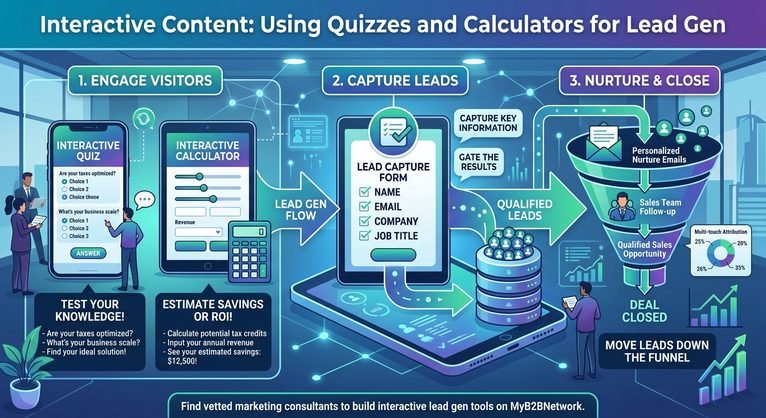
Interactive assessments — marketing maturity audits, ROI calculators, readiness scorecards, vendor comparison tools — deliver immediate, personalized value in exchange for declared intent.
A buyer who completes a “How Ready Is Your Team for Marketing Automation?” assessment and sees a personalized score report has not just shared data. They have told you their current capability level, their biggest challenges, and their desired outcome — in a single interaction.
HubSpot’s own marketing team reported that interactive content generates 2x more conversions than static content. For B2B demand generation teams targeting mid-level marketers and product managers, this conversion multiplier alone makes interactive assessment investment worthwhile.
Best practice: Build the assessment around a problem your product solves. The result page should deliver genuine insight — not just a thinly disguised pitch. The more useful the output, the more likely the buyer is to share accurate data.
2. Preference-Based Lead Capture Forms
Standard B2B lead forms ask for contact details. Preference-based forms go further — asking what the buyer is looking for, what their biggest challenge is, or what type of content they want to receive.
This small shift transforms a form submission from a passive data capture event into an active consent and preference declaration.
Examples of high-value preference questions for B2B forms:
- What is your primary business challenge right now?
- Which service area are you most interested in exploring?
- What is your timeline for making a decision?
- What is your company size and industry?
- How do you prefer to receive information — email, webinar, or direct call?
The data collected from these questions feeds directly into lead scoring, CRM segmentation, and sales outreach personalization — making every follow-up interaction more relevant and better timed.
For B2B teams in India, the US, and the UK using platforms like HubSpot, Salesforce, or Zoho, preference data can be mapped directly to contact records and used to trigger segmented nurture sequences automatically.
3. Targeted Surveys — Short, Valuable, and Well-Timed
Surveys are one of the oldest zero-party data collection tools — and one of the most underused in B2B.
The key distinction between surveys that work and surveys that get ignored is value exchange. A survey that asks buyers to spend ten minutes helping a brand understand their own product performs poorly. A survey that offers a personalized benchmark report, an industry data comparison, or early access to research findings in exchange for five minutes of responses performs extremely well.
B2B survey formats that drive high completion rates:
- Post-demo surveys — “What are your top three priorities for this project?” surfaces buying intent at the most critical stage of the funnel.
- Newsletter preference surveys — “What topics do you want us to cover?” drives both data collection and content strategy simultaneously.
- Annual benchmark surveys — Offer respondents a personalized comparison against their industry peers. The value of seeing how they compare to others is a powerful motivator to participate.
- Post-event surveys — Webinar and conference attendees who have already invested time in your content are highly likely to complete a short follow-up survey if the questions are directly relevant to the session.
Survey forms are particularly well-suited to B2B and professional audiences — they are concise, professional in tone, and ask the kind of business-relevant questions that B2B buyers are comfortable answering.
4. Conversational Lead Capture — AI Chatbots and Interactive Flows
AI-powered chatbots and conversational landing pages are one of the most underrated zero-party data collection channels in B2B.
When a prospect interacts with a well-designed conversational flow — whether through Intercom, Drift, or a custom AI-powered bot — they are volunteering intent data in real time. The data points captured conversationally are often richer than anything a static form will yield: pain points expressed in their own language, objections surfaced before the sales call, specific use cases they are evaluating your solution for.
What makes conversational data collection uniquely valuable for B2B:
- It feels like a helpful interaction, not a data extraction event.
- It allows follow-up questions based on previous answers — creating a dynamic, personalized data collection experience.
- It captures the buyer’s own language — which is invaluable for content strategy and sales messaging.
- It works 24/7 — capturing intent data from buyers in different time zones without requiring a sales rep to be online.
For B2B teams targeting buyers across India, Southeast Asia, the US, and the UK simultaneously, conversational lead capture tools that operate across time zones are a genuine competitive advantage.
5. Onboarding and Preference Centre Flows
Onboarding flows — the sequence a new lead or trial user goes through after their first interaction — are a massively underused zero-party data opportunity.
Most B2B brands treat onboarding as a product education exercise. The smartest ones treat it as a structured data collection event.
A well-designed onboarding flow asks buyers:
- What is the primary outcome you are trying to achieve?
- What is your team size and current technology stack?
- What does success look like for this project in 90 days?
- What is the biggest obstacle you are currently facing?
Each answer enriches the contact record, improves lead scoring accuracy, and gives both marketing and sales the context they need to personalize every subsequent interaction.
Preference centres — pages where subscribers can manage their communication preferences — serve a dual purpose: they are a compliance tool (giving users control over their data) and a data collection tool (revealing which topics, formats, and frequencies each subscriber values).
For B2B brands managing large email lists across multiple segments, preference centres dramatically reduce unsubscribe rates while simultaneously improving the relevance of every campaign they send.
6. Gated Content With Declared Intent Questions
Gated content — whitepapers, research reports, templates, calculators — is already a standard B2B lead generation tactic. The zero-party data layer turns it into a data collection strategy.
Instead of gating content behind a form that captures only name and email, add two to three intent-qualifying questions that reveal why the buyer wants the content and what problem they are trying to solve.
Example gate form for a “B2B Marketing Automation Guide”:
- What is your current marketing automation setup?
- What is the primary challenge you are trying to solve with automation?
- What is your implementation timeline?
These three questions take 30 seconds to answer. They deliver enough context to segment the lead, personalize the follow-up sequence, and alert the sales team to high-intent prospects — all from a single gated download event.
Building Trust: The Foundation That Makes Zero-Party Data Work
Zero-party data collection only works when buyers trust you enough to share accurate information.
That trust is not given automatically. It is built through consistent transparency, genuine value exchange, and demonstrated respect for the data buyers share.
The trust-building principles every B2B team must follow:
- Be explicit about how data will be used. Not just a privacy policy link — a clear, plain-language statement at the point of collection. “We use your answers to personalize your experience and connect you with relevant resources.”
- Deliver on the value exchange immediately. If a buyer completes a diagnostic quiz, the personalized result should appear instantly — not three days later in a sales email.
- Never use declared data as a sales pressure tool. A buyer who said they are “12 months from a decision” should not receive a “let’s schedule a demo this week” email.
- Make data sharing feel safe. Explain your data governance practices, link to your privacy policy, and make it easy to update or delete preferences at any time.
For B2B brands operating across GDPR-regulated EU and UK markets, India’s PDPB framework, or US CCPA requirements, these trust practices are not just ethically right — they are legally necessary.
Integrating Zero-Party Data Into Your B2B Marketing Stack
Collecting zero-party data is step one. Activating it is where the real growth impact happens.
Zero-party data creates competitive advantage only when it flows through your entire marketing and sales infrastructure — enriching contact records, triggering personalized sequences, and informing account prioritization.
The integration workflow for B2B teams:
Step 1 — Capture and enrich
Map every zero-party data collection point to specific CRM fields. Use enrichment tools like Clearbit or Apollo to append firmographic and technographic context to declared intent signals.
Step 2 — Segment and score
Use declared intent data to create dynamic segments — by challenge, by buying stage, by service interest, by company size. Feed these segments into your lead scoring model to prioritize accounts showing the highest intent.
Step 3 — Activate in nurture sequences
Trigger personalized email sequences based on declared preferences. A buyer who said they are interested in “marketing automation for a team of 10–50” should receive a fundamentally different nurture track than one who declared interest in “enterprise-scale CRM integration.”
Step 4 — Align with sales
Push zero-party data signals into your CRM and sales enablement tools. A sales rep who knows a prospect completed a marketing maturity assessment, scored in the “early stage” tier, and identified “lead quality” as their primary challenge can have a far more relevant first conversation than one working only from a name and email.
Step 5 — Feed into ABM and paid campaigns
Push declared intent segments into your ABM platform — 6sense, Demandbase — to personalize ad creative in real time based on what each account has explicitly told you about their needs.
For teams using B2B social platforms like LinkedIn alongside their marketing automation stack, zero-party data segments can be synced to LinkedIn Matched Audiences for highly personalized sponsored content campaigns — delivering the right message to the right account at the right stage without relying on third-party tracking.
Your Data Strategy Deserves the Right Marketing Partners Behind It
Zero-party data is the foundation of a future-proof B2B marketing strategy. But building the forms, surveys, preference centres, CRM integrations, and nurture sequences that make it work requires specialist expertise that most in-house teams do not have the time or resources to develop internally.
MyB2BNetwork connects you with vetted marketing automation, CRM, and digital marketing service providers who specialize in exactly this work — from zero-party data strategy and collection infrastructure to full-funnel B2B demand generation programmes.
Submit one requirement. Receive competitive quotations from pre-screened specialists. We scope your project, validate offers, schedule meetings, support negotiations, and protect every payment through secure escrow — so your data strategy investment delivers real pipeline, not just compliance.
[Submit your marketing or data strategy requirement on MyB2BNetwork →] and start building the kind of buyer intelligence that actually closes deals.