What Is Website Analytics?
Website analytics is the process of collecting, measuring, and interpreting data about how visitors interact with your website. It reveals where traffic comes from, what content performs, how long people stay, and what actions they take. For B2B and B2C businesses, analytics drives smarter decisions — but the metrics that matter most are fundamentally different.
Two marketing managers. Same question. Completely different answers.
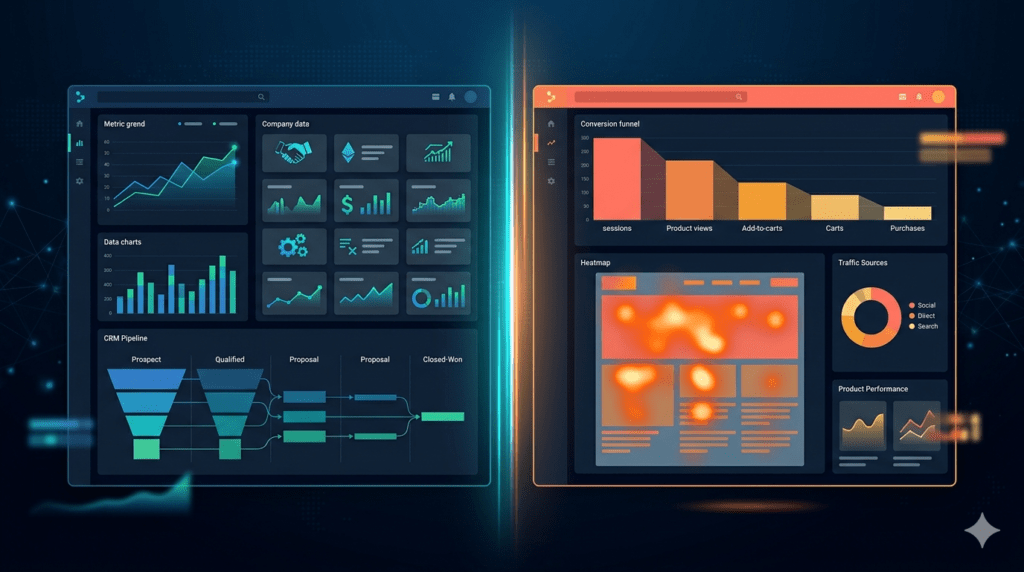
A B2C e-commerce manager at a fashion brand in Mumbai wants to know which product pages are driving the most add-to-cart events, what the checkout abandonment rate is, and whether the new Instagram ad campaign is converting better than the previous one.
A B2B marketing manager at a SaaS company in Austin wants to know which companies are visiting the pricing page, what content a procurement manager at a Fortune 500 firm consumed before requesting a demo, and whether the marketing-sourced leads from the UK are closing at a higher rate than those from the US.
Same tool. Completely different questions. And that is the fundamental tension at the heart of this blog.
The short answer to whether B2B and B2C businesses need the same website analytics tools is: partly. Some tools are genuinely universal. But B2B analytics has unique requirements — account-level identification, multi-touch attribution across long sales cycles, and CRM integration — that most consumer-focused tools simply do not address well.
According to a study by Gartner, only 53% of marketing decisions are currently made based on data — despite the abundance of analytics tools available. The gap is not about access to tools. It is about choosing the right tools for the right business model.
This blog breaks down the top 10 website analytics tools, explains the critical differences between B2B and B2C analytics needs, and helps mid-level marketers across India, the US, and the UK choose the right stack for their specific goals.
Why B2B and B2C Analytics Are Fundamentally Different
Before diving into tools, understanding why B2B and B2C analytics diverge is essential. It explains why using a purely consumer-oriented analytics stack for a B2B business produces incomplete and often misleading data.
B2C Analytics: User-Centric and Volume-Driven
B2C analytics focuses on individual users, their immediate behavior, and rapid conversion signals. The buying journey is short — often minutes to hours. Revenue is distributed relatively evenly across a large customer base. Success metrics center on conversion rate, average order value, cart abandonment, and return visitor rate.
The goal is to optimize for mass behavior patterns across millions of anonymous individual sessions.
B2B Analytics: Account-Centric and Journey-Driven
B2B analytics must track accounts — companies — not just individual users. A single deal might involve six to ten stakeholders visiting your website over three to twelve months, each consuming different content from different devices. The buying journey is long. Revenue is heavily concentrated in a small number of high-value accounts.
Success metrics center on company identification, multi-touch attribution, pipeline influence, lead quality by source, and content-to-opportunity conversion rates.
The goal is to understand which companies are engaging, at what stage, and what content is moving them toward a decision.
| Dimension | B2C Analytics Focus | B2B Analytics Focus |
|---|---|---|
| Unit of analysis | Individual user | Company / account |
| Buying cycle | Hours to days | Weeks to months |
| Decision-makers | One | Six to ten |
| Revenue distribution | Even across many users | Concentrated in few accounts |
| Key metric | Conversion rate | Pipeline influence |
| Core tool need | Behavior tracking | Account identification + attribution |
This structural difference explains why a tool like Hotjar — brilliant for understanding individual user behavior — adds limited value without an account-identification layer for a B2B team. And why a tool like Clearbit or Leadfeeder is essential for B2B but largely irrelevant for B2C.
The Top 10 Website Analytics Tools: Mapped to Your Business Model
1. Google Analytics 4 (GA4) — Universal Foundation
Best for: All businesses — B2B and B2C
Google Analytics 4 remains the non-negotiable baseline for any analytics stack. Over 29 million websites use it globally. GA4’s event-based tracking model, cross-device measurement, and integration with Google Ads and Search Console make it indispensable for understanding traffic sources, content performance, and user journeys.
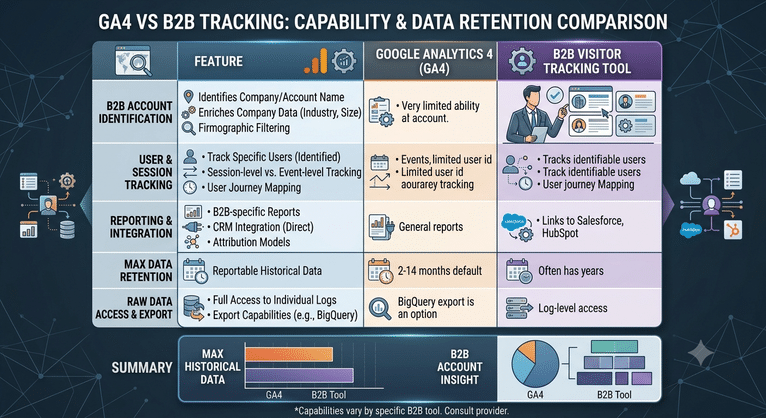
For B2B teams, GA4 provides the traffic foundation. But it does not identify which companies are visiting — only that someone from a certain country using a certain device visited certain pages. That is why B2B teams always need additional layers on top of GA4.
- Pricing: Free (GA360 for enterprise)
- B2B-specific value: High for traffic and content analysis; limited for account-level intelligence
- B2C-specific value: Very high — conversion tracking, e-commerce reporting, funnel analysis
2. HubSpot Marketing Analytics — The B2B Marketer’s Native Layer
Best for: B2B businesses with inbound marketing and CRM integration needs
HubSpot’s analytics goes beyond traffic data by connecting website behavior directly to contact and company records in its CRM. A B2B marketing team can see exactly which pages a specific lead visited before submitting a form, what content influenced their decision at each stage, and how marketing-sourced leads are progressing through the sales pipeline.
For B2B marketers in India, the US, and the UK managing inbound lead generation campaigns, HubSpot analytics closes the critical gap between anonymous website visitors and named pipeline opportunities.
- Pricing: Free tier available; paid plans from mid-market upward
- B2B-specific value: Very high — CRM-connected, pipeline-attributed analytics
- B2C-specific value: Moderate — better suited to considered purchases than high-volume e-commerce
3. Salespanel — Built Specifically for B2B Lead Intelligence
Best for: B2B businesses that need to identify and score visiting companies
Salespanel is one of the clearest examples of a tool built with B2B’s unique requirements at its core. It identifies companies visiting your website, tracks their behavior across sessions, scores leads based on engagement, and integrates with CRM systems to alert sales teams when high-intent accounts are active.
For a B2B team, this transforms anonymous website traffic into actionable account intelligence — exactly the kind of insight that GA4 alone cannot provide.
- Pricing: Paid plans; B2B-focused
- B2B-specific value: Very high — company identification, lead scoring, CRM integration
- B2C-specific value: Low — designed specifically for B2B
4. Mixpanel — Deep Behavioral Analytics for Product-Led Teams
Best for: B2B SaaS companies and product-led growth teams
Mixpanel excels at tracking what users do inside a product or application — event sequences, feature adoption, retention cohorts, and conversion funnels. For B2B SaaS companies using product-led growth strategies, Mixpanel provides the behavioral depth that traditional web analytics tools cannot.
It supports account-level reporting — grouping individual user events under company accounts — which makes it meaningfully more B2B-aware than many behavioral analytics tools.
- Pricing: Free tier; paid plans scale with data volume
- B2B-specific value: High for SaaS and product-led businesses
- B2C-specific value: High for apps and digital products with complex user journeys