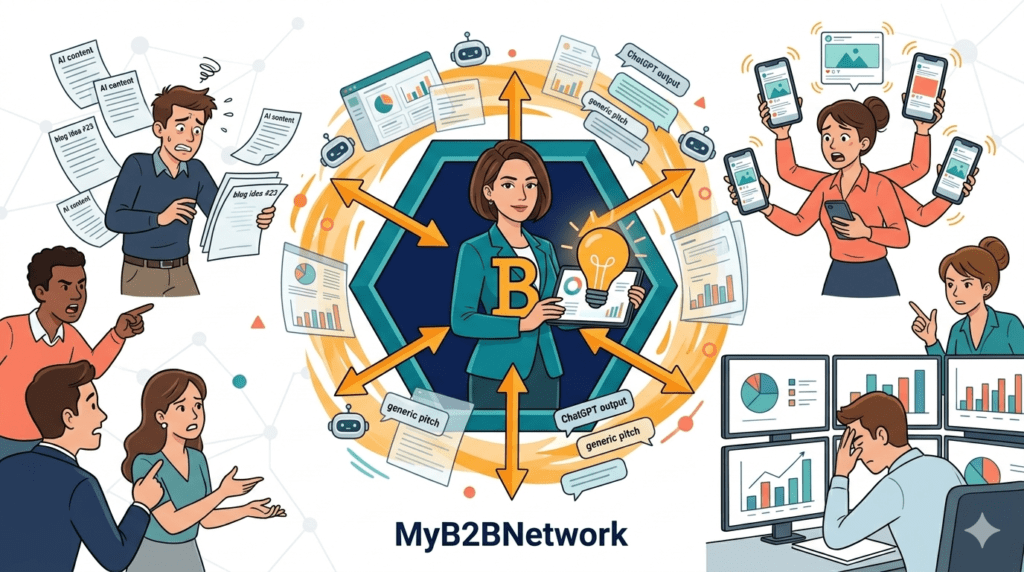
AI in B2B marketing is improving results for some companies while creating massive noise for others, and the difference is not random. Gartner projects that AI will handle 36% of all marketing work by 2028, up from just 16% in 2026, showing rapid adoption across the industry. Yet Forrester’s 2026 B2B Marketing Predictions warn that ungoverned use of generative AI will cost B2B companies more than $10 billion in enterprise value through fines, legal settlements, and declining stock prices.
The problem is not the technology itself. The problem is that many B2B marketing teams are deploying AI tools without clear governance, measurable outcomes, or human oversight. Jasper’s 2026 State of AI Marketing report found that 88% of marketers still say AI output requires significant human correction, even though 93% use it to speed up content production. This creates a paradox: AI is making content faster and cheaper, but also more generic and less effective.
For CMOs, founders, and ops leaders, the question is no longer whether to use AI in B2B marketing. The question is how to use it in ways that drive pipeline, reduce cost per lead, and maintain brand integrity. This guide gives you a clear framework for separating signal from noise, practical vendor selection criteria for U.S. businesses, and how MyB2BNetwork can connect you with vetted vendors who deliver measurable ROI.
What Is AI in B2B Marketing (And Why It Matters Right Now)?
AI in B2B marketing is the use of machine learning, generative AI, and predictive analytics tools to automate, personalize, and optimize marketing activities across content creation, lead scoring, campaign execution, and attribution modeling.
It includes tools that write first-draft blog posts, platforms that score and route leads automatically, software that builds and tests ad creative, models that predict buyer intent signals, and systems that connect marketing touchpoints to revenue. What unites them is the replacement or augmentation of repetitive manual decisions with data-driven, automated ones.
Key AI capabilities in B2B marketing include:
- Content generation and optimization (ChatGPT, Jasper, Clearscope, MarketMuse, SurferSEO)
- Lead scoring and intent detection (6sense, Demandbase, HubSpot AI features)
- Predictive analytics and pipeline forecasting (Salesforce Einstein, Clari)
- Personalization and dynamic creative (Adobe Sensei, Optimizely)
- Conversational AI and chatbots (Drift, Intercom)
AI matters right now because B2B buyers are using AI themselves. Forrester’s 2026 B2B Buyer Survey of 16,142 buyers found that B2B buyers adopt AI-powered search at three times the rate of consumers, and 19% of them feel less confident in purchasing decisions because of inaccurate or unreliable information from generative AI tools. If your content is just another AI-generated piece in a sea of generic output, it does not help buyers; it becomes noise they filter out.
MyB2BNetwork helps you cut through this noise by connecting you with B2B marketing specialists who understand how to use AI tools strategically, not just for volume. Whether you need content teams with human editorial oversight or demand gen experts who use AI for lead scoring, we can get you accurate quotations without wasting time on multiple vendor calls.
Why AI in B2B Marketing Is Creating Both Results and Noise
AI in B2B marketing creates real results when it improves relevance, speed, and measurability. It creates noise when it is used to generate volume without a governing strategy, editorial review, or clear attribution to pipeline revenue.
LinkedIn’s B2B marketing data shows that B2B marketers using AI save an average of 20 hours per week, while early adopters have achieved a 21% reduction in cost per lead and double the leads at the same budget. AI-based lead scoring improves conversion rates by up to 51%, and personalized AI-driven outreach achieves 15% to 25% response rates versus 3% to 5% for traditional cold outreach.vocal+1
However, the risk is real. The 2026 AI & B2B Marketing Report found that only 12% of B2B marketing leaders cite competitive advantage as a benefit they are actually realizing from AI, which raises serious questions about marketing homogeneity and content sameness. When every competitor is using the same AI tools with similar prompts, your content becomes indistinguishable from the rest.
Signal use cases where AI improves results:
- Predictive lead scoring — AI ranks inbound leads by fit and intent so sales teams focus on accounts most likely to close
- Dynamic content personalization — AI serves different messaging based on industry, role, or buying stage
- Attribution modeling — AI connects marketing touchpoints to pipeline revenue for cleaner ROI reporting
- AI-assisted SEO and AEO — Tools like MarketMuse and Clearscope improve topical authority, not just keyword density
- Sales cycle compression — AI-enabled teams report 30% shorter sales cycles and 50% higher win rates
Noise traps to avoid:
- Bulk AI-generated content without editorial review
- Untested ad creative scaled too fast
- Chatbots that misrepresent product capabilities
- AI email sequences that feel automated even when they try not to
- Using AI for strategy when it should only support execution
MyB2BNetwork can help you avoid these pitfalls by connecting you with marketers who have proven track records using AI strategically. We vet vendors based on their ability to deliver measurable outcomes, not just content volume.
How to Separate Signal From Noise: The SIGNAL Framework
The SIGNAL Framework is an original decision model created for this guide to help B2B marketing leaders decide where AI adds value versus where it adds noise.
- S — Specificity: Is the AI application tied to a specific, measurable outcome (pipeline, conversion, cost per lead)?
- I — Integration: Does the tool connect to your existing data, CRM, and workflow without creating data silos?
- G — Governance: Is there an editorial and legal review process before AI output reaches prospects or customers?
- N — Nuance: Does the AI application handle the complexity and context of your B2B buying process?
- A — Attribution: Can you directly attribute results from the AI application to revenue or pipeline metrics?
- L — Learning Loop: Does the system improve over time based on feedback, performance data, and corrections?
If a proposed AI deployment scores below four of these six criteria, it is likely to generate more noise than signal. This framework serves as a pre-deployment checklist before buying or building any AI marketing capability.
MyB2BNetwork vendors must demonstrate how their AI-driven services align with frameworks like SIGNAL before they are matched to your project. This ensures you get partners who prioritize measurable outcomes over content output.
Which AI Tools Are Actually Worth Using in 2026?
The best AI tools for B2B marketing are those that improve decisions, not just output. Below is a comparison across three dimensions to help marketing leaders choose wisely.demandbase+2
| Tool | Primary Use Case | Best For |
|---|---|---|
| Jasper + Clearscope | Content generation and SEO optimization | Content teams needing on-brand, search-optimized output |
| HubSpot AI + 6sense | Lead scoring, CRM enrichment, intent signals | Demand gen and RevOps teams managing large databases |
| Demandbase + Drift | ABM targeting and conversational AI | Enterprise B2B teams running account-based plays |
Key selection criteria for AI tools:
- Does it integrate with your existing CRM and marketing stack?
- Does it produce outputs that require minimal human correction?
- Does it have transparent reporting and attribution capabilities?
- Can it be trained or fine-tuned on your brand’s data and voice?
- Does the vendor comply with GDPR, CCPA, and applicable data privacy regulations?
When working with MyB2BNetwork, you do not need to buy these tools yourself. Many of our vetted vendors include tooling costs in their retainers, and we help you match with partners who already have proven expertise with the right stack for your business size and industry.
How to Source AI-Driven Marketing Services in the U.S.
For U.S.-based B2B companies outsourcing AI marketing capabilities, vendor selection is more complex than for traditional marketing services because of both technical requirements and regulatory exposure. SaaS startups in Austin, healthcare organizations in Chicago, fintech firms in New York, manufacturing businesses in Ohio, logistics companies in Atlanta, and B2B services firms in San Francisco all face different compliance requirements depending on data type and industry.
Budget expectations: AI-assisted B2B marketing retainers typically range from $4,000–$20,000 per month for integrated content, demand gen, and AI tooling support, rising to mid-five figures annually for enterprise-level ABM programs or custom AI workflow builds. MyB2BNetwork can help you receive accurate, summarized quotations for your specific scope without wasting time on multiple vendor calls.
Vendor due diligence checklist:
- Verify the vendor’s AI tooling stack and data security posture against NIST AI RMF, ISO 27001, and SOC 2 standards
- Confirm compliance with FTC rules on AI-generated content, CCPA, HIPAA (if healthcare data is involved), and GDPR/UK-GDPR for any international audiences
- Review portfolio for B2B-specific AI marketing work — not just B2C campaigns
- Ask for attribution methodology: how do they measure and report pipeline contribution?
- Check SLAs for output quality, review cycles, and correction turnaround
- Red flags: no named human strategist, AI-only outputs with no editorial layer, vague deliverables, or inability to explain their data-handling practices
Timeline: Most AI marketing outsourcing engagements reach operational delivery within 4–8 weeks, though custom ABM or AI workflow builds can take 3–4 months for full deployment and calibration.
MyB2BNetwork simplifies this process by pre-screening vendors against these criteria. When you submit a single form on our platform, you receive summarized quotations from multiple qualified vendors who meet your budget, timeline, and compliance requirements.
FAQ
What is AI in B2B marketing and why does it matter for B2B businesses?
AI in B2B marketing is the deployment of generative, predictive, and machine learning tools to automate and improve content, lead generation, personalization, and campaign performance. It matters because it can compress time-to-pipeline and reduce cost per lead when governed correctly, but it creates noise and risk when deployed without strategy or oversight. MyB2BNetwork helps you avoid the risk by connecting you with vendors who have proven governance frameworks and measurable ROI tracking.
How do I choose the right vendor for AI in B2B marketing within my budget?
Prioritize vendors who show clear attribution between their AI activities and pipeline revenue, disclose their tooling stack, have editorial governance baked into their delivery process, and can demonstrate B2B-specific case studies. Retainers typically start at $4,000–$8,000 per month for focused engagements. MyB2BNetwork helps you compare 3–5 qualified vendors side-by-side with summarized quotations, saving you weeks of outreach and discovery calls.
What checks should I do before outsourcing AI in B2B marketing?
Audit the vendor’s data-handling practices against ISO 27001 and NIST AI RMF standards, verify CCPA and GDPR compliance, review their human review and correction process for AI output, confirm their attribution and reporting methodology, and check references from clients in your industry. MyB2BNetwork already vets vendors against these criteria, so you do not need to start from scratch.
How long does AI in B2B marketing outsourcing typically take and what does it cost?
Standard engagements go live in 4–8 weeks for content and demand generation, with broader AI workflow builds taking up to 3–4 months. Annual costs range from $48,000–$240,000 depending on scope, tooling complexity, and whether ABM or custom AI development is involved. MyB2BNetwork can provide accurate, customized quotations for your specific needs so you know the exact cost before committing.
How MyB2BNetwork Solves Your AI Marketing Noise Problem
If your B2B marketing team is wasting budget on AI tools that create volume but not pipeline, MyB2BNetwork is built to solve exactly that problem. We connect B2B businesses with vetted service providers who can build, manage, and optimize AI-powered marketing programs with clear accountability and measurable results.
With MyB2BNetwork, you submit a single form describing your needs, and we match you with multiple qualified vendors who submit summarized quotations. You do not need to research tools, vet vendors, or negotiate contracts yourself. We handle the heavy lifting while you compare options and choose the best fit for your budget and timeline.
Stop generating noise. Start building signal. Submit your request today at myb2bnetwork.com and receive accurate, summarized quotations for vetted AI marketing vendors in your industry.