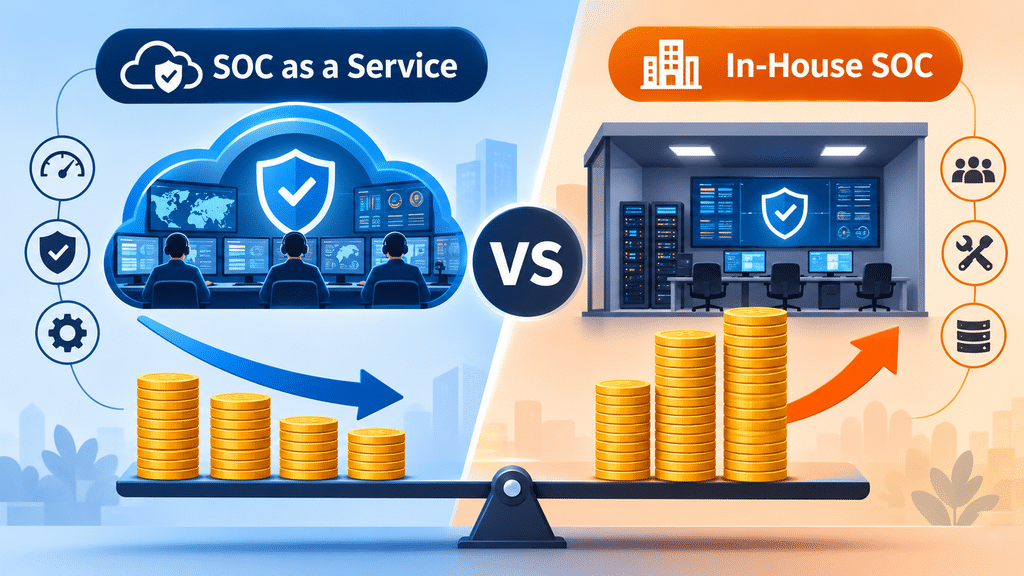
SOC as a service gives a small company round-the-clock security monitoring by renting a provider’s analysts, tools, and processes instead of hiring and running a security operations center of its own. For most small and midsize businesses (SMBs), that rental is the only realistic way to get someone watching the network at 2 a.m., because the in-house alternative typically costs $1.5 million or more per year.
The threat side of the equation doesn’t scale down with company size. Verizon’s 2026 Data Breach Investigations Report (DBIR) found that ransomware appeared in 48% of all breaches, and that about 96% of ransomware victims with a known size were SMBs. Attackers aren’t choosing small firms because they’re interesting. They’re choosing them because small firms are abundant, often unpatched, and rarely monitored overnight.
That leaves owners and IT directors with a hard trade-off: accept a monitoring gap, or pay for coverage they can’t staff. This guide explains what a managed SOC does, what it costs compared with building one, what it does not cover, and six questions to put to any provider before you sign.
What Is SOC as a Service?
SOC as a service (SOCaaS) is a subscription model in which an outside provider monitors your systems 24/7, investigates alerts, and helps contain threats on your behalf. It delivers the functions of a security operations center without you owning the people, platform, or shift schedule.
You’ll hear related terms used loosely. Gartner defines managed detection and response (MDR) as remotely delivered, human-led SOC functions covering detection, investigation, and response, which overlaps heavily with SOCaaS. Traditional managed security service providers (MSSPs) historically leaned toward alert forwarding, while MDR-style services lean toward investigation and active containment. Always ask which one a vendor is actually selling.
Why Does SOC as a Service Matter for SMBs?
It matters because detection speed decides how expensive a breach becomes, and small teams rarely have anyone awake to detect anything. IBM’s 2026 Cost of a Data Breach research puts the global average breach cost at about $4.99 million and the average time to identify and contain a breach at 247 days. SMBs won’t see those exact numbers, but the pattern holds: the longer an intruder sits undetected, the more it costs.
Verizon’s 2026 DBIR adds a useful detail. Exploitation of software vulnerabilities is now the most common way breaches begin, at 31%, overtaking stolen credentials. Fast, continuous monitoring won’t fix an unpatched server, but it can catch the lateral movement and data staging that follow the initial break-in.
Adoption reflects this. Gartner’s 2023 MDR Market Guide predicted that 60% of organizations would be actively using remote threat disruption and containment from MDR providers by 2025, up from 30% at the time. Its 2024 guide estimated that more than 600 providers now claim to offer MDR, which is why vendor vetting matters.
What Does a Managed SOC Actually Do?
A managed SOC collects security telemetry, filters the noise, investigates what’s real, and either acts or tells you exactly what to do. In practice, the core services usually include:
- 24/7 monitoring of endpoints, identity systems, email, cloud, and network logs.
- Alert triage and investigation by human analysts, so you’re not forwarded thousands of raw alerts.
- Containment actions, such as isolating a laptop or disabling a compromised account, where the contract allows it.
- Threat hunting and intelligence, using known attacker behavior to look for what automated rules missed.
- Reporting and escalation, with defined contacts and severity levels.
Under the hood, providers typically run a SIEM (security information and event management) platform, endpoint detection and response (EDR) tooling, and automation. Common platforms in this space include Microsoft Sentinel, Splunk, Elastic Security, CrowdStrike Falcon, SentinelOne, and Huntress. Many providers work on top of tools you already own, which can lower cost.
What Does SOC as a Service Not Cover?
A managed SOC detects and responds to threats; it does not make your environment secure by itself. Treating it as a complete security program is the most common and most expensive misunderstanding. Typical gaps include:
- Patching and vulnerability management. Most services will flag exposure, but your team still has to fix it.
- Backups and recovery. Detection doesn’t restore data; a tested backup does.
- Security configuration. MFA rollout, least-privilege access, and hardening remain your job.
- Unmonitored systems. If a log source or device isn’t connected, the SOC can’t see it.
- Staff training and policy. Phishing awareness and acceptable-use rules sit outside the service.
- Full incident recovery. Some contracts cover containment and guidance only, with hands-on incident response billed separately.
How Much Does SOC as a Service Cost vs. Building In-House?
SOC as a service typically costs a small fraction of an in-house 24/7 SOC, mainly because you share analysts and tooling with other customers. The figures below are vendor-published ranges, so treat them as planning estimates rather than quotes.
| Factor | In-house 24/7 SOC | Co-managed SOC | SOC as a service |
|---|---|---|---|
| Typical annual cost | $1.5M–$3M+ | $80K–$250K | $50K–$200K |
| Analysts needed | 8–12 for true 24/7 coverage | Shared with your team | Provider-staffed |
| Time to operational | 12–24 months | Weeks to a few months | 4–8 weeks |
| Tooling (SIEM, EDR) | You buy and maintain | Often use your existing licenses | Usually bundled |
| Main trade-off | Full control, highest cost | Needs internal time | Less customization |
Sources for the ranges: CyberSecOp and Total Assure (in-house and managed ranges, staffing, timelines), Adayptus (co-managed range), and Unio Digital (managed range). Per-seat pricing is another common model: Total Assure cites roughly $40–$120 per user per month, which works out to about $48,000–$144,000 a year for 100 users.
There’s also a middle trap. Two or three internal analysts can review alerts during working hours, but Radicl estimates that a minimal team for about 100 endpoints still lands between $500,000 and $750,000 per year without delivering real 24/7 coverage.
When Does Outsourced Security Monitoring Make Sense?
It makes sense when you can’t staff continuous coverage yourself and the cost of a missed overnight intrusion exceeds the subscription. To make that call concrete, use the CSR Test, a simple three-gap check:
- Coverage gap: Does anyone qualified watch alerts between 6 p.m. and 8 a.m., weekends and holidays included?
- Skills gap: Can your team investigate an alert to root cause, not just acknowledge it?
- Response gap: If an account is compromised at 3 a.m., can someone contain it within an hour?
If you answer “no” to two or more, outsourcing is usually justified. If you answer “yes” to all three, a co-managed model or a stronger internal team may fit better. An in-house SOC generally only wins when regulation or data-sensitivity rules prohibit third-party access to your telemetry, or when you’re large enough to absorb seven-figure annual costs.
6 Questions to Ask a Managed Security Provider
Put these to every shortlisted vendor, and get the answers in writing:
- What exactly will you monitor, and what is out of scope? Ask for a list of supported log sources, cloud platforms, and identity systems.
- What are your contractual response times? Look for separate commitments for acknowledgment, investigation, and containment by severity level.
- Can you take response actions, or only send alerts? Confirm what you’re authorizing them to do, such as isolating endpoints or disabling accounts.
- Who are the analysts? Ask about location, certifications, tier structure, and whether you get named contacts.
- Who owns the data, and what happens if we leave? Clarify log retention, detection-rule ownership, and export rights. The same contract discipline you’d use to protect your IP when outsourcing applies here.
- What’s the all-in price? Ask about onboarding fees, log-ingestion overages, and incident response hours, and how the vendor reports value, such as detection and response times.
FAQ
What is SOC as a service and why does it matter for B2B businesses?
SOC as a service is a subscription that gives you 24/7 monitoring, investigation, and response support from an outside security team. It matters because B2B firms are routinely targeted regardless of size, and most can’t afford the 8–12 analysts that true round-the-clock coverage requires.
How do I choose the right SOC as a service provider within my budget?
Start with scope: decide whether you need alerts only, active containment, or co-managed support, since that drives price more than company size. Then compare vendors on response-time commitments, supported tools, and total cost, not just the headline monthly fee.
What checks should I do before outsourcing security monitoring?
Verify the provider’s security attestations, ask for references from companies of similar size, and review the contract for response SLAs, data ownership, and exit terms. Red flags include vague scope, no written response times, and unwillingness to name what’s excluded.
How long does SOC as a service take to set up and what does it cost?
Most onboardings take about 4–8 weeks, depending on how many log sources and tools need connecting. Vendor-published pricing for SMBs commonly runs from roughly $50,000 to $200,000 per year, depending on scope, headcount, and service tier.
Get Matched With the Right SOC as a Service Provider
Comparing security vendors is slow when every quote uses different scope definitions. MyB2BNetwork connects SMBs with vetted managed security providers and helps you request comparable quotations, so you’re judging like with like instead of decoding proposals. If you’re also evaluating how responsive vendors really are before you commit, see our vendor response time study, then browse our managed security and IT outsourcing partners.
How to Hire, Source, or Outsource a SOC in the U.S.
U.S. SMBs commonly outsource monitoring in sectors like healthcare in Chicago, fintech in New York, SaaS in Austin, and logistics in Atlanta, where small IT teams face enterprise-grade expectations.
Budget and timeline. Plan on roughly $50,000–$200,000 per year (about $4,000–$17,000 per month) for a managed SOC at SMB scale, with onboarding taking around 4–8 weeks. Very small footprints can start lower, while heavier log volumes, regulated data, or included incident response push toward the top of the range. MyB2BNetwork can help you gather accurate quotations for your specific environment.
Checks before you sign. Ask for a current SOC 2 report or ISO 27001 certification, and check that the provider’s detection and response approach aligns with the NIST Cybersecurity Framework. Confirm they’ll support your regulatory obligations, such as HIPAA for healthcare data, the FTC Safeguards Rule for financial firms, or CCPA for California consumer data. Cross-check their ransomware guidance against CISA’s StopRansomware resources, and verify ISO 27001 claims by asking for the certificate scope. Then lock response-time SLAs, data ownership, and exit terms into the contract.