Agent washing is when a vendor relabels an existing chatbot, script, or RPA bot as an “AI agent” without adding real autonomy. The quick test is whether the system can plan multi-step work, use tools, and recover from unexpected situations without a person scripting every branch. If it only follows fixed rules or answers questions, it is automation, not an agent.
Gartner named the pattern in June 2025, describing agent washing as the rebranding of AI assistants, robotic process automation (RPA), and chatbots without substantial agentic capabilities. It estimated that only about 130 of the thousands of vendors claiming agentic AI are real.
For CTOs, procurement heads, and operations leaders, the problem is practical: a pitch deck can’t show what is running underneath. A demo can, if you know what to ask for.
This guide gives you a four-rung autonomy ladder, a seven-point demo checklist, a BPO-vs-APO comparison, six questions for providers claiming agentic process outsourcing (APO), and a pilot template.
What Is Agent Washing?
Agent washing is the practice of presenting rule-based automation, chatbots, or AI assistants as autonomous AI agents. Gartner’s June 2025 definition covers rebranded assistants, RPA, and chatbots that lack substantial agentic capability.
The term is new and the categories blur, so judge behavior, not labels. A genuine agent pursues a goal, chooses its own steps, calls tools such as APIs and databases, and adjusts when something fails.
Why Does Agent Washing Matter for Businesses?
It matters because you can pay agent-level prices for script-level capability. Gartner forecasts that over 40% of agentic AI projects will be canceled by the end of 2027 because of escalating costs, unclear business value, or inadequate risk controls.
That figure is a forecast based on a poll of 3,412 Gartner webinar attendees, so treat it as direction, not measurement. Mislabeling also hides risk: a script fails predictably, while an autonomous agent can fail in new ways and needs controls such as permission limits and audit trails, as the NIST AI Risk Management Framework describes.
How Do Rule-Based Automation, Chatbots, and AI Agents Differ?
They differ in who decides the next step: scripts follow rules, chatbots follow conversation flows, assistants suggest, and agents decide and act within limits. Use this four-rung autonomy ladder to score any vendor claim:
- Rung 1, rule-based automation: fixed if/then flows, such as UiPath bots, Zapier workflows, or Microsoft Power Automate flows. It breaks on inputs it hasn’t seen.
- Rung 2, chatbots: scripted or retrieval-based conversation that answers questions but rarely acts across systems.
- Rung 3, AI assistants: drafts and recommends, while a human approves every action.
- Rung 4, AI agents: plans multi-step tasks, uses tools, recovers from errors, and escalates within defined permissions.
Rungs 1 to 3 are useful products. The problem is only paying Rung 4 prices for them. Platforms such as Salesforce Agentforce and Microsoft Copilot Studio market agent features, but a platform name proves nothing until the demo does.
How Can You Spot Agent Washing in a Vendor Demo?
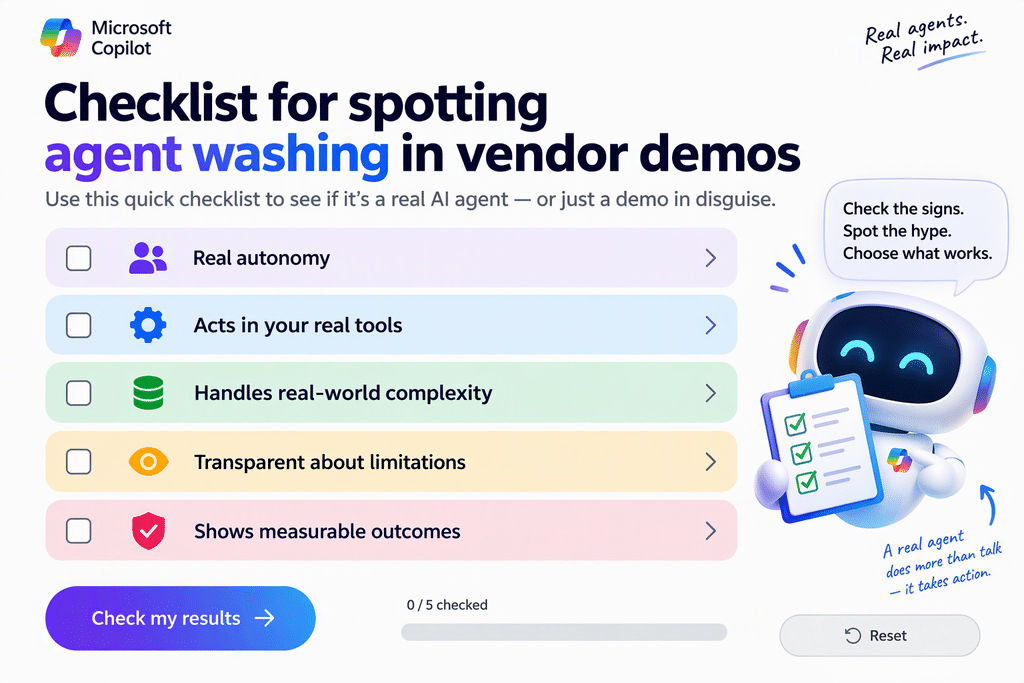
Ask for a live demo on your own data and run the seven tests below. As a rule of thumb, a real Rung 4 agent should pass at least six, and every result goes in a scorecard procurement can compare across vendors.
- Live workflow, not a recording. Run a real process end to end in a sandbox with your sample data.
- Unexpected input. Change a field, add a malformed record, or alter the request mid-run, and see whether it adapts or breaks.
- Failure handling. Force an error such as an API timeout or a missing record, and ask to see retries, rollbacks, and the final state.
- Audit logs. Ask for a step-by-step trace of decisions and tool calls that you can export, whether through the vendor’s console or an observability tool such as Langfuse or LangSmith.
- Escalation path. Trigger a handoff and check who is notified, what context they get, and how long it takes.
- Autonomy boundaries. Ask what the agent may do without approval, including permission scopes and spend limits.
- Reference clients. Speak to two clients running a similar workflow in production for six months or more, and ask for escalation and error rates.
A vendor that declines tests 1 to 3 is the clearest red flag. Reluctance to show failures usually means failures are frequent.
What Is the Difference Between BPO and APO?
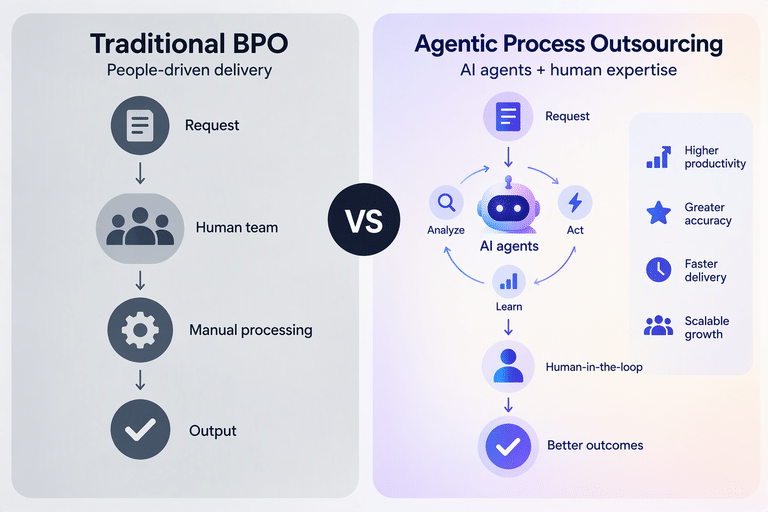
BPO uses human teams priced by headcount or transaction, while APO uses AI agents supervised by a small human team and priced by execution or outcome. APO has no single industry-standard definition yet, so confirm what each provider means.
| Dimension | Traditional BPO | APO (agentic process outsourcing) |
|---|---|---|
| Staffing | Human agents in seats; headcount scales with volume | AI agents run defined processes; a small team supervises and handles exceptions |
| Pricing | Per FTE, per hour, or per transaction | Per execution or per outcome, or platform fee plus usage |
| SLAs | Speed, accuracy, and quality scores | Resolution rate, escalation rate, error rate, and uptime |
| Risk | Turnover, quality drift, labor cost | Wrong autonomous actions, data exposure, lock-in, unclear accountability |
The pricing shift is real but gradual. HFS Research expects FTE-based commercial models to fall from 42% to 28% of deals over three years, with outcome-based and shared-revenue models rising from 20% to 39%, as reported by Analytics India Magazine in October 2026 [VERIFY against the HFS original]. Everest Group notes that execution-based pricing suits repeatable workflows with stable SLAs, such as password resets and invoice processing, and often needs complexity tiers to stay fair.
HFS also argues that outcome-based AI contracts don’t remove delivery risk, they redistribute it, so read the liability terms closely.
Which Six Questions Should You Ask a Provider Claiming APO?
Ask these six questions in writing before any pilot, and require numbers rather than adjectives in the answers. A credible provider can answer each in under a page with evidence.
- Which steps does the agent decide on its own, and which follow fixed rules?
- What share of tasks completes with no human touch today, measured how and over what period?
- How are errors and wrong actions detected, and who bears the cost?
- What do the SLAs measure, and what credits or penalties apply when they’re missed?
- Who owns the logs, prompts, workflows, and configurations if we leave?
- Which models and subprocessors handle our data, and which certifications back this up, such as SOC 2 Type II, ISO 27001, or ISO/IEC 42001?
How to Run an Agent Washing Check: Pilot Charter Template
Run a 6 to 8 week paid pilot on one process with a written charter, using the template below. Set the go/no-go date before the pilot starts so momentum doesn’t carry a weak vendor into a long contract.
| Field | What to define | Example |
|---|---|---|
| Scope | One process, one volume band | Invoice exception handling, 500 cases a month |
| Rung required | Minimum rung demonstrated | Rung 4, shown in a live test |
| Success metrics | Autonomous completion, error, and escalation rates, cost per case | Targets agreed before day one |
| Budget cap | Fixed pilot fee and a usage ceiling | Cap in writing, no overage without approval |
| Terms | Data ownership, audit rights, log access, exit | Logs exportable weekly |
| Check-ins | Weekly review of the exception log | Same attendees each week |
| Decision date | Go/no-go checkpoint | End of week 6 or 8 |
FAQ
How much does APO cost compared with traditional BPO?
It varies widely by process and volume, and pricing is often per execution or outcome rather than per seat. PwC reports one technology client cut 20% of its policy-review BPO spend in year one, with a goal of 70% by year three, but that is a single case, not a benchmark.
How long does it take to pilot and implement an AI-agent or APO engagement?
A single-process pilot typically takes 6 to 8 weeks, and a production rollout across several processes commonly takes 3 to 6 months. Integration with your systems and exception design usually take longer than the agent configuration.
What checks should I run before outsourcing to an AI-agent provider?
Run the seven-point demo, ask the six APO questions, and check certifications and reference clients. Put audit rights, log ownership, and exit terms in the contract before data is shared.
Can a real AI agent run without human oversight?
Rarely, and for high-impact actions it shouldn’t. Most production deployments keep humans in the loop for exceptions and approvals, so judge a vendor by how well it escalates, not by a claim of full autonomy.
Don’t Buy the Label: Find Verified Providers With MyB2BNetwork
Agent washing is easier to avoid when you compare providers side by side with the same scorecard. MyB2BNetwork helps CTOs, procurement heads, and operations leaders find vetted outsourcing partners, compare quotes, and shortlist vendors that can show evidence instead of slides.
Start with our guide on how to protect your IP when outsourcing, use our vendor response time benchmarks to test provider responsiveness before you sign, and browse vetted outsourcing partners to request matched quotations.
How to Hire, Source, or Outsource AI Agents and APO in the U.S.
Budget: a paid pilot commonly runs about $15,000 to $60,000, and production APO often lands between $5,000 and $30,000 or more per month depending on volume [VERIFY with quotes; these are planning ranges, not benchmarks]. MyB2BNetwork can provide accurate quotations for your scope.
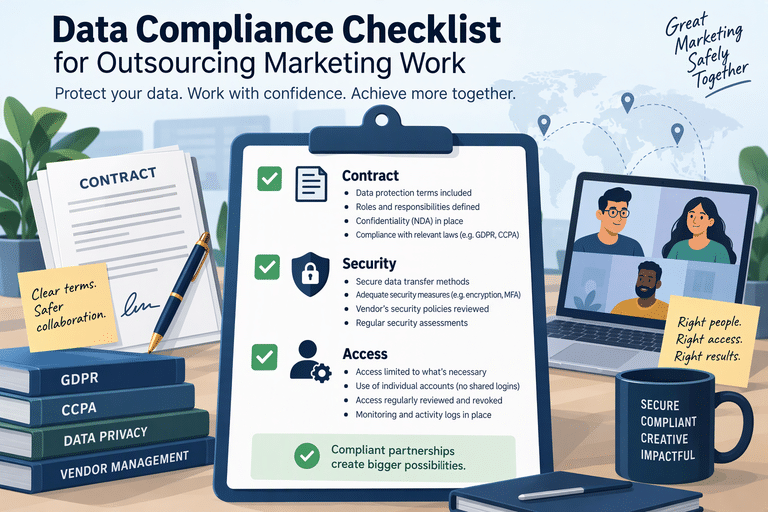
Pre-engagement checks: review a live demo, two production references, SLA definitions, log ownership, and liability terms. Ask for SOC 2 Type II or ISO 27001, and consider ISO/IEC 42001 for AI management. Fintech teams in New York and healthcare operations in Chicago should add HIPAA or PCI requirements, and any firm handling California residents’ data should confirm CCPA handling. The FTC also polices deceptive AI claims, so keep vendor promises in writing. If the vendor processes data offshore, add GDPR or UK GDPR review.
Red flags: no live demo, no failure examples, vague autonomy claims, and no log access.