Contract lifecycle management automation has moved from “nice-to-have legal tech” to a mainstream category almost every enterprise procurement and legal team has evaluated at least once. AI-powered contract review, redlining, and renewal tracking are no longer experimental — they’re standard features on most modern CLM platforms. And yet SMB adoption still lags well behind enterprise adoption, for reasons that have more to do with unclear ROI math than with the technology itself.
That gap is worth taking seriously, because the cost of staying manual is not zero — it’s just invisible. World Commerce & Contracting’s long-running research puts average contract value leakage at 9.2% of contract value from poor post-signature management. With a 2023 update (conducted with Deloitte, drawing on data from more than 1,200 organizations) showing a modest improvement to 8.6%. With top performers losing as little as 3% and the worst performers losing more than 20%. That’s not a rounding error on a company’s contract book — it’s a direct. Ongoing revenue drain that most finance teams have never actually quantified.
At the same time, the AI layer inside CLM tools has gotten genuinely useful rather than gimmicky. KPMG’s analysis found AI-assisted review cutting standard NDA and terms review time from 45 minutes down to 15. A 67% reduction — with some full-contract review workflows seeing time cuts of up to 98%. That’s the trade legal ops, procurement, and founders are actually weighing in 2026: a real. Quantifiable time saving against a real subscription cost, not a hypothetical “efficiency gain.”
This piece walks through what contract lifecycle management automation actually is, why the SMB adoption gap persists. How to compare your options honestly, and a straightforward ROI formula you can run before committing budget to any CLM tool.
What Is Contract Lifecycle Management Automation?
Contract lifecycle management automation is the use of software — increasingly AI-powered. To handle contract creation, review, negotiation, e-signature, obligation tracking, and renewal without manual tracking in spreadsheets or shared drives. It spans the full contract lifecycle: drafting from templates, clause and risk analysis, redlining, approval workflows, signature, and post-signature obligation and renewal management.
The “automation” part specifically refers to what used to require a person’s attention at every stage now happening on a schedule or trigger. A renewal alert firing automatically 90 days out, an AI flag on a non-standard liability clause. A redline suggestion generated before a lawyer even opens the document. It doesn’t remove human judgment from contracting; it removes human effort from the parts of contracting that don’t require judgment.
Why Does Contract Lifecycle Management Automation Matter for Businesses?
It matters because contracts are one of the few places where operational inefficiency and financial loss are the same problem. A missed renewal deadline, an unflagged liability clause, or a forgotten volume-discount trigger doesn’t just cost time to fix. It directly reduces the value a company is capturing from every contract it signs.
It also matters because the market has already decided this is where contracting is heading. Gartner has tracked AI-based contract management adoption climbing from under 20% of major organizations in 2021 toward roughly 60% today. And separately projects that half of procurement teams will use AI-enabled contract risk analysis and editing tools by 2027. For legal ops and procurement leaders, the question in 2026 isn’t really “will this become standard” — it’s “does it make sense for us yet.”
How Is AI Changing Contract Lifecycle Management in 2026?
AI has shifted from a marketing checkbox to a functional requirement across the CLM market. Two years ago, “has AI” was a differentiator between vendors; today, analyst evaluations from Gartner, Forrester, and IDC treat AI-based drafting, clause suggestion, risk identification, and obligation extraction as baseline expectations, not premium add-ons.
The performance gap between AI-assisted and manual contracting has also become measurable rather than theoretical. McKinsey’s research found AI-guided negotiation support delivering 10–15% in direct savings while cutting negotiation analysis time by as much as 90%. And World Commerce & Contracting’s benchmarking shows the best-performing organizations completing full contract cycles roughly four times faster than the worst-performing ones. That spread is now largely explained by which organizations have — and haven’t — automated the repetitive parts of their contract process.
Which CLM Approach Actually Fits Your Company?
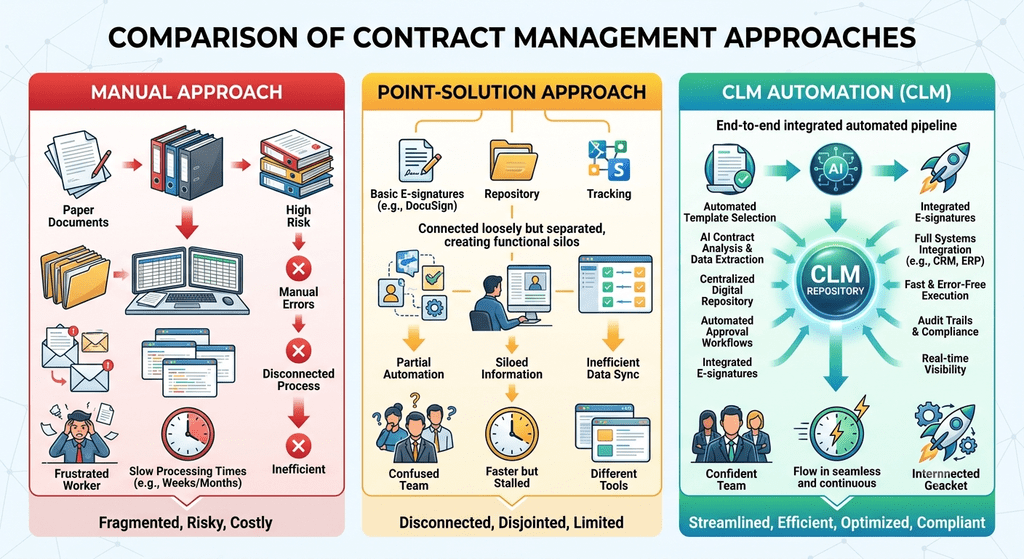
The right approach depends almost entirely on contract volume and complexity, not company size alone. Here’s how the three common tiers compare:
| Approach | Best For | Typical Cost & Time-to-Value |
|---|---|---|
| Manual / spreadsheet tracking | Very low contract volume, early-stage teams with under ~20 active contracts | No tool cost, but highest hidden labor cost, slowest renewal visibility, and the highest risk of missed deadlines |
| Point solutions (e-signature + repository, no AI review) | Growing teams that need organization and searchability but not full risk automation | Roughly $50–$500/month per user; live within days, but manual review work remains |
| Full AI-native CLM platform | Higher contract volume, recurring renewals, or compliance-heavy industries | Mid four to five figures annually for SMB-tier plans; typically 4–8 weeks to full deployment |
Most companies underestimate how quickly they move from row one to row three. The trigger is usually not headcount, but the moment renewal tracking starts happening from memory instead of a system.
What’s Actually Slowing SMB Adoption of Contract Lifecycle Management Automation?
The honest answer is budget uncertainty, not skepticism about the technology. A Legalease survey found that 66% of respondents cite budgetary constraints as a major obstacle to adopting legal technology. No doubts about whether AI-based contract review works, but uncertainty about whether the cost is justified at their contract volume.
That’s a legitimate concern, not a knowledge gap to be talked out of. A 500-contract-a-year enterprise legal team and a 15-contract-a-year startup are not weighing the same trade-off. And most CLM vendor marketing is written for the former. The fix isn’t convincing SMBs that automation is right for everyone. It’s giving them a way to run the actual numbers for their own volume before buying.
How Do You Calculate ROI Before Buying a CLM Tool?
You calculate CLM ROI by comparing what automation saves in time and recovered contract value against what it costs annually — not by taking a vendor’s efficiency claims at face value. Use this simple, named framework to run the math yourself: the Time-Value Recovery (TVR) Formula.
TVR = [(Hours saved per contract × Contracts per year × Blended hourly cost) + (Leakage % reduction × Total annual contract value)] − Annual CLM cost
To use it:
- Estimate hours saved per contract. Using KPMG’s benchmark, a 45-minute review dropping to 15 minutes saves roughly 0.5 hours per standard contract reviewed.
- Multiply by contract volume. A team processing 200 contracts a year at that saving recovers roughly 100 hours annually.
- Apply your blended hourly cost (legal or procurement staff time) to that hour figure to get a labor-savings dollar amount.
- Add recovered value leakage. If your current process resembles the ~9% average leakage WorldCC documents. Even closing that gap by 2–3 percentage points on a meaningful contract book is often worth more than the labor savings alone.
- Subtract the CLM platform’s annual cost to get your net return, and divide by that cost to express it as a percentage ROI.
Run this before every CLM purchase decision, not after — a vendor’s own ROI calculator will always favor buying; yours won’t, which is exactly why it’s the one worth trusting.
FAQ
What is contract lifecycle management automation and why does it matter for B2B businesses?
It’s the use of software to handle contract drafting, review, signature, and renewal tracking without manual spreadsheet work. And it matters because contract mismanagement causes measurable revenue loss — World Commerce & Contracting puts average value leakage at roughly 9% of contract value industry-wide.
How do I choose the right CLM vendor within my budget?
Match the tool tier to your actual contract volume rather than your company’s size or ambitions. A point solution is often the right call under a few dozen contracts a year. While an AI-native platform pays for itself faster at higher volume. Run the TVR formula above with your own numbers before comparing vendor pricing. So you’re negotiating from your own ROI threshold, not theirs.
What checks should I do before adopting a CLM automation tool?
Confirm the platform’s AI review accuracy on your actual contract types through a pilot or sandbox. Not just a vendor demo, and check integration compatibility with your existing CRM, ERP, or e-signature tools. Review data security certifications and get implementation timeline and support terms in writing before signing an annual contract.
How long does CLM implementation typically take and what does it cost?
Point solutions can go live in days; full AI-native CLM platforms typically take 4–8 weeks for template migration, workflow configuration, and team training. Budget ranges from a few hundred dollars a month for lightweight point solutions to mid four or five figures annually for a full-featured SMB-tier CLM platform.
Find the Right CLM Partner With MyB2BNetwork
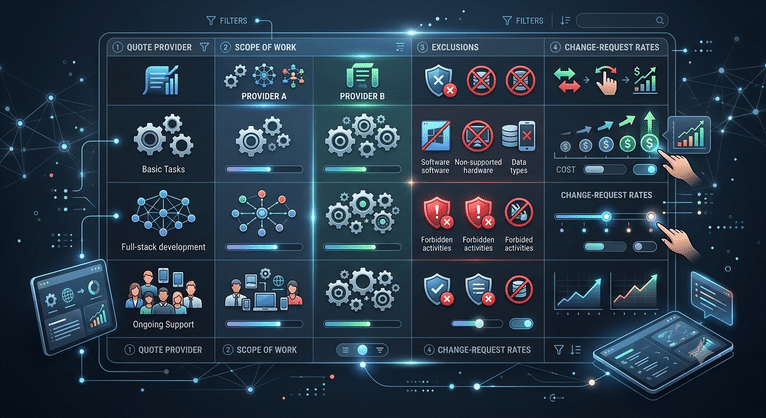
Running the ROI math is one thing; finding a CLM vendor or implementation partner that actually fits your contract volume is another. MyB2BNetwork connects legal ops, procurement, and founding teams with vetted CLM and legal-tech implementation partners, and can get you accurate, comparable quotes across vendors before you commit budget to any platform.
Browse our legal tech and CLM vendor directory to compare implementation partners, or read our related guide on protecting your IP in outsourcing contracts for how strong contract terms extend beyond CLM tooling into vendor relationships generally.
How to Hire, Source, or Outsource CLM Implementation in the U.S.
CLM adoption spans every industry with contract volume — SaaS startups in Austin managing customer MSAs, manufacturing firms in Ohio tracking supplier agreements, and fintech companies in New York navigating compliance-heavy contract terms all face the same underlying automation decision. Two things matter most before you commit.
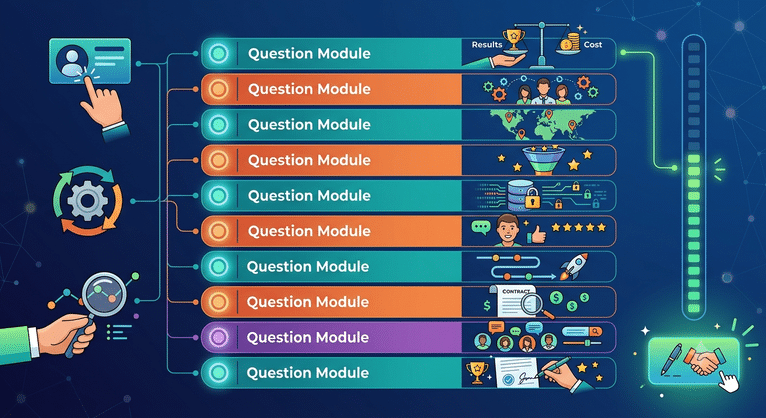
How to choose a vendor within budget. Filter first by whether you need a full AI-native platform or a lighter point solution, since that decision affects cost far more than brand recognition does. SMB-tier full CLM platforms commonly run mid four to five figures annually, while point solutions can start in the low hundreds per month — MyB2BNetwork can pull comparable quotes across vendors at either tier so you’re not negotiating blind.
Checks needed before outsourcing implementation. Ask any implementation partner for references from companies at a similar contract volume, not just enterprise logos, and confirm their security posture — SOC 2 compliance is a reasonable baseline for any vendor handling contract data, with ISO 27001 worth asking about for higher-compliance industries. If your contracts involve regulated data, confirm alignment with relevant standards such as HIPAA for healthcare-adjacent terms or CCPA/GDPR for consumer or EU-facing data. Budget 4–8 weeks for a full platform rollout, and treat the first quarter post-launch as calibration rather than final performance.