B2B Vendor response time is the gap between when a buyer raises their hand and when a human actually gets back to them. And across the B2B outsourcing industry, that gap is bigger than almost anyone selling into it wants to admit. The most cited research on the subject, a Harvard Business Review study of 2,241 U.S. companies, found an average first-response time of 42 hours. Not 42 minutes. Two full business days, on average, before a buyer who just asked for help hears anything back.
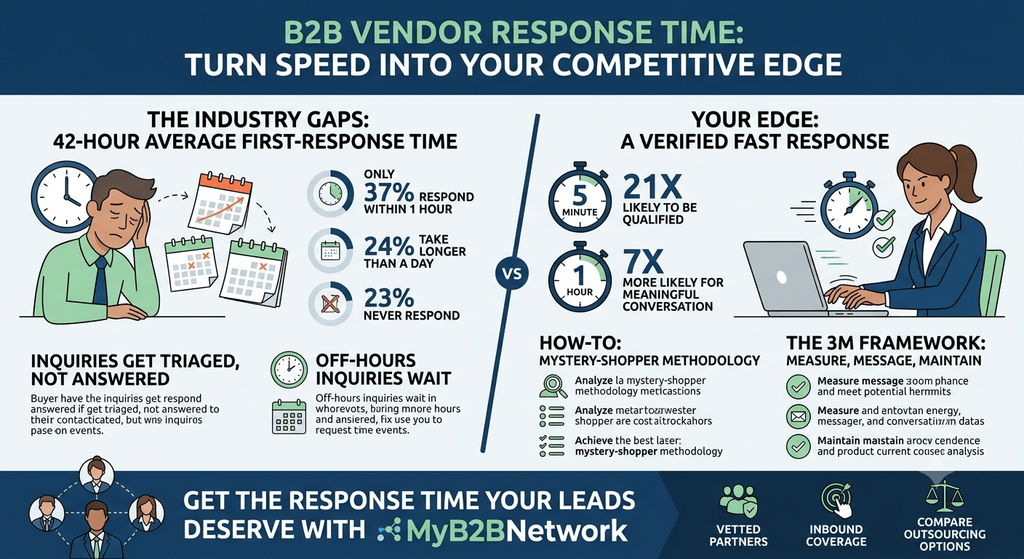
Buyers complain about slow vendor responses constantly, and the data says the complaint is earned. Only 37% of companies in that study responded within one hour. Another 16% took between one and 24 hours. 24% took longer than a full day. And 23% — nearly a quarter of the companies studied — never responded to the inbound inquiry at all.
That gap is uncomfortable for the industry and useful for you. If the typical vendor takes 42 hours and a quarter of them ghost the lead entirely. A verified fast response time isn’t a nice-to-have in your sales messaging it’s a specific, ownable. Easy-to-verify differentiator that most competitors structurally cannot match without changing how they operate.
This piece walks through what the response-time research actually shows, why it hasn’t improved much in over a decade. And how sales leaders, founders, and CMOs can turn a real, measured number into a competitive edge instead of a vague claim.
What Is B2B Vendor Response Time?
Vendor response time is the elapsed time between a buyer submitting an inbound inquiry a form fill, a quote request, a chat message, an inbound call and receiving a first substantive reply from a human at that company. It excludes automated acknowledgments like “we got your message,” which buyers correctly recognize as not being an answer.
The metric matters because it’s one of the few sales-related numbers a prospect can test themselves in real time. Simply by filling out your form and watching the clock.
Why Vendor Response Time Matters for B2B Businesses
Response time functions as a proxy for something buyers actually care about but can’t directly observe before signing: how this vendor will treat them once they’re an account instead of a prospect. A vendor that takes two days to answer a pre-sale inquiry is quietly telling a buyer what post-sale support will feel like.
It also has a measurable effect on whether a deal happens at all. Research from the Lead Response Management Study found that contacting a lead within five minutes made it roughly 21 times more likely to be qualified than contacting them after 30 minutes. And that responding within an hour made a meaningful conversation with a decision-maker about seven times more likely than responding after two hours. Speed isn’t just a courtesy — it’s correlated directly with whether the deal survives long enough to be worked.
Why the Industry Still Responds So Slowly
The 42-hour average isn’t a motivation problem; it’s a structural one. And it shows up the same way across most outsourcing vendors.
- Inquiries get triaged, not answered. A form submission lands in a shared inbox, competes with dozens of other messages. And waits for someone to notice it rather than being routed to an available person immediately.
- Routing adds hops. The inquiry moves from a general inbox to marketing, from marketing to sales, from sales to whichever rep is assigned. And each handoff adds hours before anyone actually replies.
- Off-hours inquiries wait until Monday. A large share of inbound interest arrives outside business hours. And most vendors have no one monitoring the queue overnight or on weekends. So those leads sit untouched for a full business day or more.
- “We’ll get back to you” gets treated as a response. Live chat and contact forms that auto-acknowledge a message create the appearance of responsiveness without producing an actual answer, which is functionally the same as silence from the buyer’s perspective.
None of these are hard problems to fix. They’re just problems most vendors have never measured closely enough to notice.
How to Measure Your Own B2B Vendor Response Time (Mystery-Shopper Method)
A secondhand statistic proves the industry has a problem. A number you measured yourself proves you don’t. Here’s a mystery-shopper methodology that produces a real, defensible figure:
- Define your competitive set. Choose 20–40 vendors serving your buyer segment. Spanning a mix of company sizes so the result isn’t skewed toward either enterprise slowness or boutique speed.
- Submit identical inquiries. Use each vendor’s own inbound channel — contact form, quote request, chat, or phone line. With a consistent buyer persona and message, submitted at varied times and days.
- Time every touchpoint separately. Log the timestamp of submission, the timestamp of any automated acknowledgment. And the timestamp of the first substantive human reply — these are three different numbers, not one.
- Run it across a full week. Response behavior shifts by day and time of day; a single test gives you an anecdote, a week of tests gives you a median.
- Report the median, not the average. A handful of vendors that never respond at all will distort a mean; the median holds up against outliers.
- Repeat quarterly. One study is a data point. A recurring one becomes a trend line you can put a date on and defend.
Run the identical test on your own team at the same time. That paired comparison — your real number next to a real industry number — is the entire pitch.
The 3M Response Framework: Measure, Message, Maintain
Turning a fast response time into an actual sales advantage takes more than being quick once. A simple framework keeps it consistent:
- Measure — Track first-response time as a formal internal metric, reported the same way you’d report pipeline or close rate, not as an informal impression.
- Message — Put the real number where buyers can verify it: on your website, in your first reply email. And directly in competitive conversations, positioned against the documented 42-hour industry average.
- Maintain — Hold the number as an internal SLA your team is measured against. Because a public response-time claim that slips from a real differentiator into a broken promise does more damage than never having made the claim at all.
FAQ
What is vendor response time and why does it matter for B2B businesses?
Vendor response time is how long it takes a company to give a real, human reply to an inbound inquiry. And it matters because it’s one of the few claims a buyer can personally verify before signing a contract. Research shows contacting a lead within five minutes makes it roughly 21 times more likely to be qualified than waiting 30 minutes, so speed directly affects whether a deal happens.
How do I choose the right outsourced sales or lead-response vendor within my budget?
Start by deciding whether you need full inbound coverage, after-hours-only support. Or a lightweight lead-routing tool, since scope drives most of the cost difference. Then compare vendors on their own documented response-time SLA, not just their promised feature list, since a vendor that can’t state their number is unlikely to be fast.
What checks should I do before outsourcing inbound lead response?
Test the vendor’s actual response time yourself before signing, the same way you’d mystery-shop a competitor, and ask for their internal SLA and how it’s monitored. Confirm handoff procedures for after-hours inquiries and get response-time commitments written into the contract rather than left as a verbal assurance.
How long does outsourcing lead response typically take to set up, and what does it cost?
Most inbound-response outsourcing programs take 2–6 weeks to implement, covering routing setup, after-hours coverage, and integration with your CRM. Costs commonly range from the low four figures per month for after-hours-only coverage to the low five figures monthly for full-coverage, multichannel response teams.
Turn Your Response Time Into a Competitive Edge With MyB2BNetwork
A fast, verified response time only works as a differentiator if it’s real and consistent — which is exactly where most internal teams run out of bandwidth after hours or on weekends. MyB2BNetwork connects sales leaders, founders, and CMOs with vetted outsourcing partners who specialize in inbound lead coverage, so the 42-hour industry average never becomes your number.
Compare vetted response-focused partners in our B2B outsourcing marketplace, or read our related piece on why cold outreach still works when it’s built on relevance and timing to see how the same speed-and-relevance principles apply on the outbound side of your pipeline.
How to Hire or Outsource Fast Inbound Lead Response in the U.S.
SaaS startups in Austin, fintech firms in New York, and B2B services companies in San Francisco increasingly outsource after-hours and overflow lead response rather than staffing a 24/7 internal team. Two things matter most before signing a contract.
How to choose a vendor within budget. Filter first by coverage model — after-hours-only, overflow during business hours, or full first-response coverage — since that decision affects cost more than any other factor. After-hours-only coverage typically starts in the low four figures per month; full multichannel first-response coverage more commonly runs mid-four to low-five figures monthly. Prioritize vendors who can show you their own measured response-time data over ones who only describe their process.
Checks needed before outsourcing. Mystery-shop the vendor yourself using the methodology above before signing anything — if they can’t respond quickly to you as a prospect, they won’t respond quickly to your leads either. Confirm how they handle contact data under FTC guidelines and, if you sell into healthcare or financial services, ask how they handle HIPAA- or CCPA-relevant lead information. Get a specific response-time SLA, escalation procedure, and reporting cadence written into the contract, and treat the first month as a baseline to verify against, not a final verdict.