An IT director puts out an RFP for “outsourced IT support” and gets back two wildly different kinds of proposals: one from a firm offering a fixed-scope project with a delivery date, and one from a firm offering 24/7 monitoring, a dedicated help desk, and a service-level agreement that never technically ends. Both vendors called themselves “outsourcing partners.” Only one of them is actually an Managed Service Provider.
That mismatch is common, and it’s expensive when it isn’t caught early. Buyers who expect ongoing operational ownership from a vendor that only signed up for a defined project end up with gaps nobody’s contractually responsible for. Buyers who expect a fixed, one-time deliverable from an MSP end up paying for continuity they didn’t need.
This piece answers the question directly, in the order most ops and IT leaders actually ask it: what an MSP is, how it differs from general outsourcing, why the distinction affects lead quality and vendor selection, and a simple three-point checklist for deciding which model actually fits your situation.
What Is a Managed Service Provider (MSP)?
A managed service provider is a vendor that takes ongoing operational responsibility for a defined set of IT or business functions network monitoring, help desk support, cybersecurity operations, cloud infrastructure under a formal service-level agreement (SLA) that specifies uptime, response times, and performance standards. The relationship doesn’t end at project delivery; it continues as long as the contract runs, typically renewed annually or multi-year.
The defining feature isn’t the type of work — it’s the accountability structure. An MSP is on the hook for outcomes (uptime, resolution time. Security posture) on a continuous basis, not just for completing a scoped task.
What Is Outsourcing, and How Is It Different From an managed service provider?
Outsourcing, in the general sense, is contracting any external party to perform work a company would otherwise do internally. And it can be structured as a one-time project, a fixed-term engagement, or an ongoing arrangement. An MSP is technically a form of outsourcing, but not all outsourcing is an MSP relationship.
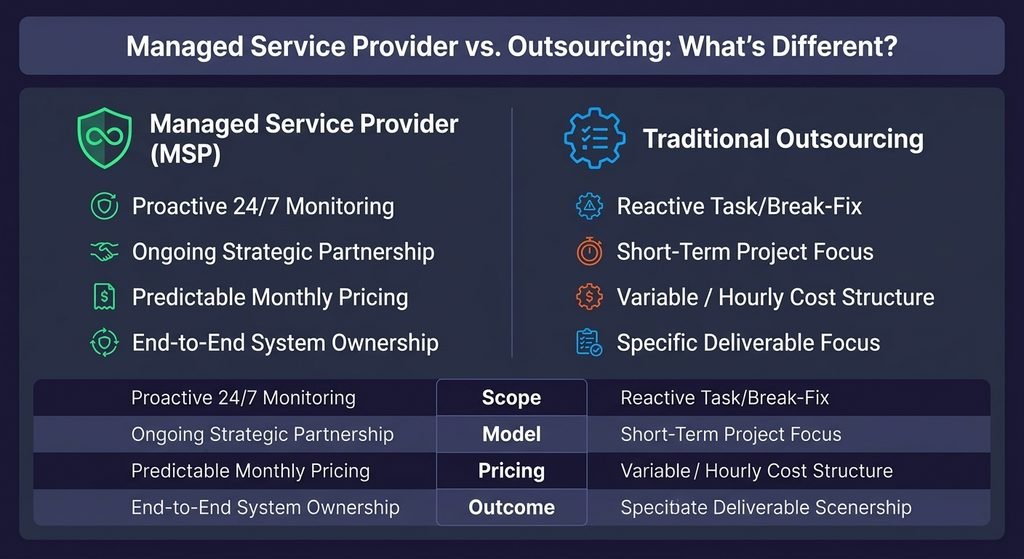
The practical difference comes down to three things:
- Duration — Project-based outsourcing has a defined end date; MSP engagements are structured to continue indefinitely under renewal terms.
- Accountability — Outsourcing typically holds a vendor accountable for delivering a specific output; MSPs are held accountable for maintaining an ongoing operational standard, measured by SLA metrics.
- Scope flexibility — A one-off outsourced project has a fixed scope defined upfront. An MSP relationship is built to flex as the client’s operational needs shift month to month.
A company hiring a firm to migrate its email system to a new platform is outsourcing a project. A company hiring a firm to monitor, patch, and support that same email system indefinitely is engaging an MSP.
Why Does This Distinction Matter for Businesses?
It matters because conflating the two leads directly to mismatched expectations. And mismatched expectations are one of the most common reasons vendor relationships fail in the first year. A buyer who thinks they’ve hired an MSP but actually signed a project-based contract may discover. Only after an outage, that nobody is contractually obligated to respond within a guaranteed window.
It also matters for lead quality on the vendor side. IDC’s research on managed services has consistently shown that buyers searching for ongoing operational support convert differently than buyers searching for one-time project help they have different budget structures, different procurement timelines, and different decision-makers involved. Vendors and marketplaces that blur the two terms attract inquiries that don’t match what they actually offer, which wastes sales cycles on both sides.
A few concrete consequences of getting this wrong:
- Coverage gaps — assuming SLA-backed responsiveness from a vendor who only committed to a fixed deliverable
- Budget mismatch — comparing a project quote against an MSP retainer quote as if they’re the same type of spend
- Procurement delay — RFPs written without specifying which model is wanted tend to draw incomparable proposals, extending the evaluation cycle
How Do MSPs Structure Accountability Through SLAs?
Direct answer: MSPs formalize accountability through service-level agreements that define specific, measurable performance standards — not general promises of good service.
A typical MSP SLA specifies things like guaranteed uptime percentages, maximum response times by issue severity, resolution time targets. And financial penalties or credits if those standards aren’t met. This is what separates an MSP from a general IT vendor: the commitment is written into a contract as a measurable obligation, not just implied by the sales relationship.
Frameworks like ISO/IEC 20000 (IT service management) and ITIL give MSPs a structured way to define and report on these commitments. Which is part of why buyers evaluating MSP vendors often ask whether the provider operates against a recognized service management framework rather than an internally invented one.
Which Business Functions Typically Use MSPs vs. Project-Based Outsourcing?
Direct answer: functions that require continuous monitoring or availability tend toward MSP arrangements. While functions with a clear start and finish tend toward project-based outsourcing.
Commonly managed under an MSP model:
- Network and infrastructure monitoring
- Help desk and end-user IT support
- Cybersecurity operations and threat monitoring
- Backup and disaster recovery management
- Cloud infrastructure management
Commonly handled as project-based outsourcing:
- A one-time system migration or platform implementation
- A defined software development project with a delivery date
- A one-time security audit or compliance assessment
- A website redesign or one-off marketing campaign build
Some functions genuinely sit in between — cloud cost optimization, for instance. Can be a one-time project or an ongoing managed function depending on how a company structures the engagement.
Which Model Fits Your Need — Ongoing or One-Time?
Direct answer: the right model depends on whether the underlying need is continuous or has a natural end point, which is exactly what a simple three-point check can clarify before you write an RFP.
Rather than guessing based on vendor pitches, it helps to run the decision through what we’ll call the Ownership Test — three questions that separate an MSP need from a project-based outsourcing need:
- Does the function need to run every day, indefinitely, or does it have a natural finish line? Ongoing monitoring points to MSP; a defined migration or build points to project outsourcing.
- Do you need a contractually guaranteed response standard, or just a completed deliverable? If uptime and response time matter continuously, that’s an SLA-backed MSP relationship, not a project contract.
- Will the scope of work stay roughly fixed, or will it shift as your operational needs change month to month? Fixed scope favors a project engagement; evolving, reactive scope favors an MSP retainer.
Answering “ongoing” to two or more of these is a strong signal you’re shopping for an MSP. Not a project vendor — and writing that into the RFP upfront saves both sides a mismatched sales cycle.
FAQ
What is a managed service provider and why does the distinction from outsourcing matter for B2B businesses?
An MSP is a vendor that takes ongoing, SLA-backed responsibility for a business function. While outsourcing more broadly can include one-time or fixed-scope work. The distinction matters because it directly affects budget structure, contract terms, and whether anyone is contractually accountable when something breaks between scheduled deliverables.
How do I choose the right MSP or outsourcing vendor within my budget?
Start by determining whether your need is ongoing or one-time using the Ownership Test above. Since that determines whether you should even be comparing MSP retainer pricing against project-based quotes. Then prioritize vendors who can show SLA performance history (for MSPs) or delivery track record on comparable projects (for one-off outsourcing).
What checks should I do before outsourcing to an MSP or project-based vendor?
For MSPs, review actual SLA performance data from existing clients, not just the SLA terms on paper, and confirm what financial remedies apply if standards are missed. For project-based outsourcing, check references specifically on whether past projects were delivered on the agreed timeline and scope, since that’s the risk that matters most in a fixed-term engagement.
How long does it typically take to bring on an MSP or outsourcing partner, and what does it cost?
Onboarding an MSP for core IT functions typically takes four to eight weeks to fully transition monitoring and support, while a defined project engagement’s timeline depends entirely on project scope. Costs vary widely by function and company size, so a scoped quote matters more than a general benchmark either way.
Not Sure Which Model You Actually Need?
Writing an RFP without first deciding between an MSP and a project-based vendor is one of the most common reasons companies get proposals they can’t compare apples to apples. MyB2BNetwork connects ops and IT leaders with vetted MSPs and project-based outsourcing partners, and can help clarify which model fits before you’re deep into vendor calls. Compare MSP and outsourcing partners on MyB2BNetwork.
Hiring or Outsourcing to an MSP in the U.S.
Two things matter most when a U.S. company brings on an MSP versus a project-based outsourcing vendor: matching contract type to budget cycle and verifying SLA performance, not just SLA terms.
On budget, project-based outsourcing is typically quoted as a one-time fee scaled to scope, while MSP retainers commonly run in the low-to-mid five figures monthly for small-to-midsize companies, scaling into the mid-five-figures to low-six-figures annually for larger IT footprints. MyB2BNetwork can help source accurate, vetted quotations for either model rather than relying on a vendor’s standard rate card.
On due diligence, ask any MSP candidate for SOC 2 or ISO 27001 certification relevant to how they’ll access your systems and data, and confirm HIPAA alignment specifically if healthcare data is in scope. This applies whether you’re a healthcare provider in Chicago, a fintech company in New York, a manufacturer in Ohio, or a SaaS company in Austin — the compliance and SLA scrutiny should scale with how critical the managed function is to daily operations.