A prospect lands on a pricing page, scrolls for four seconds, and leaves. In that window, they weren’t reading your copy line by line — they were scanning for proof that you’re real, secure, and worth the risk of a first conversation. That scan is where B2B trust signals either earn a second look or lose the visitor for good.
Most marketing teams treat trust signals as decoration: a row of logos here, a badge in the footer there. But CRO data tells a different story. Buyers are making fast, subconscious credibility judgments before they ever read a value proposition, and the signals that pass that test are surprisingly specific — not every badge or review widget carries equal weight.
This matters more in B2B than almost anywhere else, because the purchase itself is high-stakes and rarely made by one person. A security badge that reassures a procurement lead can be invisible to the marketing manager evaluating the same page for brand fit. Getting trust signals right means understanding which ones move which buyer, not just adding more of them.
This piece breaks down what trust signals actually are, why they influence conversion more than most teams assume, which types perform best in B2B contexts, and how to run a fast audit of your own site to see what’s missing.
What Are B2B Trust Signals?
B2B trust signals are the visual and content elements on a website — reviews, certifications, security badges, client logos, case study proof points — that let a visitor judge credibility without needing a sales conversation to confirm it. They work because buyers default to skepticism, and a credible third-party marker shortcuts that skepticism faster than brand copy can.
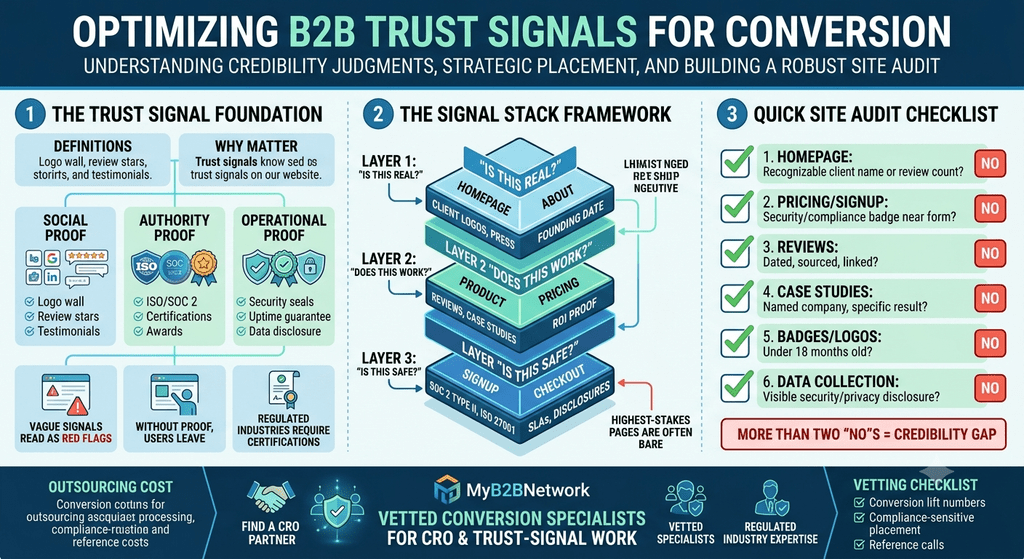
Not all signals carry the same weight. Signals fall into three broad categories:
- Social proof — reviews, testimonials, client logos, case study results
- Authority proof — industry certifications, compliance badges, analyst mentions, awards
- Operational proof — security seals, uptime guarantees, SLAs, data-handling disclosures
The strongest pages combine at least one signal from each category, placed where the buyer is actually making a decision — not buried in a footer they’ll never scroll to.
Why Trust Signals Matter for Conversion
Trust signals matter because B2B buying committees research extensively before ever contacting sales, and a missing or vague signal is often read as a red flag rather than a neutral gap. Buyer research from Gartner has consistently found that B2B purchasers spend the bulk of their buying journey on independent research and peer validation rather than direct interaction with a vendor’s sales team, which means the website has to do the convincing that a salesperson used to do in person.
A few consequences follow from that shift:
- Pages without visible proof see higher bounce rates at exactly the moments (pricing, demo request, checkout) where conversion is decided.
- Reviews influence B2B buyers similarly to how they influence consumers — a near-empty review profile reads as a risk signal, not a neutral one.
- Compliance and security badges matter disproportionately in regulated or IT-adjacent categories, where a missing SOC 2 or ISO certification can quietly disqualify a vendor from consideration.
Which Signals Actually Move the Decision
Direct answer: reviews with specific, attributed detail and recognized compliance badges tend to move B2B decisions more than generic awards or vague “trusted by” claims. Buyers have learned to discount signals that feel self-awarded.
What tends to perform:
- Third-party review platforms (G2, Capterra, TrustRadius) carry more weight than on-site testimonials alone, because the review process is independently verified rather than curated by the vendor.
- Named, specific case studies (“cut onboarding time by 40% for a 200-person logistics firm”) outperform generic client logo walls, because they give the buyer a comparable scenario, not just a name.
- Security and compliance badges (SOC 2 Type II, ISO 27001) matter most on pages tied to data handling — pricing, signup, and integration pages — not the homepage.
- Recency matters — a testimonial or badge dated three years ago reads as stale; buyers notice when “as seen in” logos link to nothing current.
What tends to underperform: unverifiable superlatives (“industry-leading,” “#1 rated”) with no source attached, and badges placed so far down the page that high-intent visitors never scroll to see them.
A Framework for Prioritizing Signal Placement: The Signal Stack
Rather than adding trust signals everywhere at once, it helps to map them against where a buyer actually is in the decision. We’ll call this the Signal Stack — three layers, each answering a different buyer question:
- Layer 1 — “Is this real?” (homepage, about page): client logos, founding date, team credibility, press mentions.
- Layer 2 — “Does this work?” (product and pricing pages): reviews, case studies, ROI proof points, comparison content.
- Layer 3 — “Is this safe?” (signup, checkout, integration pages): security badges, compliance certifications, data-handling disclosures, SLAs.
Most conversion loss happens when a Layer 3 question goes unanswered on a page where the buyer is about to commit — teams often put all their trust content in Layer 1 and leave the highest-stakes pages bare.
A Quick Site Audit Checklist for Trust-Signal Placement
Direct answer: a fast trust-signal audit checks whether each page answers the buyer question appropriate to that stage, not whether trust content exists somewhere on the site. Run through this on your five highest-traffic pages:
- Does the homepage show at least one recognizable client name or review count within the first screen?
- Does the pricing or signup page display a security or compliance badge near the form, not just in the footer?
- Are review counts and ratings dated, sourced, and linked to the original platform (G2, Trustpilot, etc.)?
- Do case studies include a named company and a specific, attributable result rather than a vague outcome?
- Are any badges, awards, or “as seen in” logos more than 18 months old without a refresh plan?
- Is there a visible security or privacy disclosure on any page that collects data?
If more than two of these come back “no,” that page is likely losing conversions to a credibility gap rather than a copy or design problem.
FAQ
What are B2B trust signals and why do they matter for B2B businesses?
They’re the reviews, certifications, and proof points that let a buyer judge credibility without a sales call. They matter because most of the B2B buying journey happens through independent research, so the website has to carry the trust-building work sales used to do directly.
How do I choose the right vendor for trust-signal and CRO work within my budget?
Prioritize a vendor who can show before-and-after conversion data from comparable B2B sites, not just design portfolios, and match the engagement size to scope — a single-page audit needs far less budget than an ongoing CRO program.
What checks should I do before outsourcing this kind of work?
Ask for case studies with named clients and measurable lift, confirm they understand compliance-sensitive placement (security badges, data disclosures) for your industry, and clarify who owns implementation versus recommendations only.
How long does trust-signal or CRO outsourcing typically take, and what does it cost?
A focused audit and placement fix can run two to four weeks, while a full CRO program including testing typically runs three to six months, with cost scaling from a few thousand dollars for an audit to a recurring monthly retainer for ongoing optimization.
Want a Second Set of Eyes on Your Site?
Knowing which trust signals to use is only half the job — placement and testing are where most teams leave conversions on the table. MyB2BNetwork connects marketing and CRO teams with vetted conversion specialists who’ve done this work across regulated and high-consideration B2B categories. Find a vetted CRO partner on MyB2BNetwork.
Hiring or Outsourcing Trust-Signal and CRO Work in the U.S.
The two questions U.S. marketing teams ask most often are what this should cost and how to vet a vendor before handing over the site.
On cost, a standalone trust-signal audit with placement recommendations typically runs $2,500–$6,000, while an ongoing CRO retainer that includes testing and iteration usually falls in the $5,000–$15,000 per month range depending on traffic volume and page count. MyB2BNetwork can help source accurate, comparative quotations rather than relying on a single vendor’s rate card.
On vetting, ask for a portfolio that includes conversion lift numbers, not just visual redesigns, and check whether the vendor has handled compliance-sensitive placement before — this matters most for fintech companies in New York, healthcare providers in Chicago, or SaaS companies in Austin, where a missing HIPAA or SOC 2 disclosure can cost a deal outright. A short reference call with a past client, asking specifically what broke or underperformed, is usually more revealing than the case study itself.