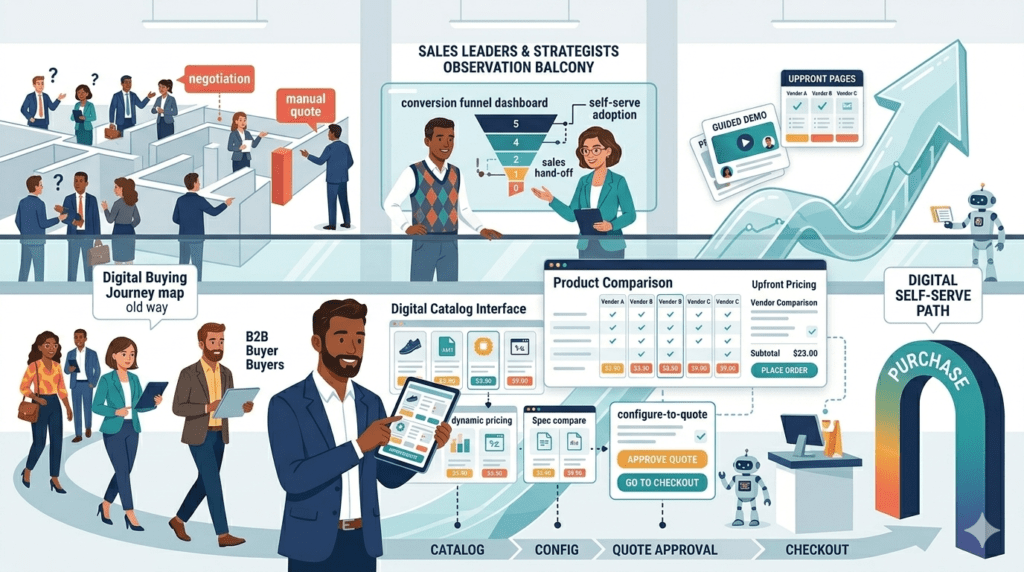
Self-serve buyers are not making sales teams irrelevant, but they are changing what sales teams must do to stay valuable. As Forrester notes, digital buying and self-service now shape every stage of the B2B journey, while sellers still matter when buyers need guidance, reassurance, or complex deal support.
That shift is important because many buyers now build shortlists, compare options, and make early decisions before they ever speak with a rep. Forrester’s 2026 predictions also show that digital self-serve channels are becoming a default path for large purchases. If sales teams wait until buyers ask for help, they may arrive too late to shape the deal.
The real opportunity is not to fight self-serve buying. It is to build content, tools, and processes that help buyers move confidently on their own, then let sales step in where human expertise adds value.
What Is Self-Serve Buying?
Self-serve buying is when B2B buyers research, compare, configure, quote, and sometimes purchase with minimal direct interaction from sales. It spans early discovery through later-stage evaluation and even repeat ordering in some categories.
This model is now common because buyers want speed, autonomy, and access to information on their own schedule. Forrester says self-service activity is rising across lifecycle stages, product types, and channels, which means digital buying is no longer limited to low-cost or simple purchases.
Core self-serve elements
- Product pages and comparison content.
- Pricing, configurators, and quote tools.
- Demos, webinars, and guided trials.
- Knowledge bases and support portals.
Why Self-Serve Buying Matters for Businesses
Self-serve buying matters because it changes where influence happens. Buyers often decide what they think before sales ever gets a chance to speak, so marketing now plays a bigger role in shaping the buying journey.
That does not eliminate the sales function. It changes it. Sales becomes more consultative, more strategic, and more focused on complex opportunities rather than repetitive information delivery.
The business risk is friction. If your website, product pages, or quote flows are weak, buyers may leave before a rep ever knows they were there. Forrester notes that companies need better buying tools, stronger visibility into digital signals, and hybrid selling models to keep pace.
How Self-Serve Buying Changes Sales
Self-serve buying changes sales by shifting reps from gatekeepers to guides. Sales teams that once controlled information now need to support informed buyers who already have a shortlist and clear expectations.
That means the sales process becomes shorter in some cases and more technical in others. Reps spend less time repeating basic product information and more time on fit, risk, negotiation, and stakeholder alignment.
Sales process changes
- Buyers arrive later but with more intent.
- Sales conversations become more specific.
- Qualification must happen faster.
- Product knowledge and commercial clarity matter more.
- Follow-up must align with the buyer’s digital journey.
Which Content Helps Before Sales Enters?
Content helps before sales enters when it answers the buyer’s questions clearly and reduces uncertainty. Forrester recommends refreshed self-service tools such as pre-recorded webinars, guided demos, on-demand configurators, and online resources that help buyers complete tasks independently.
The best content is not just educational. It is decision-support content. Buyers want proof, comparison, and confidence, not generic top-of-funnel messaging.
High-value pre-sales assets
- Product comparison pages.
- Pricing and packaging explainers.
- Demo videos and guided walkthroughs.
- ROI calculators and business case templates.
- Implementation and onboarding guides.
Can Hybrid Selling Still Work?
Yes, hybrid selling still works when digital self-serve and human support are designed to complement each other. Forrester argues that buyers need the best source for each task, which means some tasks should be digital and others should involve people.
This is where sales and marketing alignment becomes essential. Marketing builds the self-serve path, sales supports high-value conversations, and product or customer success can handle onboarding and recurring use cases. The companies that win are not the ones with the most calls; they are the ones with the fewest unnecessary handoffs.
Hybrid selling works best when
- Buyers can self-educate before contacting sales.
- Reps have visibility into digital behavior.
- Sales focuses on complex or high-value deals.
- Support content is available at each stage.
Why the New Sales Model Needs Better Data
The new sales model needs better data because self-serve activity is harder to see than traditional rep-led engagement. Forrester says teams should combine digital and personal buying signals using an integrated marketing and sales tech stack.
That means CRM, MAP, analytics, product usage, and website behavior need to work together. If they do not, sales will miss intent signals and marketing will misread buyer readiness.
Useful tools for visibility
- Salesforce or HubSpot for CRM.
- 6sense or Demandbase for intent and account data.
- GA4 and product analytics for behavior tracking.
- Gong or ZoomInfo for sales insight and account intelligence.
How to Source Support in the U.S.
For U.S. businesses, the right vendor is one that can build self-serve buying experiences without overcomplicating the sales process. Prioritize teams that can show work in digital commerce, buyer enablement, content strategy, and CRM integration rather than only traditional sales collateral.
A realistic timeline is 4–8 weeks for a self-serve content audit or workflow plan, and 3–6 months for a full self-service experience build involving pricing, configurators, and sales alignment. Budget ranges often sit around $6,000–$20,000 per month depending on scope and technology needs. In SaaS startups in Austin, healthcare in Chicago, fintech in New York, manufacturing in Ohio, logistics in Atlanta, and B2B firms in San Francisco, it is wise to ask about NIST-aligned security, SOC 2 readiness, and data handling for customer-facing tools. MyB2BNetwork can help you get accurate quotations for the same.
Vendor evaluation checklist
- Ask how they support the buyer before sales contact.
- Review references and case studies from B2B clients.
- Confirm SLAs, reporting, and handoff logic.
- Check for red flags like rep-dependent funnels or weak content governance.
- Make sure the vendor can connect marketing, sales, and product data.
FAQ
What is self-serve buyers and why does it matter for B2B businesses?
Self-serve buyers research and decide with limited sales interaction, and it matters because it shifts influence earlier in the journey and changes how revenue teams operate.
How do I choose the right vendor for self-serve buyers within my budget?
Choose vendors that can build digital buying experiences, improve visibility, and support sales alignment without adding unnecessary complexity. MyB2BNetwork can help you compare qualified options within budget.
What checks should I do before outsourcing self-serve buyers?
Review case studies, confirm integration with your CRM and analytics stack, check SLAs and data handling, and verify that the team understands buyer enablement. MyB2BNetwork can pre-screen vendors for you.
How long does self-serve buyers outsourcing typically take and what does it cost?
Most projects take 4–8 weeks to plan and 3–6 months to fully implement, with monthly costs often ranging from $6,000–$20,000 depending on scope. MyB2BNetwork can help you get accurate quotations for the same.
Build for Buyers First
Self-serve buying is not a threat to sales; it is a signal that sales must evolve. The companies that win will be the ones that help buyers make progress before any rep joins the conversation.
MyB2BNetwork helps sales leaders and marketing teams find the right partners to build that experience. Explore B2B outsourcing models, marketing operations tips, and B2B lead generation strategy to strengthen your buying journey and get vendor quotations that fit your needs.