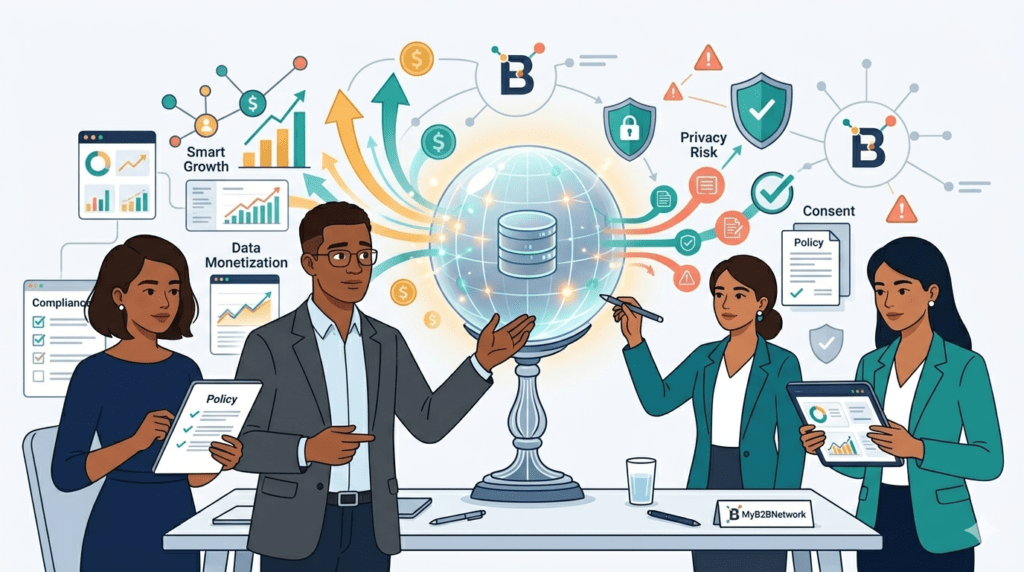
Data monetization can drive growth, but it can also create privacy risk if consent, transparency, and governance are weak. For legal, compliance, and data leaders, the real question is not whether to use data commercially, but whether the business can prove that its use is fair, limited, and understood.
That tension is becoming more important as privacy moves from a legal issue to a trust issue. Harvard Business Review says privacy can function as a growth strategy, while Gartner-linked governance research shows modern data programs are increasingly being rebuilt around trust models and unstructured data control. If customers believe data is being sold or used too aggressively, the long-term cost can outweigh the short-term revenue.
The safest path is not “collect less and do nothing.” It is to create a clear framework for consent, transparency, retention, and purpose limitation so the business can unlock value without eroding confidence. This article gives you that framework in practical terms.
What Is Data Monetization?
Data monetization is the process of generating business value from data, either directly by selling data products or indirectly by using data to improve decisions, products, pricing, and customer experience.
It can be direct, such as packaging insights or datasets for commercial use, or indirect, such as using customer behavior data to improve forecasting and targeting. The difference matters because direct monetization usually raises greater privacy and contractual scrutiny than internal analytics.
Common forms of monetization
- Selling aggregated or anonymized insights.
- Using first-party data to improve product decisions.
- Building paid data services or dashboards.
- Enhancing pricing, sales, and retention models.
Why Data Monetization Matters for Businesses
Data monetization matters because it can unlock new revenue and better decisions without launching an entirely new product line. It is attractive for firms that already sit on rich customer, operational, or transaction data.
The risk is trust loss. If customers feel the company is overusing their data, the monetization strategy can trigger legal complaints, reputational damage, and reduced willingness to share future data. That makes governance part of the growth model, not a separate compliance exercise.
For B2B organizations, the stakes are especially high because data often crosses teams, systems, and vendors. A weak framework can turn a useful asset into a liability.
How Consent Creates Trust
Consent creates trust when people understand what data is collected, why it is used, and how they can control it. Consent is weak when it is buried in vague policies or bundled into unrelated terms.
A good consent model does three things: it is specific, reversible, and traceable. Specific means the user knows the purpose. Reversible means they can withdraw permission. Traceable means the business can prove when and how consent was given.
Consent checklist
- State the purpose in plain language.
- Separate essential from optional use.
- Capture permission by use case, not one broad blanket.
- Keep an audit trail.
- Make withdrawal as easy as giving consent.
Which Transparency Signals Matter Most?
Transparency matters most when users can quickly see what is happening with their data. If a company cannot explain its use of data in simple language, it is likely creating risk even if it is technically compliant.
The most important signals are not legal jargon. They are practical disclosures that build confidence: what data is used, whether it is sold or shared, who receives it, how long it is kept, and what opt-out choices exist. Commerce Department data ethics guidance also emphasizes clarity, accountability, and responsible handling as core governance principles.
Transparency signals
- Plain-language privacy notices.
- Clear sharing and sale disclosures.
- Retention and deletion rules.
- Data subject rights workflows.
- Audit logs for major data uses.
Can a Framework Reduce Privacy Risk?
Yes, a framework can reduce privacy risk by making monetization decisions repeatable and reviewable. Without a framework, data use tends to expand faster than oversight.strategy.
A practical model for this article is the CLEAR Framework:
- C — Consent: Is permission specific and documented?
- L — Limits: Is use tied to a defined purpose and retention period?
- E — Explainability: Can the business explain data use in plain language?
- A — Access: Can people view, correct, or withdraw their data where required?
- R — Review: Is the data use periodically re-approved by legal, privacy, and business owners?
If a monetization initiative cannot pass all five checks, it should be paused or redesigned. That is how you turn privacy from a blocker into a design constraint.
How Tools Support Governance
Governance tools help by mapping data, tracking consent, and reducing manual oversight gaps. Common platforms include OneTrust, TrustArc, BigID, Collibra, Alation, and Informatica for discovery, consent, classification, and policy management.
The right tools do not replace judgment. They give legal and compliance teams better visibility into where data lives, who can access it, and how it is being used. Gartner’s 2026 governance coverage suggests that more organizations are rethinking data governance specifically to support AI and analytics trust.
Useful tool categories
- Consent and preference management.
- Data catalog and lineage tools.
- Privacy operations and DSAR workflow tools.
- Data loss prevention and access control systems.
- Governance dashboards for policy enforcement.
How to Source Support in the U.S.
For U.S. organizations outsourcing privacy, governance, or data monetization support, choose vendors that can show experience with consent management, privacy impact assessments, and data governance workflows. Prioritize firms that can work with NIST-style risk controls, ISO 27001 practices, SOC 2 expectations, and relevant privacy laws such as CCPA and FTC guidance.
A realistic timeline is 4–8 weeks for a privacy or data governance assessment and 3–6 months for implementation of a full consent and transparency program. Budget ranges often run from $8,000–$25,000 per month for managed privacy operations or consulting, with broader enterprise programs costing more. In regulated sectors such as healthcare, fintech, and SaaS in cities like Austin, Chicago, New York, and San Francisco, legal review and contract changes usually add time. MyB2BNetwork can help you get accurate quotations for the same.
Vendor evaluation checklist
- Review prior privacy and governance work.
- Ask how they map data flows and retention.
- Verify references, SLAs, and contract terms.
- Check for red flags such as vague data handling or no audit trail.
- Confirm support for consent, transparency, and deletion workflows.
FAQ
What is data monetization and why does it matter for B2B businesses?
Data monetization is the process of creating business value from data, either directly or indirectly. It matters because it can create new revenue and better decisions, but it can also weaken trust if consent and transparency are poor.
How do I choose the right vendor for data monetization within my budget?
Choose vendors that can demonstrate privacy governance, consent management, and relevant case studies, then compare them by scope and controls rather than price alone. MyB2BNetwork can help you compare qualified vendors and get accurate quotations.
What checks should I do before outsourcing data monetization?
Check their privacy framework, consent workflows, data mapping approach, references, SLAs, and contract terms. MyB2BNetwork can help pre-screen vendors so you do not have to start from scratch.informatica+1
How long does data monetization outsourcing typically take and what does it cost?
A privacy or governance assessment usually takes 4–8 weeks, while a full program can take 3–6 months. Costs commonly range from $8,000–$25,000 per month depending on complexity, and MyB2BNetwork can help you get accurate quotations.
Build Trust With MyB2BNetwork
If your organization is evaluating data monetization, MyB2BNetwork can help you find the right privacy, compliance, and governance partners. We connect legal, compliance, and data leaders with vendors who understand how to protect trust while creating business value.
Submit one request, receive summarized quotations, and compare providers without wasting weeks on vendor outreach. Explore B2B outsourcing models, marketing operations tips, and B2B lead generation strategy to see how MyB2BNetwork supports smarter sourcing decisions.