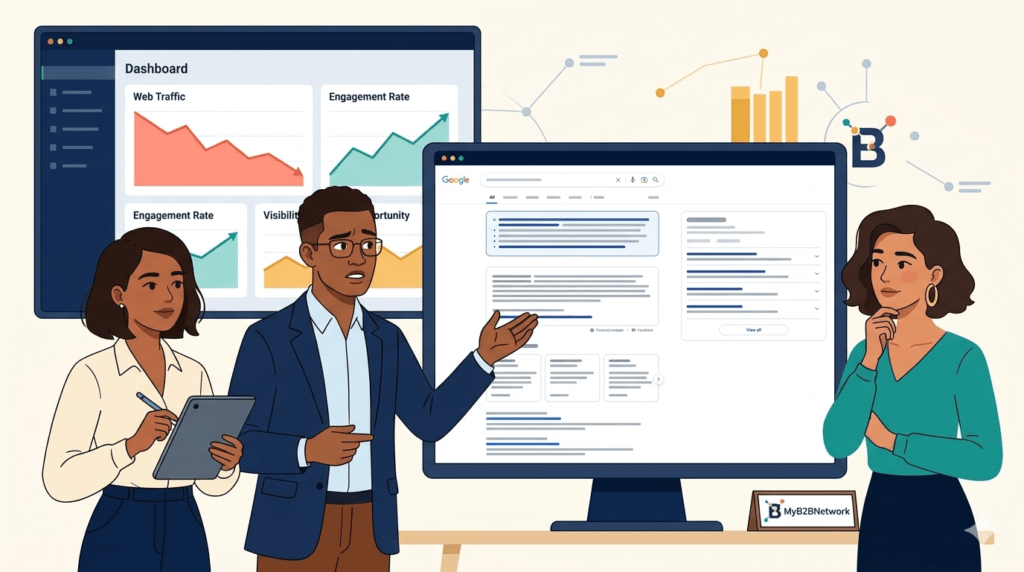
Zero-click search is not killing B2B website traffic overnight, but it is changing where attention happens and what counts as success. Search users are getting more direct answers from AI overviews, snippets, and conversational search tools, which means fewer people need to click through to a website.
That shift matters because B2B marketers have long depended on organic traffic to create awareness, educate buyers, and capture leads. Forrester says AI-powered search will reshape organic traffic and push more information consumption off provider websites. Bain also reports that click-through rates have fallen in categories like B2B software as AI-generated summaries become more common.
For SEO managers and content strategists, the answer is not to chase clicks at any cost. The better move is to build answer-first content that earns visibility in zero-click environments and still gives visitors enough on-page value to convert once they arrive. This article shows how to do that without relying on outdated traffic-only metrics.
What Is Zero-Click Search?
Zero-click search is when a user gets the answer they need directly on the search results page or in an AI response, so they do not click through to another site. In B2B, that often happens through featured snippets, AI overviews, knowledge panels, and conversational search tools.
This does not mean search has stopped working. It means the first layer of discovery is shifting from “click to read” to “read here, then maybe click later.” That is why answer quality, citation readiness, and content structure now matter as much as classic ranking.
What it changes
- Buyers consume more information before reaching your site.
- Short, direct answers win more often than long introductions.
- Search visibility becomes partly about being cited, not only clicked.
Why Zero-Click Search Matters for Businesses
Zero-click search matters because it can reduce measurable traffic while still increasing influence in the buying journey. A page may get fewer sessions but still shape what buyers believe before they ever talk to sales.
For B2B brands, that creates a measurement problem. If your reporting only tracks clicks and sessions, you may miss the fact that your content is still being used to inform decisions. Forrester notes that AI-powered search is likely to drive more organic discovery, but a larger share of that attention will happen outside the traditional website visit.
The practical risk is complacency. Teams that see traffic decline may assume SEO is failing, when the real issue is that search behavior has changed faster than their content model.
How AI Answers Reduce Clicks
AI answers reduce clicks by satisfying intent earlier in the journey. When a search engine or AI tool summarizes the answer well enough, the user has less reason to visit the source page.
That is especially true for definitional queries, comparison queries, and basic “what is” searches. These are the easiest prompts for AI to answer, which makes them the most vulnerable to traffic loss. Bain found that click-through rates in some B2B software categories fell by as much as 30% after AI-generated summaries became more prominent.
Most affected content types
- Basic definitions.
- Short comparison articles.
- Quick “best X” listicles.
- Simple how-to pages without deeper insight.
Which Content Wins Now?
Answer-first content wins now because it is easier for AI systems to extract and easier for buyers to trust. That means the best pages start with a direct answer, then provide proof, nuance, and practical next steps.
This is where zero-click search and SEO intersect with AEO. Your page should still be useful on its own, but it should also be structured so an AI system can quote it accurately. That usually means clear headings, concise definitions, original examples, and supporting data.
High-value content traits
- A direct answer in the first 1–2 sentences.
- Clear subheadings that match likely buyer questions.
- Original examples, frameworks, or benchmarks.
- Strong internal linking to related content.
- Useful tables, checklists, or decision steps.
How to Build Answer-First Pages
Answer-first pages work because they make both the search engine and the human reader’s job easier. The page gives a fast answer up top, then earns the click-through with depth, specificity, and usefulness.
A simple structure helps. Start with a crisp definition, then expand into risks, trade-offs, examples, and a clear action path. Add schema, internal links, and comparison blocks where they help clarity rather than clutter.
Answer-first page checklist
- Put the direct answer in the first paragraph.
- Use H2s that match real user questions.
- Add one comparison table or decision matrix.
- Include original insights, not just rewritten industry advice.
- End with a practical CTA that fits the topic.
Can Better On-Page Value Protect Traffic?
Better on-page value can protect traffic by giving visitors a reason to stay, explore, and convert after the click. If the page only repeats the snippet, the user has no incentive to go further.
Think of the website as more than a traffic destination. Forrester argues that B2B providers need their websites to function as trusted information sources and as content that search systems can reuse. That means original models, useful tools, and deeper explanations become strategic assets, not optional extras.
A good example is a page that opens with a direct answer, then adds a framework, examples, and next steps. That kind of page is more likely to earn citations, support conversion, and survive the zero-click shift.
Why Metrics Need to Change
Metrics need to change because traffic alone no longer reflects influence. If AI answers are shaping purchase intent before the click, then impressions, citations, assisted conversions, branded search lift, and content engagement matter more than raw sessions.
This is not an argument to abandon SEO analytics. It is an argument to add better signals. Track how often your content is surfaced in AI answers, how often it is cited, and how well visitors behave once they land.
Better metrics to watch
- Branded search growth.
- Assisted conversions.
- Content-to-opportunity paths.
- Scroll depth and time on page.
- Citation frequency in AI and snippet environments.
How to Source SEO Help in the U.S.
If you need outside help, choose vendors that show how they adapt SEO for zero-click search, not just how they rank keywords. Prioritize agencies or consultants with experience in structured data, content design, and AEO-style formats, plus proof they can improve visibility beyond traffic alone.
A practical U.S. sourcing cycle usually takes 4–8 weeks for audit and implementation planning, and a realistic budget is often $3,500–$12,000 per month for ongoing SEO and content strategy support, with more for enterprise programs. In sectors like SaaS in Austin, healthcare in Chicago, fintech in New York, manufacturing in Ohio, logistics in Atlanta, and B2B firms in San Francisco, buyers should also ask about NIST-aligned security practices, SOC 2 readiness, and data handling for content workflows. MyB2BNetwork can help you get accurate quotations for the same.
Vendor checklist
- Ask how they optimize for snippets and AI answers.
- Review case studies that show conversions, not only rankings.
- Check their technical SEO, schema, and internal linking approach.
- Confirm SLAs, reporting cadence, and deliverables.
- Watch for red flags like traffic-only reporting or template content.
FAQ
What is zero-click search and why does it matter for B2B businesses?
Zero-click search is when users get the answer directly in the search interface without visiting a website. It matters because it can reduce traffic while still shaping buyer decisions, which changes how B2B teams measure SEO success.
How do I choose the right vendor for zero-click search within my budget?
Choose a vendor that can show experience with AEO, schema, content structure, and outcome-based metrics like assisted conversions and citations. MyB2BNetwork can help you compare qualified options within your budget.
What checks should I do before outsourcing zero-click search?
Review case studies, ask for their technical SEO process, confirm how they track visibility beyond traffic, and verify contract terms, SLAs, and reporting standards. MyB2BNetwork can pre-screen vendors so you do not have to start from scratch.
How long does zero-click search outsourcing typically take and what does it cost?
Most engagements take 4–8 weeks to audit and implement, and monthly costs often range from $3,500–$12,000 depending on scope and complexity. MyB2BNetwork can help you get accurate quotations for the same.
Build for Visibility
Zero-click search is changing the way B2B buyers discover content, but it is not ending the value of your website. It is forcing websites to become more useful, more structured, and more trustworthy. MyB2BNetwork helps SEO managers and content strategists find the right partners to build answer-first content, improve on-page value, and adapt to AI-driven search behavior. Explore B2B outsourcing models, marketing operations tips, and B2B lead generation strategy to strengthen your search approach and get vendor quotations that fit your needs.