Founders debating usage-based vs flat-fee pricing usually frame it as a branding question. It isn’t. It’s a retention and expansion question disguised as a pricing page decision. The model you pick shapes how customers grow with you, or how quickly they leave.
Flat-fee pricing feels safer. Revenue is predictable, forecasting is simple, and sales conversations are short. Usage-based pricing feels riskier but often grows faster, since revenue expands automatically as customers get more value from the product.
Neither model (usage-based vs flat-fee) is universally correct. A security tool billed by seat behaves differently than an infrastructure tool billed by API call. The right choice depends on how your product creates value, not on which model looks more modern on a landing page.
This piece compares both models honestly, names the trade-offs each one carries, and gives founders and pricing leads a simple scorecard for picking a model that fits their actual business, not just the current trend.
What Is Usage-Based vs Flat-Fee Pricing?
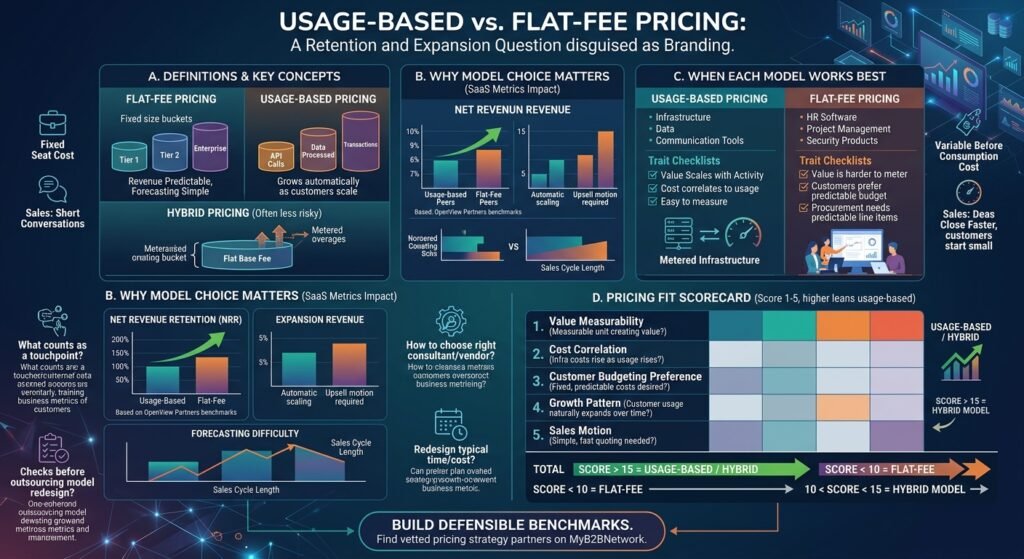
Flat-fee pricing charges a fixed amount per period, usually per seat or per tier, regardless of how much a customer actually uses the product. Usage-based pricing charges based on consumption, such as API calls, data processed, or transactions completed.
Many companies now run a hybrid of the two, charging a flat base fee plus usage-based overages. That hybrid model is often less risky than either pure approach, but it still requires choosing which parts of the product to meter.
Why Pricing Model Choice Matters for B2B SaaS Businesses
It matters because pricing model directly shapes retention and expansion revenue, two of the most closely watched metrics in SaaS. A poor fit between pricing model and product value tends to show up in churn within a year.
A few reasons this decision carries real weight:
- Expansion revenue depends on it. Usage-based models can expand automatically as customers scale, while flat-fee models require active upsell motions.
- Forecasting difficulty varies. Flat-fee revenue is easier to predict; usage-based revenue can swing with customer activity levels.
- Sales cycle length changes. Usage-based deals often close faster since customers can start small, while flat-fee deals may require longer negotiation over tier fit.
How Each Model Affects Retention and Expansion Revenue
Direct answer: usage-based pricing tends to expand revenue more smoothly, while flat-fee pricing tends to retain revenue more predictably, and each carries a matching risk.
OpenView Partners’ annual SaaS benchmarks research has repeatedly found that companies with usage-based components report higher net revenue retention than pure flat-fee peers, largely because growth in usage automatically grows the invoice. Forrester’s research on subscription pricing similarly notes that usage-based models align vendor incentives with customer outcomes more directly than flat pricing does.
The risk runs the other way too. Usage-based revenue can contract sharply during a customer’s slow season, while flat-fee revenue stays flat until a renewal decision changes it. Founders need to plan for both directions of that swing, not just the upside.
When Usage-Based Pricing Works Best
Direct answer: usage-based pricing works best when product value scales clearly and measurably with customer activity, such as infrastructure, data, or communication tools.
Products that meter well share a few traits. Usage is easy to measure accurately, usually through API calls or data volume. Customers can visibly connect their usage to their own business outcomes. And the cost of running the underlying infrastructure scales with that same usage, keeping margins healthy as volume grows.
Common billing infrastructure for usage-based models includes Stripe Billing, Metronome, and Chargebee, all of which handle metering, invoicing, and usage-based contract logic that would otherwise require significant in-house engineering.
When Flat-Fee Pricing Works Best
Direct answer: flat-fee pricing works best when product value is harder to meter cleanly, or when customers strongly prefer predictable, budgetable costs.
This tends to apply to categories like HR software, project management tools, and many security products, where usage doesn’t map cleanly to value delivered. A team doesn’t get more value from a project management tool by clicking it more often.
Flat-fee pricing also tends to suit finance and procurement teams who need predictable line items for budgeting, which is common in larger enterprise deals with formal purchasing processes.
A Scorecard for Picking a Pricing Model
Rather than choosing a model by instinct or competitor imitation, founders can score their product against five factors. We’ll call this the Pricing Fit Scorecard, rating each factor from 1 (favors flat-fee) to 5 (favors usage-based):
- Value measurability — can you cleanly measure the unit that creates customer value?
- Cost correlation — do your infrastructure costs rise as usage rises?
- Customer budgeting preference — do your buyers strongly prefer fixed, predictable costs?
- Growth pattern — does customer usage naturally expand over time as they succeed?
- Sales motion — does your team need simple, fast quoting, or can it handle usage-based negotiation?
A total score above 15 generally favors usage-based or hybrid pricing. A score below 10 generally favors flat-fee. Scores in between usually point toward a hybrid model with a flat base and metered overages.
FAQ
What is usage-based vs flat-fee pricing and why does it matter for B2B businesses?
Flat-fee pricing charges a fixed recurring amount, while usage-based pricing charges based on actual consumption. It matters because the choice directly shapes retention, expansion revenue, and how predictable your forecasting will be.
How do I choose the right pricing consultant or vendor within my budget?
Look for a consultant who asks about your cost structure and customer usage patterns before recommending a model, rather than pitching one approach for every client. Confirm they’ve worked with companies at a similar stage and pricing complexity to yours.
What checks should I do before outsourcing a pricing model redesign?
Ask for case studies with real before-and-after retention or expansion metrics, not just pricing page mockups. Confirm who owns the billing implementation work, since pricing strategy and billing engineering are often separate skill sets.
How long does a pricing model redesign typically take, and what does it cost? Expect four to eight weeks for research, modeling, and a new pricing structure, with implementation and billing system changes often extending that to three to six months. Strategy-only engagements often run in the low-five-figures, while full implementation support can reach mid-five-figures.
Want a Second Opinion on Your Pricing Model?
Running the Pricing Fit Scorecard is easier with a partner who has seen how these models perform across different SaaS categories. MyB2BNetwork connects founders and pricing leads with vetted pricing strategists and billing implementation partners. Find pricing strategy partners on MyB2BNetwork.
Hiring or Outsourcing Pricing Strategy Work in the U.S.
Two things matter most when a U.S. company brings in outside help for pricing strategy: budget fit and due diligence on measurable past results.
On budget, a focused pricing strategy engagement, covering research, modeling, and a recommended structure, typically runs $8,000–$20,000 as a project fee, while a fuller engagement including billing system implementation can reach the mid-five-figures. MyB2BNetwork can help source accurate, vetted quotations rather than relying on a single consultant’s rate card.
On due diligence, ask for specific retention or expansion metrics from past engagements, not just pricing page redesigns, and confirm data handling practices align with relevant privacy rules like CCPA if customer usage data is involved. This applies whether you’re a SaaS company in Austin evaluating a usage-based shift, a fintech firm in New York with strict compliance needs, or a healthcare software company in Chicago navigating HIPAA-adjacent billing data.