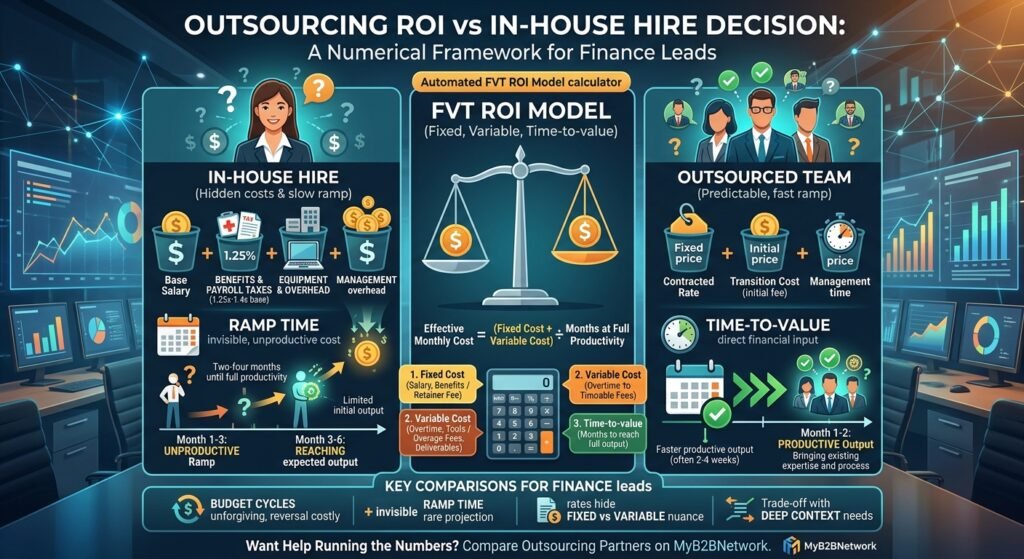
Finance leads asking about outsourcing ROI vs in-house hire decisions usually run into the same wall: the two options don’t come pre-packaged in comparable numbers. A salary offer is one line. An outsourced rate is another. Nobody hands you a formula that puts them on equal footing.
That gap is why so many outsourcing decisions stall in committee. A founder feels the outsourced rate looks expensive per hour. While a finance lead knows the in-house number hides costs that never make it into the base salary line. Both are right, and both are working from an incomplete picture.
This piece is written as a working Q&A, the way the comparison actually gets debated in a budget meeting. It walks through what belongs in each side of the equation, then gives finance leads and founders a simple calculator format to settle the comparison with numbers instead of instinct.
What Does “Outsourcing ROI vs. In-House Hire” Actually Mean?
Direct answer: it means comparing the total cost of each option against the total value delivered over a matched time period. Not just comparing a salary figure to an hourly rate.
Most flawed comparisons happen because one side is measured in fully-loaded cost and the other is measured in sticker price. A real ROI comparison has to put fixed costs, variable costs, and time-to-value on the same table for both options.
Why Does This Comparison Matter for B2B Businesses?
It matters because getting it wrong is expensive in both directions. Over-hiring in-house too early strains cash flow before revenue catches up. Under-investing in outsourced support can slow output when speed actually mattered more than headcount optics.
A few reasons finance leads should own this calculation, not just approve it after the fact:
- Budget cycles are unforgiving. A wrong hiring decision often can’t be reversed mid-fiscal-year without real cost.
- Ramp time is invisible until it isn’t. A new hire’s first few unproductive months rarely show up in the original budget projection.
- Outsourced rates hide fixed-versus-variable nuance. A retainer behaves differently than a pay-per-deliverable model, and finance needs to know which one it’s approving.
What Costs Actually Belong in the In-House Side of the Comparison?
Direct answer: the in-house side includes base salary, benefits, payroll taxes, equipment, management overhead, and ramp time before the hire reaches full productivity.
A fully-loaded in-house cost typically runs 1.25 to 1.4 times base salary once benefits, payroll taxes. And standard overhead are included. Ramp time adds further hidden cost, since most roles take two to four months before a new hire reaches expected output.
Founders often underestimate this last piece specifically. A hire who costs $8,000 a month but produces limited output for the first quarter has an effective early cost well above the salary line alone.
What Costs Actually Belong in the Outsourced Side of the Comparison?
Direct answer: the outsourced side includes the contracted rate, any onboarding or transition cost. And management time spent overseeing the engagement, weighed against a much shorter ramp period.
Outsourced engagements typically reach productive output faster, often within two to four weeks, since the provider brings existing expertise and process rather than starting from zero. That speed is a real financial input, not just a convenience.
The trade-off runs the other way in a few common cases:
- Deep institutional knowledge needs. Roles requiring extensive company-specific context often ramp slower even when outsourced.
- Long-term retention value. In-house hires build compounding institutional knowledge that outsourced engagements don’t always retain long-term.
- Management overhead variability. Poorly scoped outsourced engagements can require more oversight time than expected, eating into the speed advantage.
How Do You Build a Simple ROI Calculator for This Decision?
Direct answer: a workable calculator compares three inputs side by side for each option — fixed cost, variable cost, and time-to-value — then converts them into a single comparable cost-per-productive-month figure.
We’ll call this the FVT ROI Model (Fixed cost, Variable cost, Time-to-value):
- Fixed cost — the predictable recurring cost: salary and benefits for in-house, or a retainer fee for outsourced.
- Variable cost — costs that scale with volume: overtime, tools, and management overhead for in-house, or per-deliverable or overage fees for outsourced.
- Time-to-value — the number of months before the option reaches expected productive output.
The comparison formula looks like this:
Effective Monthly Cost = (Fixed Cost + Variable Cost) ÷ Months at Full Productivity, averaged across the full engagement period
Here’s how it plays out with real numbers. An in-house hire at $90,000 annually costs roughly $10,500 a month fully loaded, but needs three months to ramp. Making the effective cost during that ramp period closer to $15,000 a month in unproductive spend. An outsourced team at $12,000 a month reaching full output in three weeks has a far shorter unproductive window. Even at a higher headline rate.
Neither option wins by default. The formula simply forces both sides onto the same footing before a decision gets made.
FAQ
What is the comparison between an outsourcing ROI vs in-house hire, and why does it matter for B2B businesses?
It’s a comparison of total fixed cost, variable cost, and time-to-value for each option, rather than comparing salary to hourly rate directly. It matters because an incomplete comparison leads to hiring decisions that look cheaper on paper but cost more in lost productive time.
How do I choose the right outsourcing vendor within my budget?
Ask for a clear breakdown of fixed retainer costs versus variable or overage costs upfront, since blended pricing can hide the true monthly commitment. Prioritize vendors who can show a realistic ramp-to-productivity timeline based on past client onboarding, not just a sales estimate.
What checks should I do before outsourcing instead of hiring in-house? R
eview the vendor’s contract terms for exit clauses and notice periods, since flexibility is one of outsourcing’s core financial advantages and a rigid contract erodes it. Confirm past client references specifically on how quickly the team reached productive output.
How long does outsourcing typically take to show ROI, and what does it cost?
Most outsourced engagements show measurable output within three to six weeks, compared to two to four months for a new in-house hire to fully ramp. Costs vary widely by function, but retainers commonly range from the low five figures to the mid five figures monthly depending on scope and seniority.
Want Help Running the Numbers?
The FVT ROI Model is easier to apply with accurate market rates for your specific function and region. MyB2BNetwork connects finance leads and founders with vetted outsourced teams across marketing, sales, and operations, plus realistic rate benchmarks to run the comparison properly. Compare outsourcing partners on MyB2BNetwork.
Hiring or Outsourcing Talent in the U.S.: What Finance Leads Should Check
Two things matter most when a U.S. company is deciding between an outsourcing ROI vs in-house hire: budget fit and due diligence on true ramp time.
On budget, outsourced retainers for specialized functions like marketing, finance operations, or technical support commonly run $4,000–$15,000 per month, depending on scope and seniority, while a comparable in-house hire’s fully-loaded cost often lands 25–40% above the base salary figure once benefits and overhead are included. MyB2BNetwork can help source accurate, vetted quotations to run this comparison with real numbers rather than estimates.
On due diligence, ask outsourced providers for documented average ramp times from past engagements, and confirm contract terms around notice periods and deliverable ownership before signing. This applies whether you’re a fintech company in New York weighing compliance-sensitive roles, a SaaS startup in Austin scaling quickly, or a manufacturing firm in Ohio comparing outsourced operations support against a full-time hire.