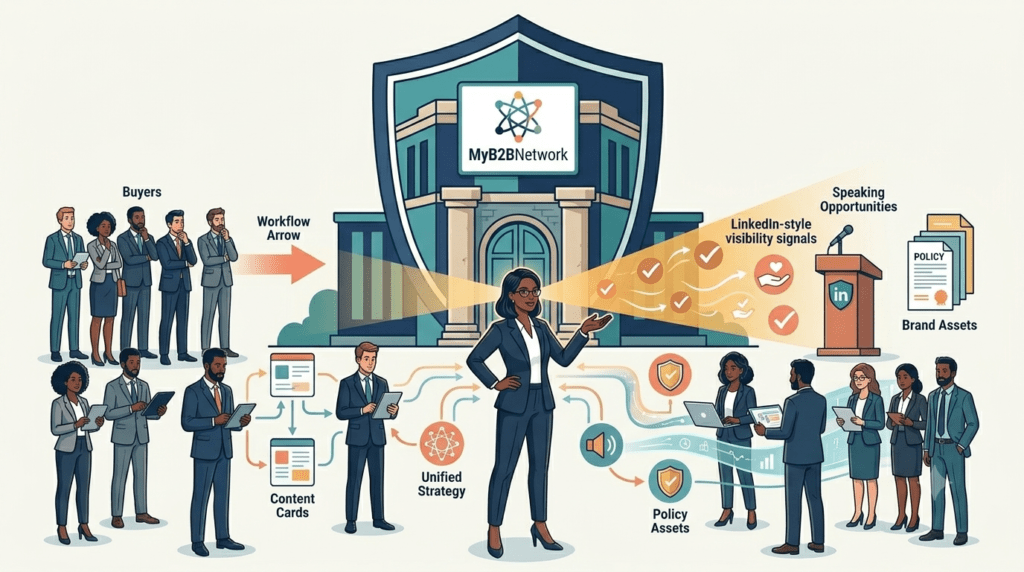
Personal branding vs company branding is not really a winner-takes-all choice. Buyers often trust people faster than logos, but companies still need a brand that can scale beyond one individual.
That is why founder and executive visibility has become more important in B2B. A visible leader can build trust, accelerate conversations, and make the company feel more credible before the first sales call. At the same time, a company brand creates consistency, product legitimacy, and resilience when the business grows.
For founders, executives, and B2B marketers, the best approach is to build both in the right order. Start with the person, but do not stop there.
What Is Personal Branding vs Company Branding?
Personal branding vs company branding is the difference between building trust around a person and building trust around an organization. Personal branding focuses on your voice, expertise, and visibility, while company branding focuses on the business’s mission, offer, and market identity.
Both influence buying decisions, but they work differently. A personal brand tends to build faster trust and stronger emotional connection, while a company brand tends to create scale, stability, and institutional credibility.
Simple distinction
- Personal branding = people trust you.
- Company branding = people trust the business.
- The strongest B2B growth plans usually need both.
Why It Matters for Businesses
This matters because B2B buyers often want a human face behind the offer. Executives and founders who show up publicly can shorten the trust-building cycle and make cold outreach, content, and sales conversations more effective.
Company branding still matters because buyers also look for reliability, process, and continuity. If your market only knows one person, the business may struggle to scale, recruit, or survive leadership change. The real risk is overdependence on either side.books.
The best brands make the person and the company reinforce each other. That gives the business both warmth and durability.
How Personal Brand Builds Trust
Personal brand builds trust by making expertise visible and relatable. Buyers can see the leader’s point of view, track record, and values, which often feels more credible than polished corporate messaging alone.
That is especially powerful in service businesses and early-stage B2B companies. When buyers are comparing similar offers, the person behind the company can become the differentiator.
What helps a personal brand
- A clear point of view.
- Regular visibility on the right channels.
- Proof of experience and results.
- Consistent, useful commentary.
Why Company Branding Still Matters
Company branding still matters because it outlives any single leader. It creates a shared identity across sales, marketing, product, and customer success, which is essential when the business grows beyond the founder.
A strong company brand also supports recruiting, partnerships, and repeatability. Buyers may start with a person, but they often commit to a company because of the system, service, and stability behind that person.
Company brand strengths
- Scales beyond one leader.
- Supports product credibility.
- Creates team alignment.
- Reduces dependency on a single face.
Which Brand Wins in B2B Buying?
Personal branding usually wins early in the relationship, while company branding wins over the longer term. Founders and executives can create attention and trust quickly, but the company brand must carry the deal across the finish line.
That means the answer is stage-dependent. If you are trying to get a meeting, a personal brand can help more. If you are trying to build a long-term market position, the company brand becomes essential.
| Brand Type | Best Use | Main Limitation |
|---|---|---|
| Personal brand | Trust, visibility, and early attention | Depends on one person |
| Company brand | Scale, consistency, and institutional trust | Can feel impersonal |
| Combined model | B2B growth and resilience | Requires coordination |
Can a Personal Brand Hurt the Company?
Yes, a personal brand can hurt the company if it becomes too disconnected from the business itself. If all the attention sits with one leader, the company may attract interest but fail to convert that attention into a durable brand asset.
The fix is alignment. Leaders should speak in a way that reinforces the company’s positioning, not competes with it. A personal brand works best when it acts as a front door to a clear, credible company brand.
Watch for these risks
- The leader overshadows the company.
- Messaging becomes inconsistent.
- Sales relies too heavily on one person.
- The company brand never matures.
How to Build a Personal Brand Plan
You build a personal brand plan by choosing a point of view, a channel, and a repeatable content rhythm. HeavyBit’s founder guidance and Harvard Business School’s personal branding guidance both point to clarity, consistency, and authenticity as the foundation.
For B2B leaders, a practical plan looks like this:
- Define the expertise you want to be known for.
- Pick one or two channels, often LinkedIn and email.
- Share useful insights, not just company promotions.
- Tie your visibility to company themes and buyer pain points.
This approach keeps the personal brand useful rather than performative. It also makes content easier for sales teams to use in outreach and follow-up.
How to Source Support in the U.S.
If you need outside help in the U.S., choose vendors that can support both executive visibility and company brand alignment. Prioritize partners that understand LinkedIn strategy, thought leadership, personal brand systems, and B2B messaging, rather than agencies that only produce generic content.
A realistic timeline is 4–8 weeks for strategy and profile setup, and 3–6 months for building a consistent brand system. Budget ranges often fall between $4,000 and $15,000 per month, depending on content volume, executive involvement, and distribution needs. In SaaS startups in Austin, healthcare in Chicago, fintech in New York, manufacturing in Ohio, logistics in Atlanta, and B2B firms in San Francisco, ask about governance, approvals, and brand consistency across personal and corporate channels. MyB2BNetwork can help you get accurate quotations for the same.
Vendor evaluation checklist
- Ask how they balance personal and company brand strategy.
- Review examples of executive visibility work.
- Confirm SLAs, content approval flow, and reporting.
- Check for red flags like ghostwriting without positioning or no company alignment.
- Make sure they can support sales enablement too.
FAQ
What is personal branding vs company branding and why does it matter for B2B businesses?
It is the difference between building trust around a person and building trust around a company. It matters because B2B buyers often trust people faster, but companies still need scale and credibility.
How do I choose the right vendor for personal branding vs company branding within my budget?
Choose a vendor that can align executive visibility with company messaging, then compare strategy depth, content quality, and distribution support.
What checks should I do before outsourcing personal branding vs company branding?
Check references, portfolio quality, approval workflows, brand alignment, and whether they can support both leader visibility and company consistency.online.
How long does personal branding vs company branding outsourcing typically take and what does it cost?
A setup usually takes 4–8 weeks, while a full brand system can take 3–6 months. Monthly costs often range from $4,000 to $15,000 depending on scope, and MyB2BNetwork can help you get accurate quotations.
Build Both Brands
Personal branding vs company branding is not an either-or choice. The strongest B2B teams use personal visibility to build trust and company branding to build scale.
MyB2BNetwork helps founders, executives, and B2B marketers find the right partners to build that balance. Explore B2B outsourcing models, marketing operations tips, and B2B lead generation strategy to strengthen your brand plan and get vendor quotations that fit your needs.