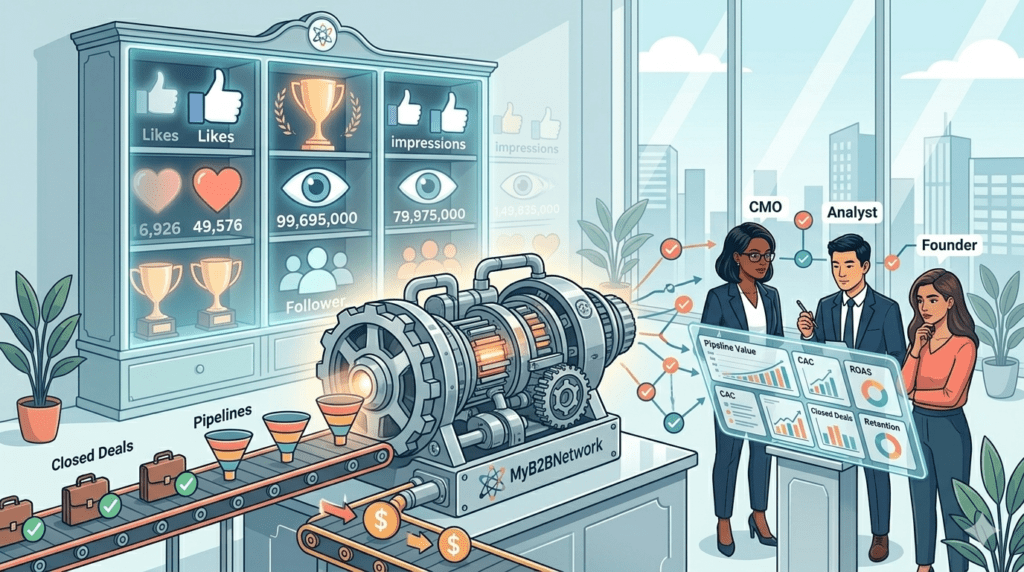
Yes — many businesses are still addicted to vanity metrics, especially when dashboards reward easy-to-read numbers like likes, impressions, and followers. Those figures can make progress look real even when they do not move conversion, pipeline, or revenue.
That matters because leadership teams often make budget and channel decisions based on the metrics they see first. If the numbers are not tied to business outcomes, teams can end up optimizing for attention instead of growth. The result is a false sense of success.
The better approach is not to ignore awareness metrics entirely. It is to treat them as context, not proof, and build reporting around conversion, pipeline, and revenue impact instead.
What Is Vanity Metrics?
Vanity metrics are numbers that look impressive but do not reliably show business performance. Common examples include likes, raw impressions, follower counts, and page views when they are not connected to conversion or revenue.
These metrics are not useless by default. They can help with reach or brand awareness. The problem is that they are often treated like KPI-level proof even though they fail the “so what?” test.
Examples of vanity metrics
- Social likes without conversion context.
- Raw impressions without click-through or pipeline data.
- Follower growth without engagement quality.
- Page views without lead or revenue attribution.
Why Vanity Metrics Matter for Businesses
Vanity metrics matter because they can distort decision-making. When leaders see large numbers, they may assume the campaign is working even if no meaningful business action follows.
This is especially risky in B2B, where sales cycles are longer and pipeline quality matters more than surface activity. A channel that generates attention but no qualified opportunities can quietly waste budget for months. That is why revenue-linked measurement is essential.
The business cost is not just wasted spend. It is strategic confusion, because teams keep scaling the wrong things.
How Vanity Metrics Mislead Teams
Vanity metrics mislead teams by creating the illusion of momentum. A campaign can look successful on a dashboard while failing to generate leads, opportunities, or closed revenue.
They also encourage shallow optimization. If a team is rewarded for likes or impressions, it may produce content that is more clickable than useful, which can damage lead quality over time. That is a common trap in social and top-of-funnel reporting.
How they mislead
- They reward visibility over value.
- They hide weak conversion rates.
- They can be inflated by bots or low-quality traffic.
- They encourage budgets to flow toward the wrong channels.
Which Metrics Actually Matter
The metrics that actually matter are the ones tied to conversion, pipeline, and revenue impact. In B2B, that usually means qualified leads, stage conversion rates, pipeline coverage, win rate, sales velocity, and revenue attributed to campaign activity.
These metrics are harder to manage than likes, but they are far more useful. They tell you whether your marketing is creating business value or just activity. For leadership teams, that makes them better inputs for budget and strategy decisions.
Better metrics to track
- Conversion rate by campaign or channel.
- Pipeline generated and influenced.
- Win rate.
- Average deal size.
- Sales velocity.
- Revenue per source.
| Metric Type | What It Shows | Decision Value |
|---|---|---|
| Vanity metrics | Attention and surface activity | Low unless paired with outcomes |
| Conversion metrics | Movement to leads or opportunities | High for campaign optimization |
| Revenue metrics | Business impact and growth | Highest for leadership decisions |
Can Awareness Metrics Still Help?
Yes, awareness metrics can still help when they are used as early indicators rather than proof of success. A spike in impressions or reach may signal that a message is landing, but it should be checked against engagement quality and downstream conversions.clicdata+1
That means awareness metrics belong in a broader reporting model. They are useful for diagnosing distribution, but not for judging ROI on their own. If awareness rises while pipeline stays flat, the campaign may need a different offer, audience, or follow-up system.
Use awareness metrics for
- Reach monitoring.
- Content distribution checks.
- Early signal testing.
- Creative comparison.
How to Build Better Reporting
You build better reporting by starting with the business outcome and working backward. Define what counts as success, map the steps that lead to it, and report on the metrics that reflect those steps.
One practical framework for this article is the REAL Score:
- R — Revenue: Does the metric connect to money?
- E — Engagement quality: Is the interaction meaningful?
- A — Attribution: Can you trace the source?
- L — Lift: Does it improve conversion or pipeline?
If a metric does not pass at least two of those checks, it should not drive major decisions.
How to Source Support in the U.S.
If you need outside help in the U.S., choose vendors that can connect measurement to business outcomes, not just build dashboards. Prioritize firms that understand conversion tracking, attribution, pipeline reporting, and revenue analytics rather than those that only report traffic or social engagement.
A realistic timeline is 4–8 weeks for a measurement audit and 3–6 months for a full reporting redesign. Budget ranges often fall between $6,000 and $20,000 per month, depending on the complexity of data sources and attribution setup. In SaaS startups in Austin, healthcare in Chicago, fintech in New York, manufacturing in Ohio, logistics in Atlanta, and B2B firms in San Francisco, ask vendors about NIST-aligned practices, SOC 2 readiness, and data governance. MyB2BNetwork can help you get accurate quotations for the same.
Vendor evaluation checklist
- Ask how they define success before building dashboards.
- Review past attribution and revenue reporting work.
- Confirm SLA terms, data access, and implementation support.
- Check for red flags like “engagement-only” reporting.
- Make sure they can connect marketing activity to pipeline and revenue.
FAQ
What are vanity metrics and why does it matter for B2B businesses?
Vanity metrics are surface-level numbers like likes and impressions that look good but do not prove business impact. They matter because B2B teams need metrics tied to pipeline and revenue.
How do I choose the right vendor for vanity metrics within my budget?
Choose a vendor that can show revenue-linked reporting, conversion tracking, and attribution work, then compare scope and data depth before buying.
What checks should I do before outsourcing vanity metrics?
Check the vendor’s reporting model, attribution methods, case studies, SLAs, and whether they can tie dashboards to pipeline and revenue.
How long does vanity metrics outsourcing typically take and what does it cost?
A measurement audit usually takes 4–8 weeks, while a full reporting redesign can take 3–6 months. Monthly costs often range from $6,000 to $20,000 depending on scope, and MyB2BNetwork can help you get accurate quotations.
Measure What Matters
Vanity metrics are not the enemy, but they are a poor foundation for decision-making. The businesses that grow sustainably are the ones that measure conversion, pipeline, and revenue impact first.
MyB2BNetwork helps CMOs, analysts, and founders find the right partners to build reporting that reflects real business outcomes. Explore B2B outsourcing models, marketing operations tips, and B2B lead generation strategy to strengthen your measurement system and get vendor quotations that fit your needs.