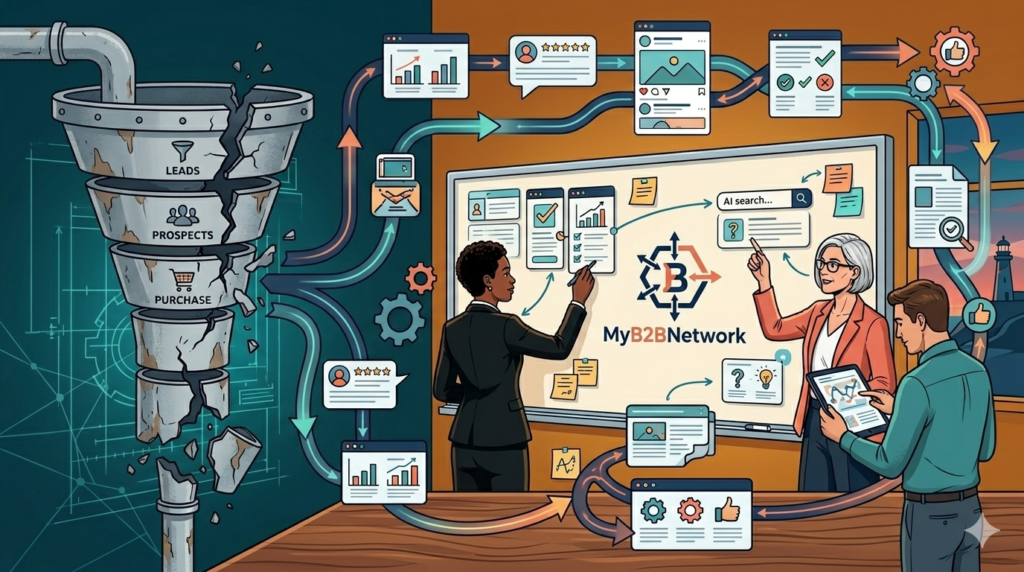
The funnel model is increasingly outdated as a standalone planning tool because buyers do not move in a neat straight line anymore. They jump between channels, revisit earlier questions, and often arrive at decisions after several loops rather than a simple top-to-bottom sequence.
That does not mean the funnel is useless. It means funnel-only planning is too narrow for modern B2B behavior, especially when buyers self-educate across search, peer content, video, and AI summaries before they ever speak with sales. If your content strategy still assumes a fixed path, you may be creating gaps between what buyers need and what your team produces.
For strategists and marketing leaders, the better approach is to map content to real buying behavior. That means building around journey moments, intent clusters, and decision questions instead of relying on a linear framework alone.
What Is the Funnel Model?
The funnel model is a linear way of describing how buyers move from awareness to consideration to decision. It has been useful for organizing marketing work, but it assumes a step-by-step path that modern buyers often do not follow.
In B2B, the funnel still helps teams think about stage coverage and conversion flow. The problem is that buyers can enter at different points, leave, return, compare, and restart, so the model is incomplete when used as the only planning system.
Core funnel stages
- Awareness.
- Consideration.
- Decision.
- Action.
Why the Funnel Still Matters
The funnel still matters because it gives teams a simple structure for planning campaigns, measuring conversion, and aligning content with stage intent. It is especially useful when you need a common language across marketing, sales, and leadership.
The issue is not the framework itself. The issue is overreliance on it. When leaders treat the funnel as a literal customer path, they tend to overproduce top-of-funnel content and underinvest in decision support, comparison, and post-purchase content.
That creates a content imbalance. Buyers may be educated at the top and left unsupported when they need proof, clarity, and reassurance.
How Buyer Journeys Have Changed
Buyer journeys have become less linear because people now move across channels and formats before deciding. They may discover a solution through social or search, read reviews later, compare options in AI-assisted summaries, and return through email or direct traffic much later.
This means modern journeys are more like loops than ladders. Buyers jump forward, pause, revisit, and seek validation from multiple sources before committing. The result is a fragmented path that the classic funnel can describe only partially.
What changed most
- Buyers research independently longer.
- They consume content across more channels.
- They return to earlier questions repeatedly.
- They expect proof, not just messaging.
Which Content Mapping Works Better?
Journey-based content mapping works better because it ties content to real buyer questions, not just funnel stages. This approach helps you create the right asset for the right moment, whether the buyer wants awareness content, comparison content, or decision support.
A good map starts with questions and objections, then assigns content formats to each one. That is more flexible than stage-only planning and usually more useful for B2B teams with long sales cycles.
| Planning Model | Strength | Limitation |
|---|---|---|
| Funnel-only planning | Simple to organize | Misses looping and non-linear behavior |
| Journey-based mapping | Matches real buyer behavior | Requires more research and maintenance |
| Topic cluster planning | Builds depth and authority | Needs strong internal linking and governance |
Can the Funnel and Journey Work Together?
Yes, the funnel and journey can work together if the funnel is used as a reporting frame and the journey is used as a content design frame. That gives teams structure without forcing buyers into a path they do not actually follow.
This hybrid model is usually the most practical. You can still measure awareness, consideration, and conversion, but you design content around how buyers ask questions, compare options, and validate decisions. That is more accurate and more adaptable.
Hybrid planning works best when
- Funnel stages guide measurement.
- Journey maps guide content creation.
- Topic clusters support repeated buyer questions.
- Sales and marketing share the same intent signals.
How to Replace Funnel-Only Planning
You replace funnel-only planning by mapping content to buyer questions, objections, and decision moments. That begins with a content audit, a journey workshop, and a review of what your sales and customer teams hear most often.
A practical model for this article is the JUMP Framework:
- J — Journey moments: Identify when buyers pause, compare, or decide.
- U — Unanswered questions: Map the objections and gaps buyers still have.
- M — Media formats: Match content type to the need, such as blogs, guides, webinars, or case studies.
- P — Proof points: Add evidence, examples, and validation to help the buyer move forward.
This framework makes content planning more realistic and more buyer-centered.
How to Source Help in the U.S.
If you need outside help in the U.S., choose vendors that can do journey mapping, content audits, and content architecture rather than only funnel graphics or campaign calendars. Prioritize partners that understand buyer research, topic clusters, and lifecycle content planning.
A realistic timeline is 4–8 weeks for a journey-mapping audit and 3–6 months for implementing a full content architecture. Budget ranges often fall between $6,000 and $22,000 per month, depending on content volume, research depth, and governance needs. For SaaS startups in Austin, healthcare in Chicago, fintech in New York, manufacturing in Ohio, logistics in Atlanta, and B2B firms in San Francisco, ask about NIST-aligned practices, SOC 2 readiness, and how they handle content governance. MyB2BNetwork can help you get accurate quotations for the same.
Vendor evaluation checklist
- Ask how they map questions, not just funnel stages.
- Review their audit process and content architecture examples.
- Confirm SLAs, timelines, and reporting.
- Check for red flags like template-only deliverables or shallow persona work.
- Make sure they can connect content to buyer intent and conversion.
FAQ
What is the funnel model and why does it matter for B2B businesses?
The funnel model is a linear way to organize the buyer journey, and it still matters because it helps teams plan and measure marketing activity.
How do I choose the right vendor for the funnel model within my budget?
Choose a vendor that can do journey mapping, content audits, and content architecture, then compare the scope and quality of their research before deciding.
What checks should I do before outsourcing the funnel model?
Check their portfolio, content strategy process, references, SLAs, and whether they can map content to real buyer questions and decisions.
How long does the funnel model outsourcing typically take and what does it cost?
A journey-mapping audit usually takes 4–8 weeks, and a full implementation can take 3–6 months. Monthly costs often range from $6,000 to $22,000 depending on scope, and MyB2BNetwork can help you get accurate quotations.
Build for Journeys
The funnel model is not dead, but it is no longer enough on its own. Modern B2B marketing works better when you plan for how buyers actually move, loop, and decide.
MyB2BNetwork helps strategists and marketing leaders find the right partners to build that kind of content system. Explore B2B outsourcing models, marketing operations tips, and B2B lead generation strategy to strengthen your journey-based planning and get vendor quotations that fit your needs.