Human-in-the-loop is quietly becoming the default architecture for enterprise AI. Not because automation failed as an idea, but because fully automated workflows kept failing in the specific. Expensive ways humans are good at catching. Gartner now predicts that more than 40% of agentic AI projects will be canceled by the end of 2027 due to escalating costs, unclear business value. Or inadequate risk controls — a sharp reversal from the “automate everything” pitch most of these projects were sold on.
The pullback isn’t anti-AI. It’s a correction. Ops leaders who greenlit full-automation pilots two years ago are now the ones explaining to their boards why a chatbot approved a refund it shouldn’t have. Or why an automated triage system routed a compliance-sensitive case straight past anyone qualified to catch it. Full automation didn’t get more accurate as it scaled — it got more confidently wrong at a larger volume.
Human-in-the-loop design is the response to that pattern: keep AI doing the high-volume. Low-ambiguity work, and keep a human positioned at the specific points where judgment, context, or accountability actually matter. It’s a more modest pitch than full automation, and the data increasingly says it’s the one that survives contact with production.
This piece walks through what human-in-the-loop actually means, why the market is correcting toward it. And gives Ops Leaders and AI Implementation Teams a concrete framework for deciding exactly where a human needs to stay in the loop. And where they genuinely don’t.
What Is Human-in-the-Loop?
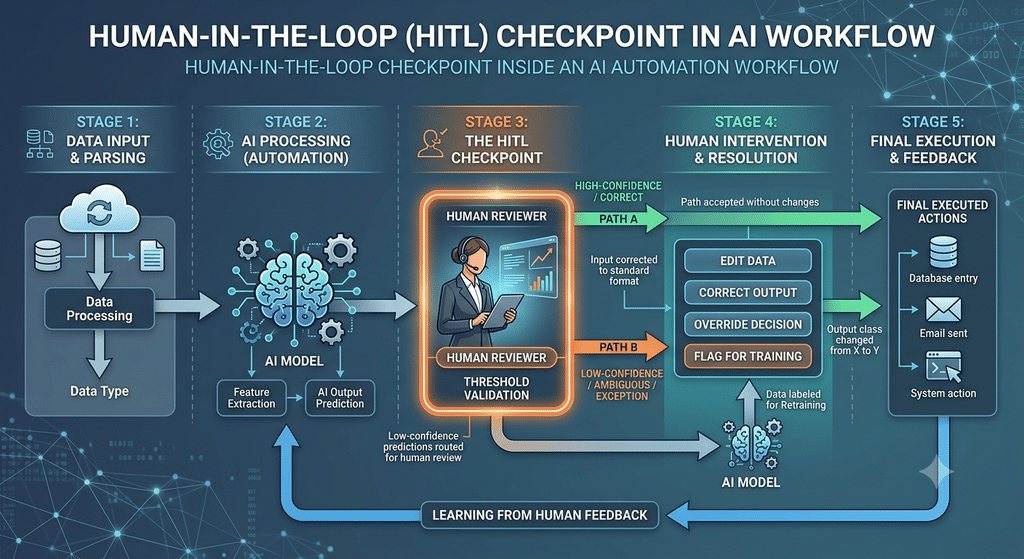
Human-in-the-loop (HITL) is an AI system design where a person reviews, approves. Or can override a model’s output at one or more defined points in a workflow. Rather than letting the system act fully autonomously end to end. It’s not the same as “having a human somewhere on the team”. The review point has to be structurally built into the workflow, with real authority to stop or change the outcome.
HITL exists on a spectrum. At one end, a human reviews every single output before it goes live (heavy oversight, slower throughput). At the other, a human only gets pulled in when the model’s own confidence score drops below a threshold or a flagged edge case appears (light oversight, higher throughput). Most mature human-in-the-loop programs land somewhere in between, calibrated to the specific risk of the decision being made.
Why Human-in-the-Loop Matters for Businesses
Human-in-the-loop matters because it’s the difference between an AI failure costing you one bad output and an AI failure costing you a thousand identical bad outputs before anyone notices. Full automation removes the checkpoint that would have caught the error at output number one.
It also matters for trust, both internal and external. Gartner’s own research found that 64% of customers would actually prefer companies not use AI for customer service at all. A sentiment fully automated systems reinforce every time they mishandle something a human would have caught immediately. Gartner has gone as far as predicting that none of the Fortune 500 will have fully eliminated human customer service by 2028. Explicitly advising service leaders to redeploy human talent rather than chase complete automation.
For Ops Leaders specifically, human-in-the-loop is also a governance answer. When a regulator, auditor, or customer asks “who approved this decision,” a properly designed HITL workflow has an answer. A fully automated one often doesn’t.
Why Are Companies Actually Pulling Back From Full Automation?
Companies are pulling back because the ROI case for full automation kept failing to materialize once projects moved from pilot to production scale. Gartner analyst Patrick Quinlan put it plainly: full automation is “prohibitively expensive for most organizations,”. And leading companies are now using AI to drive engagement rather than to cut headcount costs outright.
The pattern shows up consistently across functions. Automated systems tend to perform well on the 80% of cases that look like their training data and degrade sharply on the remaining 20%. The edge cases, unusual requests, and judgment calls that make up a disproportionate share of customer complaints and compliance exposure. Full automation had no mechanism to distinguish “this is routine” from “this needs a human,” so it treated both the same way, at scale.
Gartner’s own agentic AI research names the core issue directly: many canceled projects were driven by hype rather than a clear-eyed read of cost, complexity, and where autonomous decision-making was actually appropriate.
Where Does Full Automation Actually Break Down?
Full automation breaks down at exactly the points where a decision requires context the model wasn’t trained on. Three failure patterns show up most often in postmortems from Ops and AI Implementation teams:
- Edge cases outside the training distribution — a refund request tied to a natural disaster, a support ticket referencing a legal dispute. A transaction pattern that looks fraudulent but isn’t. Full automation treats these like routine cases because it has no reliable way to flag “I haven’t seen this before.”
- Decisions with real consequences for the customer or the company — approving credit, denying a claim, escalating a safety issue. These carry reputational and legal weight that most organizations are unwilling to hand to a system with no accountability.
- Compounding errors at volume — an automation error that would have been a single mistake for a human becomes a thousand identical mistakes overnight when it runs unsupervised, often before anyone notices the pattern.
Human-in-the-loop design exists specifically to interrupt that third pattern — catching an error at one instance instead of a thousand.
Which Tools and Platforms Support Human-in-the-Loop Workflows?
Most modern automation and AI orchestration platforms now build human-in-the-loop checkpoints in as a native feature rather than a workaround. Tools like UiPath and Microsoft Power Automate support human-approval steps directly inside RPA workflows. Letting a process pause for sign-off before continuing. Platforms like ServiceNow and Zendesk build confidence-based routing into their AI modules. Escalating a ticket to a human agent automatically when the model’s certainty drops below a set threshold.
For teams building custom AI workflows, orchestration layers increasingly expose “human review” as a built-in node type. The same way a workflow might include a conditional branch or an API call. The direction of the tooling market itself is a signal: vendors aren’t building human-in-the-loop as a bolt-on anymore; they’re building it as core infrastructure, because customers are asking for it by name.
Full Automation vs. Human-in-the-Loop vs. Fully Manual: How Do They Compare?
The right model depends on the specific task, not a blanket policy across your whole operation. Here’s how the three approaches compare on the factors Ops leaders weigh most:
| Factor | Full Automation | Human-in-the-Loop | Fully Manual |
|---|---|---|---|
| Speed at volume | Fastest — no review bottleneck | Slower than full automation, much faster than manual | Slowest, limited by headcount |
| Error/quality risk | High — errors compound silently at scale | Low — errors caught at review checkpoints | Low, but inconsistent across individual reviewers |
| Cost at scale | Cheapest per unit, but rework and incident costs often erase savings | Moderate — reviewer cost offset by fewer costly errors | Highest per unit due to labor cost |
No row in this table is a universal winner, which is the point — the right column depends on how costly an error is for the specific task in question, not on which approach sounds most modern.
How Do You Decide Where Humans Should Stay in the Loop? The SCALE Framework
Deciding where to keep a human in the loop shouldn’t be a gut call. It should be scored against the specific risk profile of the task. Use the SCALE framework to evaluate any workflow before deciding how much autonomy to hand to AI:
- Stakes — How costly or irreversible is a wrong decision? High-stakes outcomes (financial, medical, legal) argue strongly for a human checkpoint.
- Complexity — Does the task require contextual judgment beyond pattern-matching, or is it genuinely repetitive and rule-based?
- Ambiguity — How often does this task produce edge cases that fall outside the system’s training data or defined rules?
- Legal/compliance exposure — Is a human sign-off required by regulation, contract, or industry standard, regardless of the AI’s accuracy?
- Explainability — If challenged by a customer, regulator, or auditor, can the AI’s reasoning actually be explained in plain language?
Score each dimension as high or low risk for a given workflow. If two or more dimensions score high, that’s a strong signal to keep a human explicitly in the loop at that decision point — not because the AI can’t do the task, but because the cost of it being wrong outweighs the efficiency gained by removing the checkpoint.
FAQ
What is human-in-the-loop and why does it matter for B2B businesses?
Human-in-the-loop is an AI workflow design where a person can review, approve, or override outputs at defined points, rather than letting a system run fully autonomously. It matters because it catches costly errors at one instance instead of letting them compound silently across thousands of automated decisions.
How do I choose the right vendor for human-in-the-loop implementation within my budget?
Look for vendors who treat human review checkpoints as core architecture, not an afterthought bolted onto a fully automated pipeline. Compare vendors on how transparently they can show you where and why a human gets pulled into a given workflow, not just on their overall automation claims.
What checks should I do before outsourcing human-in-the-loop AI implementation?
Ask for real examples of how a vendor’s systems have handled edge cases and escalations in production, not just accuracy metrics on clean test data. Confirm their approach to audit trails, model monitoring, and how quickly a flagged decision actually reaches a qualified human reviewer.
How long does human-in-the-loop implementation typically take and what does it cost?
A scoped pilot with defined review checkpoints typically takes 6–10 weeks to design, test, and tune the escalation thresholds correctly. Budgets vary widely by scope, but mid-five-figure engagements are common for a single well-defined workflow, with ongoing review-team costs layered on top depending on volume.
Build Human-in-the-Loop AI Right With MyB2BNetwork
Getting the SCALE framework right in theory is one thing; implementing it across a real production workflow is another, and it’s easy to either over-automate or over-staff the review layer. MyB2BNetwork connects Ops leaders and AI implementation teams with vetted partners who specialize in human-in-the-loop design — not just automation vendors selling full autonomy as the finish line.
Compare our AI implementation partners to find a team that scopes review checkpoints correctly from day one, or read our related piece on protecting your IP when outsourcing development if your human-in-the-loop workflow involves proprietary models or training data changing hands.
How to Hire, Source, or Outsource Human-in-the-Loop AI Implementation in the U.S.
Human-in-the-loop implementation work is in active demand across U.S. tech hubs — SaaS companies in Austin building AI-assisted support tooling, fintech firms in New York adding review checkpoints to lending decisions, and healthcare organizations in Chicago layering human oversight onto clinical-adjacent automation, where the stakes of a wrong call are highest. Two things matter most before you sign with a vendor.
How to choose a vendor within budget. Filter first by whether the vendor can show real examples of tuned escalation thresholds — the specific rules for when a case gets pulled to a human — rather than generic “human oversight available” language. Budgets for a single scoped human-in-the-loop workflow commonly start in the mid five figures, with more complex multi-workflow implementations running into six figures annually; MyB2BNetwork can help you get accurate, comparable quotes across vendors before committing.
Checks needed before outsourcing. Confirm the vendor’s approach aligns with the NIST AI Risk Management Framework, which explicitly recommends human oversight for high-risk AI decisions, and ask whether they’ve begun aligning with ISO 42001, the international standard for AI management systems. If your workflow touches regulated data, confirm SOC 2 compliance at minimum, and HIPAA or CCPA alignment specifically if health or California consumer data is involved. Get escalation thresholds, audit-log access, and review-team SLAs written into the contract before implementation begins, and budget 6–10 weeks for a properly tuned pilot rather than rushing straight to full deployment.