CSRD and sustainability reporting are no longer a compliance exercise confined to the companies directly required to file. They’re starting to reshape which vendors get shortlisted in the first place. If your customer is in scope of the EU’s Corporate Sustainability Reporting Directive. They may now need emissions and governance data from you as part of their own disclosure. Whether or not your company is legally required to report anything at all.
That shift is easy to miss because it doesn’t arrive as a new law addressed to you. It arrives as a new question in a vendor questionnaire, a new clause in an RFP. Or a procurement contact suddenly asking for Scope 3 emissions data you’ve never been asked for before. For procurement and sustainability/ESG leads, understanding why that question is showing up now. And how to answer it, is quickly becoming a practical requirement rather than a nice-to-have.
The regulatory picture has also genuinely changed in the last year, which is part of why this is confusing right now. The EU’s Omnibus I simplification package, in force since March 2026, significantly narrowed which companies must report under CSRD directly. But narrowing who has to report hasn’t narrowed the pressure trickling down supply chains. if anything. It’s made large in-scope companies more selective about which smaller vendors they’ll accept incomplete data from.
This piece explains what CSRD and sustainability reporting actually require today. Why the requirement is showing up in vendor selection even for companies never directly in scope. And three specific questions procurement teams should be asking vendors right now.
What Is CSRD and Sustainability Reporting?
CSRD (the Corporate Sustainability Reporting Directive) is an EU law requiring large companies to disclose detailed environmental, social, and governance (ESG) data using a standardized framework called the European Sustainability Reporting Standards (ESRS). Sustainability reporting, more broadly, is the practice of disclosing that same kind of ESG performance data. Whether a company is legally required to or doing so voluntarily for investors and customers.
After the EU’s Omnibus I Directive entered into force on 18 March 2026. Mandatory CSRD scope was narrowed to companies with more than 1,000 employees and over €450 million in net annual turnover. Non-EU parent companies meeting similar turnover thresholds are also captured. With non-EU-specific reporting standards expected no earlier than 2027 and initial non-EU reporting on FY2028 data due in 2029.
Why CSRD and Sustainability Reporting Matter for Vendor Selection
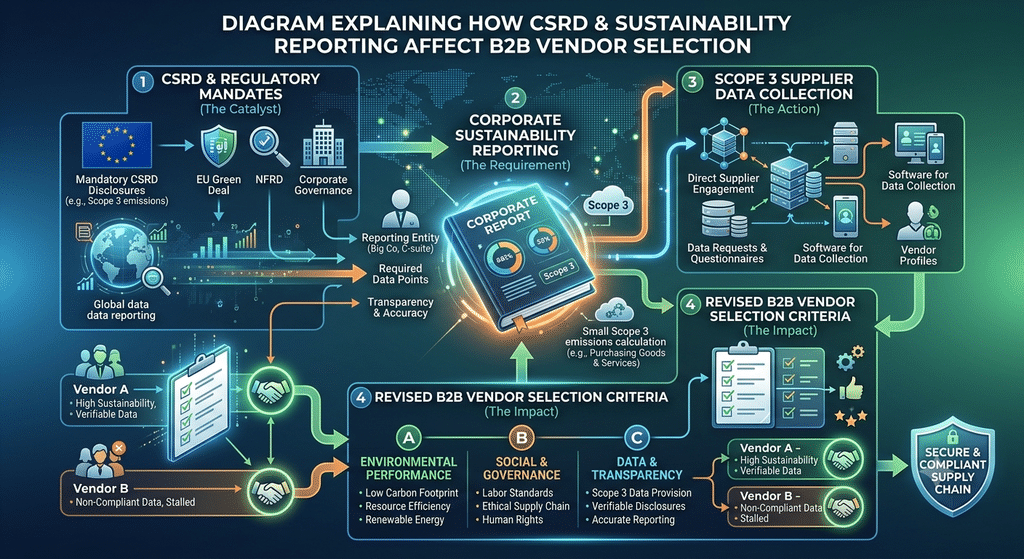
They matter because large, in-scope companies generally can’t produce a complete ESRS-aligned disclosure using only their own operational data. A meaningful share of their reported footprint sits inside their supply chain (so-called Scope 3 emissions and value-chain governance data). That means CSRD and sustainability reporting obligations don’t stay contained to the reporting company; they flow downstream into the vendors that company buys from.
Gartner’s 2026 Chief Procurement Officer Role Agenda research found that sustainability and ESG rank among the top five themes CPOs expect to become urgent over the next six to eighteen months. Separately, Gartner’s Sustainable Procurement Pulse Survey found that 70% of organizations. Now use dedicated sustainability-focused procurement applications to assess suppliers, up from 54% just two years earlier. Vendors who can’t answer basic ESG data requests are increasingly filtered out before price or capability even enter the conversation.
How Is Sustainability Data Actually Used in Vendor Selection Right Now?
It’s used less as a pass/fail compliance gate and more as a screening and scoring input layered onto traditional vendor evaluation. Procurement teams at in-scope companies commonly ask vendors to complete a sustainability questionnaire. Provide emissions or energy-use data, or hold a recognized third-party rating (such as an EcoVadis score) before a contract is finalized.
The practical effect varies by company size and category. A large enterprise vendor may face a detailed ESRS-aligned data request. A smaller vendor is more likely to see a shorter, standardized questionnaire — and under the Omnibus I changes, vendors with 1,000 or fewer employees now have an explicit right to decline requests that exceed a forthcoming EU voluntary reporting standard, which the European Commission is required to finalize by July 2026.
What Has Changed Since the Omnibus I Simplification?
The core change is scope, not intent: fewer companies must report directly. But the companies that remain in scope face the same underlying pressure to source credible supply-chain data. The table below summarizes how the picture shifted.
| Aspect | Before Omnibus I | After Omnibus I (in force March 2026) |
|---|---|---|
| CSRD mandatory scope | Phased in from FY2024 for large public-interest entities and listed SMEs | Narrowed to companies with 1,000+ employees and over €450M turnover |
| Value-chain data requests | Largely undefined; smaller suppliers often faced open-ended requests | Vendors with ≤1,000 employees can refuse requests beyond the upcoming EU voluntary standard |
| Non-EU company timeline | Reporting standards expected from 2027 | First non-EU reporting delayed to FY2028 data, filed in 2029 |
The net result for procurement teams: the list of companies legally required to report shrank. But the ones that remain in scope still need vendor-level data, and now have a clearer. Narrower standard to request it against instead of an open-ended ask.
The S.E.T. Framework: Three Questions Buyers Should Ask Vendors About Sustainability Data
Rather than sending a generic ESG questionnaire, procurement and sustainability teams can evaluate any vendor’s sustainability data using three focused questions. A simple model worth naming so it’s repeatable across your team: the S.E.T. Framework (Scope, Evidence, Trajectory).
- Scope: What exactly does your sustainability data cover? Ask whether the vendor’s figures cover their full operations or only a subset (a single facility, a single product line). Since partial data presented as complete is one of the most common gaps in vendor ESG claims.
- Evidence: Is this data verified, or self-reported? Ask whether emissions or ESG claims are backed by third-party assurance, a recognized rating (like EcoVadis or a CDP score). Or purely internal self-assessment — the difference matters enormously to how much weight you can place on the number.
- Trajectory: What’s the plan if this data doesn’t meet our requirements today? Ask what the vendor is doing to close specific gaps and on what timeline, since very few vendors. Especially smaller ones — will have complete, audited ESG data immediately. And a credible improvement plan is often a more useful signal than a perfect current score.
Applying Scope, Evidence, and Trajectory consistently turns a vague “do you care about sustainability?” conversation into a structured, comparable input across every vendor in a shortlist.
FAQ
What is CSRD and sustainability reporting, and why does it matter for B2B businesses?
CSRD is an EU directive requiring large companies to disclose standardized ESG data, and sustainability reporting is the broader practice of disclosing that kind of performance data. It matters even for companies not directly in scope because in-scope customers increasingly need vendor-level data to complete their own disclosures, which is pulling sustainability questions into ordinary procurement decisions.
How do I choose the right vendor for sustainability data collection and reporting support within my budget?
Start by deciding whether you need a full sustainable-procurement platform (used by 70% of organizations per Gartner’s latest Pulse Survey) or lighter-weight questionnaire and scoring support, since platform costs scale significantly with supplier volume. Prioritize vendors who map directly to ESRS categories rather than generic ESG scoring, so the output is actually usable in a CSRD-linked disclosure.
What checks should I do before outsourcing sustainability data collection or reporting?
Confirm whether the vendor’s methodology aligns with ESRS and recognized standards, and ask for a sample report or dashboard before committing. Check how they handle supplier non-response and partial data, since that’s where most sustainable-procurement programs actually get stuck in year one.
How long does implementing sustainability reporting or supplier ESG screening typically take, and what does it cost?
Standing up a basic supplier ESG questionnaire and scoring process typically takes 4–8 weeks; full ESRS-aligned reporting support for an in-scope company usually runs 3–6 months for the first cycle. Costs range from a few thousand dollars a month for a lightweight scoring tool to mid-five-figures annually or more for full sustainable-procurement platforms at enterprise supplier volumes.
Get Vendor Sustainability Data Right With MyB2BNetwork
Sorting out which vendors can actually meet CSRD-linked sustainability data requests — and which need more time — is exactly the kind of vetting procurement teams shouldn’t have to do from scratch on every RFP. MyB2BNetwork connects procurement and sustainability leads with vetted vendors and platforms that already understand ESRS-aligned reporting, and can help you get accurate, comparable quotes before you commit to a sustainability data or reporting partner.
Explore our vendor sustainability and ESG partners to compare options, or read our related guide on outsourcing vendor evaluation for a broader due-diligence checklist beyond sustainability data alone.
How to Hire, Source, or Outsource Sustainability Reporting Support in the U.S.
Sustainability reporting support is increasingly relevant for manufacturing firms in Ohio supplying EU-linked customers, B2B technology companies in San Francisco navigating investor ESG expectations, and logistics companies in Atlanta responding to customer sustainability questionnaires for the first time. Two things matter most before you bring in outside help.
How to choose a vendor within budget. Filter first by whether you need a full sustainable-procurement platform or narrower questionnaire and reporting support, since that decision affects cost far more than vendor reputation does. Lightweight scoring and questionnaire tools often start in the low thousands per month, while enterprise ESRS-aligned reporting platforms commonly run mid-five-figures annually or more depending on supplier volume — and MyB2BNetwork can help you get accurate, apples-to-apples quotes across vendors at either tier.
How to evaluate vendors. Ask each vendor to walk through how their methodology maps to ESRS categories specifically, not just generic ESG scoring, and request a sample supplier dashboard before signing. Confirm they can handle the reality of incomplete supplier data — since even in-scope companies typically start with significant data gaps in year one — rather than a tool that only works when every supplier responds perfectly.