The headline has been circulating in boardrooms from San Francisco to New York: AI replacing the marketing team. For CMOs, marketing heads, and founders managing lean budgets, this either sounds like a threat or an opportunity — and right now, it is unmistakably both. AI replacing the B2B marketing team is not a future scenario; it is a structural shift already underway, and understanding exactly which roles are at risk, which are irreplaceable, and how to source the right expertise is now a strategic priority.
What Is AI-Driven B2B Marketing Team Transformation?
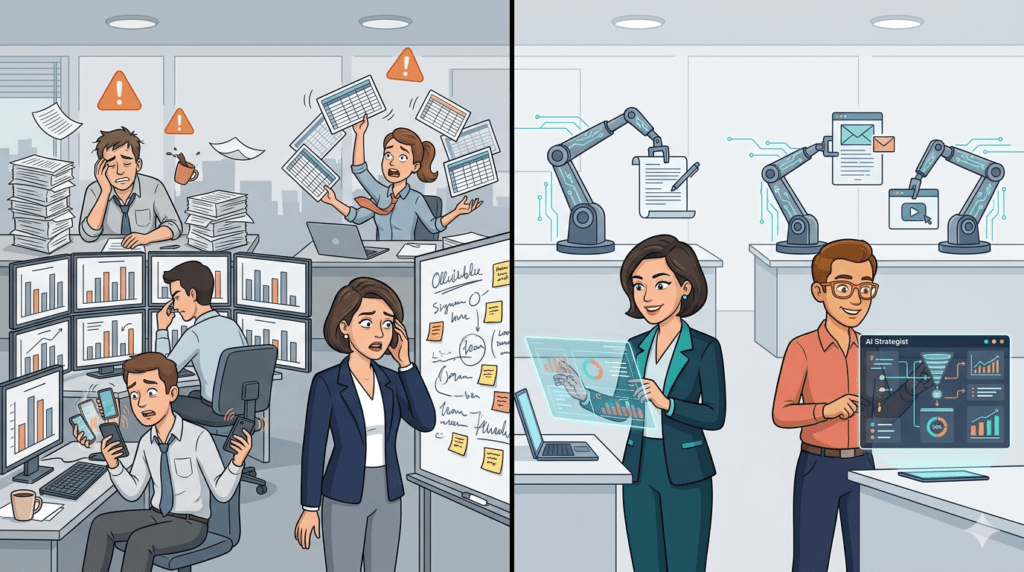
AI-driven B2B marketing team transformation is the systematic replacement, augmentation, or redesign of traditional marketing roles and workflows using artificial intelligence tools — including generative AI, predictive analytics, and agentic automation platforms. It does not mean firing everyone; it means every role is being redefined.
The traditional B2B marketing team model — with dedicated headcount for content writing, SEO, paid ads, email marketing, graphic design, data analysis, and lead scoring — was designed for a pre-AI world where each function required full-time human labor. Generative AI platforms like Jasper, ChatGPT (GPT-4o), HubSpot AI, and Demandbase can now execute many of those tasks in seconds, at a fraction of the cost.
The real transformation is this: marketing is shifting from headcount-heavy task execution to AI-assisted strategic orchestration.
Why AI Replacing B2B Marketing Teams Matters for U.S. Businesses
The economics are impossible to ignore. A full-stack B2B marketing team in the U.S. — covering content, demand gen, SEO, paid, and analytics — can easily cost $600,000–$1.2M annually in salaries alone. AI replacing tools that cover 60–70% of the same output now run $15,000–$60,000/year in platform costs.
This is reshaping team structures at every company size:
- SaaS startups in Austin, TX are launching with 2-person marketing teams backed by AI stacks that previously required 8–10 people
- Fintech firms in New York are using Clay and Demandbase to automate prospecting and ABM campaigns that used to require a 4-person demand gen team
- Healthcare B2B providers in Chicago are deploying AI content tools while maintaining human compliance reviewers to satisfy HIPAA marketing communication requirements
- Manufacturing companies in Ohio are replacing manual trade publication outreach with AI-personalized email sequences, cutting campaign setup time by 70%apricot-studio+1
Regulatory context matters for U.S. teams. When deploying AI in marketing, firms must account for FTC Guidelines on AI-generated content endorsements (updated 2023–2024), CCPA opt-out requirements for AI-driven personalization in California, and CAN-SPAM compliance for AI-generated email sequences. Globally, GDPR restricts AI-driven profiling of EU contacts without explicit consent.
Which B2B Marketing Roles Stay Human vs. Get Automated?
The honest answer: no role is fully automated, but many are dramatically reduced in headcount requirement. Here is a frank breakdown:
Roles That AI Can Now Handle (Reduce Headcount)
- First-draft content writing — Jasper, ChatGPT, Copy.ai generate SEO drafts in minutes
- Email sequence creation — HubSpot AI, Klaviyo AI write and A/B test sequences autonomously
- Basic graphic design — Canva AI, Adobe Firefly generate on-brand social assets
- Lead scoring and segmentation — Demandbase, 6sense, Marketo AI score and tier accounts predictively
- SEO keyword research and briefs — Semrush AI, Frase, Surfer SEO automate brief generation
- Ad copy variants — Google Performance Max, Meta Advantage+ auto-generate and test copy
- Data reporting and dashboards — Tableau AI, HubSpot reporting AI summarize performance
Roles That Remain Irreducibly Human
- Brand strategy and positioning — requires organizational context, stakeholder alignment, competitive intuition
- Thought leadership and executive voice — AI can draft, but authentic POV must come from humans
- Customer relationship management and ABM strategy — relationship nuance, enterprise deal dynamics
- Ethical and legal content review — HIPAA, CCPA, FTC compliance sign-off
- Partner and influencer relationship management — trust-based, relationship-driven
- Creative direction and campaign concept — the “why this idea” judgment that drives breakthrough
The Role Comparison Table
| Marketing Function | AI Automation Level | Human Requirement | Key Tools |
|---|---|---|---|
| Blog/SEO Content (first draft) | 80% automatable | Editing, strategy, EEAT layer | Jasper, Frase, ChatGPT |
| Email Marketing | 70% automatable | Segmentation strategy, compliance | HubSpot AI, Klaviyo |
| Paid Ads Management | 60% automatable | Budget strategy, offer design | Google PMax, Meta Advantage+ |
| Lead Scoring & ABM | 75% automatable | ICP definition, sales alignment | Demandbase, 6sense, Clay |
| Brand Strategy | 5% automatable | Nearly fully human | N/A |
| Executive Content / POV | 15% automatable | Voice, credibility, lived experience | ChatGPT assist only |
| Compliance Review | 0% automatable | Fully human, legally required | N/A |
| Data Analysis | 65% automatable | Insight interpretation, action | Tableau AI, GA4 AI |
How to Outsource AI-Powered B2B Marketing in the U.S.
Outsourcing AI-enabled B2B marketing functions is the fastest way for lean teams to compete with larger departments — and it is increasingly how CMOs at mid-market B2B firms in Atlanta, Chicago, and San Francisco are bridging the gap between AI tool capability and in-house expertise.
Step 1 — Define What You’re Outsourcing
Do not outsource “marketing.” Be specific:
- Are you outsourcing AI content production (blogs, emails, LinkedIn posts)?
- Paid media + AI optimization (Google/Meta/LinkedIn campaigns)?
- Demand generation + ABM (Demandbase, 6sense workflows)?
- Full-stack fractional CMO + AI team?
Each has a different vendor profile, timeline, and budget range.
Step 2 — Build Your Vendor Shortlist and Due Diligence Checklist
Use this checklist when evaluating AI marketing vendors:
- ✅ Can they show a portfolio of AI-assisted B2B campaigns with measurable outcomes (pipeline influenced, MQLs, cost per lead)?
- ✅ Do they disclose which AI tools they use and how human review is layered in?
- ✅ Are they compliant with FTC disclosure requirements for AI-generated content (endorsement guides)?
- ✅ Do they have a data handling policy covering CCPA (for California contacts) and CAN-SPAM for email campaigns?
- ✅ Do they carry data security certifications — at minimum SOC 2 Type II for any vendor accessing your CRM or customer data?
- ✅ Can they name past B2B clients in your industry (SaaS, fintech, healthcare, manufacturing)?
- ✅ What are their SLA terms: content turnaround, campaign go-live timelines, reporting cadence?
- ✅ Is there an IP ownership clause — do you own all content and assets produced?
- ✅ What is the contract exit clause — 30-day or 90-day notice? What happens to active campaigns?
🚩 Red Flags to Watch For
- Claims of “100% AI content” with no human editorial review — FTC risk, and Google’s Helpful Content System actively demotes low-quality AI content
- No ability to name the specific AI tools used in their workflow
- Vague SLAs like “we deliver content regularly”
- No case studies from your industry vertical
- Refuses to share a data processing agreement (DPA) for GDPR/CCPA compliance
- No mechanism for brand voice training or style guide adherence
Step 3 — Ask These Questions Pre-Engagement
- How do you train AI outputs to match our brand voice and ICP?
- What is your content review and quality assurance process before delivery?
- How do you measure marketing performance — what KPIs do you own?
- How do you handle AI hallucinations or factual errors in content?
- Who is our day-to-day point of contact — a strategist or an account coordinator?
- What happens if we want to pause or change scope mid-engagement?
Budget and Timeline Estimates
| Scope | Timeline | Estimated U.S. Budget |
|---|---|---|
| AI content production only (4–8 blogs/mo + social) | 4–8 weeks to full output | $3,000–$8,000/month |
| Demand gen + ABM campaigns (AI-assisted) | 6–10 weeks to launch | $8,000–$20,000/month |
| Full-stack AI marketing team (fractional CMO + execution) | 8–16 weeks to strategic rhythm | $15,000–$45,000/month |
| One-time AI marketing stack buildout + SOP documentation | 6–12 weeks | $20,000–$60,000 fixed |
The PRISM Framework — Evaluating AI Marketing Vendors
This article introduces the PRISM Framework for CMOs evaluating AI marketing vendors:
- P — Portfolio Evidence (real B2B campaigns, named clients, measurable results)
- R — Regulatory Readiness (FTC, CCPA, CAN-SPAM, GDPR compliance documentation)
- I — AI Infrastructure Transparency (which tools, how human oversight works)
- S — SLA Specificity (turnaround times, reporting, escalation paths)
- M — Measurement Ownership (do they own KPIs, or just deliver outputs?)
Score each vendor 1–5 per dimension. Any vendor scoring below 3 in R (Regulatory Readiness) or M (Measurement Ownership) should be disqualified regardless of price.
FAQ: AI Replacing B2B Marketing Teams
Q: Will AI actually reduce the size of B2B marketing teams?
A: For most U.S. companies, yes but gradually and unevenly. Gartner projected that by 2026, 75% of B2B marketing content would be AI-assisted. Teams are not being eliminated; they are being compressed. A team of 8 doing repetitive content and reporting tasks may consolidate to 3–4 strategic roles backed by AI tools.
Q: Which AI tools are CMOs actually using in 2026?
A: The most adopted platforms include HubSpot AI (email, CRM, reporting), Jasper (long-form content), Demandbase and 6sense (ABM and intent data), Clay (prospecting and personalization at scale), Surfer SEO / Frase (content optimization), Canva AI (design), and ChatGPT / Claude (ideation and drafting).
Q: How do I choose an AI marketing vendor within my budget?
A: Start by scoping to one function. Request fixed-fee pilot engagements of 4–8 weeks before committing to a retainer. For fast, accurate, budget-matched quotations from pre-vetted AI marketing vendors, MyB2BNetwork lets you submit a single requirement form and receive summarized quotes — eliminating 4–6 weeks of RFP sourcing time.
Q: How long does it take to outsource and get results from AI B2B marketing?
A: For AI content production (blogs, LinkedIn, emails), expect 4–6 weeks to see consistent output. For demand gen campaigns with meaningful pipeline impact, expect 8–16 weeks to establish performance baselines. For full-stack AI marketing transformation, budget 4–6 months.
Q: Are there ISO or NIST standards relevant to AI in marketing?
A: Yes. The NIST AI Risk Management Framework (AI RMF 1.0) provides governance guidance for deploying AI responsibly — directly applicable to AI marketing tools that process customer data. ISO/IEC 42001 is increasingly requested by enterprise procurement teams when evaluating AI vendors.
Get Accurate AI Replacing Marketing Vendor Quotes with MyB2BNetwork
Whether you are a CMO at a SaaS company in Austin looking to scale content with AI, a founder at a fintech firm in New York building a lean demand gen function, or a marketing head at a healthcare B2B firm in Chicago navigating HIPAA-compliant AI deployment — finding the right vendor at the right price point used to require weeks of RFPs, calls, and proposals.
MyB2BNetwork simplifies this entirely. Submit one form describing your AI marketing requirement scope, budget range, industry, compliance needs — and receive summarized, competitive quotations from pre-vetted B2B marketing vendors. No cold outreach. No wasted discovery calls. Just accurate, budget-matched options delivered to you.
🔗 Submit your AI marketing requirement today → myb2bnetwork.com