
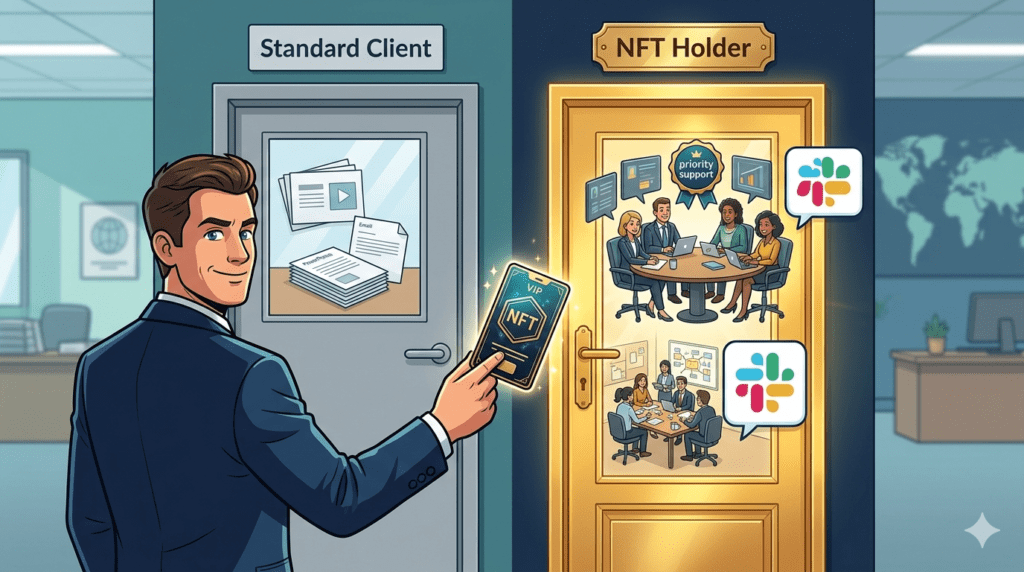
What Are NFT Loyalty Programs?
NFT loyalty programs for B2B are enterprise retention strategies that use blockchain-minted digital tokens — Non-Fungible Tokens — to reward, recognize, and grant exclusive access to high-value enterprise clients. Unlike traditional point-based loyalty schemes, NFT loyalty programs create verifiable, tradeable, and programmable digital assets that clients genuinely own — unlocking token-gated experiences, exclusive content, priority services, and milestone recognition that no spreadsheet-based loyalty programme can replicate.
Enterprise loyalty is broken in most B2B companies.
A SaaS platform renews a three-year contract with an enterprise client. The reward? A generic email saying “Thank you for your continued partnership.” Meanwhile, that same client has been quietly evaluating three competitors for the past quarter.
Traditional B2B loyalty programmes — tiered account management, quarterly business reviews, occasional gifts — were designed for a world where switching costs alone kept clients loyal. That world is disappearing. As enterprise software markets mature, switching costs decline, and buyer expectations rise, the B2B companies winning on retention are those creating genuinely differentiated, high-value client experiences that competitors cannot easily replicate.
NFT loyalty programs represent one of the most innovative retention tools now available to B2B customer success and loyalty teams — and the data is starting to support the investment. Digital collectibles and token-based loyalty mechanisms have demonstrated up to 25% improvement in retention rates in early enterprise adopters, driven by the psychological ownership effect of genuine digital asset ownership and the exclusivity of token-gated access.
This blog explains how NFT loyalty programs work in B2B contexts, what token-gated access looks like for enterprise clients. How minting platforms and wallet connects function in practice. And how customer success leaders and loyalty managers can build NFT-backed retention programmes.
Why Traditional B2B Loyalty Programmes Are Losing Effectiveness
B2B loyalty has historically relied on three mechanisms: relationship depth, switching cost friction, and service quality differentiation. All three are under pressure.
Relationships are thinner than they appear. Key account managers change. Procurement teams rotate. The personal relationships that once anchored enterprise loyalty are increasingly fragile in a world of high executive turnover and remote-first client management.
Switching costs are declining. SaaS-model pricing, API-first architectures, and maturing data portability standards are steadily reducing the technical lock-in that once made switching impractical. A competitor with a better offer and a credible migration path is more viable than ever.
Service quality is table stakes. In mature B2B markets, adequate service quality no longer differentiates — it merely qualifies a vendor for consideration. True loyalty requires something clients value beyond the core product or service.
NFT loyalty programs address this gap by creating a new category of enterprise value: provable, exclusive, programmable membership that clients genuinely own, that signals their status within a vendor’s ecosystem, and that unlocks experiences and access unavailable to standard accounts.
How NFT Loyalty Programs Work in B2B
The core mechanics work like this:
Step 1 — Define loyalty tiers and associated NFTs
Map your existing client segments — onboarding, growth, strategic, and enterprise — to a set of NFT loyalty tiers. Each tier is represented by a distinct digital collectible with unique visual identity and metadata. A new client receives a “Founding Partner” NFT on signing. A three-year renewal triggers a “Legacy Partner” NFT upgrade. A specific revenue threshold unlocks a “Platinum Council” NFT with exclusive access privileges.
Step 2 — Mint NFTs on a business-appropriate blockchain
Using minting platforms designed for enterprise use — such as Thirdweb, Manifold, or custom smart contract deployments on Polygon or Ethereum L2s — the loyalty NFTs are created on-chain with specific metadata encoding the client’s tier, join date, and associated access privileges.
Step 3 — Connect client wallets or manage wallets on their behalf
This is the most important UX decision in any B2B NFT loyalty programme. Enterprise clients should not need to understand crypto wallets to participate. The best implementations use custodial wallet solutions — where the vendor manages the wallet infrastructure and clients access their NFT dashboard through a standard web login — or white-labelled wallet-connect flows that abstract away all blockchain complexity.
Step 4 — Gate premium experiences behind NFT ownership
Token-gated access is where NFT loyalty programmes generate the most tangible business value. NFT holders can be granted:
- Early access to new product features before general availability
- Exclusive seats at private advisory councils and strategy sessions
- Priority access to dedicated senior support engineers
Step 5 — Automate milestone recognition and upgrades
Smart contracts can be programmed to automatically trigger NFT upgrades when clients hit predefined milestones — contract renewal, usage threshold, referral conversion, or certification completion. This removes the manual overhead from loyalty milestone management and creates a transparent, verifiable progression system that clients can trust.
Token-Gated Access: The Strategic Core of B2B NFT Loyalty
Token-gating is the mechanism that turns an NFT from a digital collectible into a genuine business access credential.
In the consumer world, token-gating is used for event access, exclusive merchandise, and community membership. In B2B, token-gating creates a structural differentiation between standard and loyalty clients that cannot be replicated by a competitor offering a discount.
The most valuable token-gated experiences for B2B enterprise clients include:
Private advisory councils
NFT holders at strategic and enterprise tier gain access to a quarterly advisory council with the vendor’s product and leadership team — where they influence roadmap priorities, review beta features. And share strategic challenges. This transforms loyal clients from passive buyers into genuine co-creators. Dramatically increasing switching cost through relationship depth rather than technical lock-in.
Exclusive knowledge communities
Token-gated Slack communities, private Notion workspaces, or curated peer networks where NFT holders share implementation knowledge, benchmark data. And operational best practices with each other — creating a peer-value network that exists only within the vendor’s loyalty ecosystem.
Priority service tiers embedded in smart contracts
Smart contract logic can encode SLA commitments that are automatically enforced based on NFT tier — so a Platinum Partner NFT holder’s support ticket is automatically escalated to senior engineering within two hours, without requiring manual intervention from the customer success team.
Transferable value
Unlike a point balance that evaporates if a client churns, NFTs are genuinely owned digital assets. This creates a fundamentally different psychological relationship with loyalty rewards — one that clients take more seriously because the asset has real, portable value.
Minting Platforms and Wallet Connects for B2B
The technical infrastructure behind B2B NFT loyalty programmes has matured significantly. Customer success teams do not need to understand Solidity or blockchain architecture to deploy an effective programme — they need to understand the four key infrastructure decisions.
Minting Platform Choice
For B2B loyalty use cases, the most practical minting platforms are:
- Thirdweb — developer-friendly, multi-chain, with pre-built contract templates for loyalty and membership NFTs
- Manifold — creator-focused with strong metadata control and direct wallet-connect integrations
- Polygon ID — privacy-preserving identity and credential NFTs particularly suited to B2B compliance-sensitive environments
- Custom EVM smart contracts — for enterprise teams with in-house blockchain development capability who need full control over logic and metadata
Blockchain Selection
Ethereum L2 networks — particularly Polygon and Arbitrum — dominate B2B NFT loyalty deployments due to their low transaction costs, EVM compatibility, and established enterprise integration ecosystem. Minting and transferring NFTs on Polygon costs fractions of a cent, making high-volume enterprise loyalty programmes economically viable.
Wallet Connect Architecture
The wallet UX is the single biggest adoption barrier in B2B NFT programmes. Three approaches work in practice:
- Custodial wallets — vendor manages the wallet, client accesses their NFT through a standard web dashboard with no crypto knowledge required. Best for enterprise clients with no existing Web3 experience.
- WalletConnect integration — clients connect their own MetaMask or similar wallet to the loyalty portal. Best for technology-forward clients who already have Web3 exposure.
- Embedded wallet solutions — platforms like Privy or Dynamic create embedded wallets that appear as standard login flows, abstracting all blockchain complexity behind a familiar email-or-SSO authentication experience.
Metadata and Access Control
NFT metadata should encode not just visual attributes but access privileges — tier level, expiry conditions, associated SLA commitments, and event access rights. This metadata is what the token-gating logic reads when determining whether a client’s wallet qualifies for a specific premium experience.
Building a B2B NFT Loyalty Programme: A Practical Framework
For customer success leaders and loyalty managers approaching this for the first time. A structured launch framework prevents the most common mistakes.
Phase 1 — Map loyalty architecture (Weeks 1–3)
Define loyalty tiers, milestone triggers, associated NFT designs, and token-gated privileges before touching any technology. The loyalty strategy drives the technical decisions — not the other way around.
Phase 2 — Design NFT identity (Weeks 3–5)
Commission unique visual identities for each NFT tier. B2B NFTs do not need to be consumer-style art — they can be clean, professional. Brand-aligned digital credentials that communicate status without requiring aesthetic appreciation from enterprise clients.
Phase 3 — Build minting and wallet infrastructure (Weeks 5–10)
Select minting platform, blockchain, and wallet architecture. Implement custodial wallet solution for client onboarding. Build token-gating logic for each premium experience.
Phase 4 — Pilot with five to ten strategic accounts (Weeks 10–16)
Soft-launch with your highest-value accounts who are most likely to appreciate the innovation. Gather feedback on wallet UX, NFT dashboard experience, and perceived value of token-gated access.
Phase 5 — Full programme launch milestone automation (Month 6+) :
Expand programme to full client base, activate smart contract milestone triggers. And integrate NFT tier data into CRM and customer success platforms for lifecycle management.
FAQ
1. What are NFT loyalty programs for B2B and how do they differ from traditional loyalty schemes?
NFT loyalty programs for B2B use blockchain-minted digital tokens to represent client tier, milestone achievement. And access privileges rather than point balances or tier labels in a CRM. Unlike traditional loyalty schemes, NFT programmes create genuinely owned, verifiable. And programmable digital assets that unlock token-gated experiences unavailable to standard accounts.
2. Do enterprise clients need to understand crypto or wallets to participate in B2B NFT loyalty?
No — with custodial wallet solutions and embedded wallet platforms like Privy or Dynamic. Enterprise clients can access their NFT loyalty dashboard through standard email or SSO login with no crypto knowledge required. The best B2B NFT loyalty implementations make the blockchain layer completely invisible to the end user.
3. How does token-gated access create business value in B2B contexts?
Token-gating restricts premium experiences — advisory councils, priority support tiers, exclusive communities, co-creation opportunities — to verified NFT holders, creating a structural differentiation between standard and loyalty clients that no competitor can replicate by simply offering a discount. The exclusivity is verifiable, programmable, and genuinely valuable.
4. Which minting platforms are best suited to B2B NFT loyalty programmes?
Thirdweb and Manifold are the most practical starting points for most B2B teams due to their developer-friendly architecture, multi-chain support, and pre-built contract templates. Enterprise teams with compliance requirements should evaluate Polygon ID for privacy-preserving credential NFTs. Teams with full blockchain development capability can deploy custom EVM smart contracts for maximum control.
5. How do you measure the ROI of a B2B NFT loyalty programme?
The primary ROI metrics are retention rate improvement among NFT programme participants versus non-participants. NPS delta between tier groups, contract renewal rates and expansion revenue from loyalty tier clients, and engagement rates with token-gated premium experiences. Secondary metrics include referral rates from loyalty tier clients and advisory council participation rates.
Build Your B2B NFT Loyalty Programme With the Right Specialists
NFT loyalty programme design spans brand strategy, smart contract development, wallet UX, token-gating architecture. And customer success integration — a cross-functional challenge that most in-house teams are not equipped to own end-to-end.
If your customer success or loyalty team needs support designing an NFT loyalty framework, building minting and wallet infrastructure, or integrating token-gated access into your existing client experience. MyB2BNetwork connects you with vetted developers, loyalty programme specialists, blockchain UX experts who have delivered these programmes for B2B organisations
Submit one requirement. Receive competitive quotations from pre-screened providers. We scope your project, validate offers, schedule meetings, support negotiations, and protect every payment through secure escrow. So your NFT loyalty investment builds genuine enterprise retention, not just blockchain novelty.
[Submit your NFT loyalty or Web3 customer success requirement on MyB2BNetwork →]
With havin so much content do you ever run into any problems of plagorism or copyright infringement?
My site has a lot of exclusive content I’ve either created myself or
outsourced but it appears a lot of it is popping
it up all over the internet without my permission. Do you
know any methods to help protect against content from being ripped
off? I’d definitely appreciate it.
Thanks for raising this, it’s a common challenge with original content. At myb2bnetwork, we tackle this by using canonical tags, monitoring tools like Copyscape, and issuing DMCA takedowns when needed. While it’s hard to stop completely, these steps help protect content and maintain SEO authority.