SDR vs BDR sounds like a job-title quibble, but it decides who owns your pipeline and what you pay to build it. The clean split most guides use is simple: an SDR (sales development representative) qualifies the inbound leads marketing creates, while a BDR (business development representative) prospects cold accounts to create outbound pipeline. Whether to outsource either one depends on your sales motion, your data and your lead volume.
The confusion is real. Prospeo’s 2026 benchmark roundup found that only about 25% of companies split inbound and outbound into separate roles, so many teams use “SDR” and “BDR” interchangeably. That means a job post, a vendor pitch and an internal org chart can each mean something different.
This Q&A walks through the questions sales leaders, founders and RevOps teams ask most: what each role does, how they compare, and when it makes sense to hand the work to an outside team. You’ll also get a three-gate test for the outsourcing decision.
A note on evidence: many cost and performance figures come from vendor-published 2026 guides. They agree on direction but not on exact numbers, so treat them as planning ranges.
What Is SDR vs BDR? The Core Difference
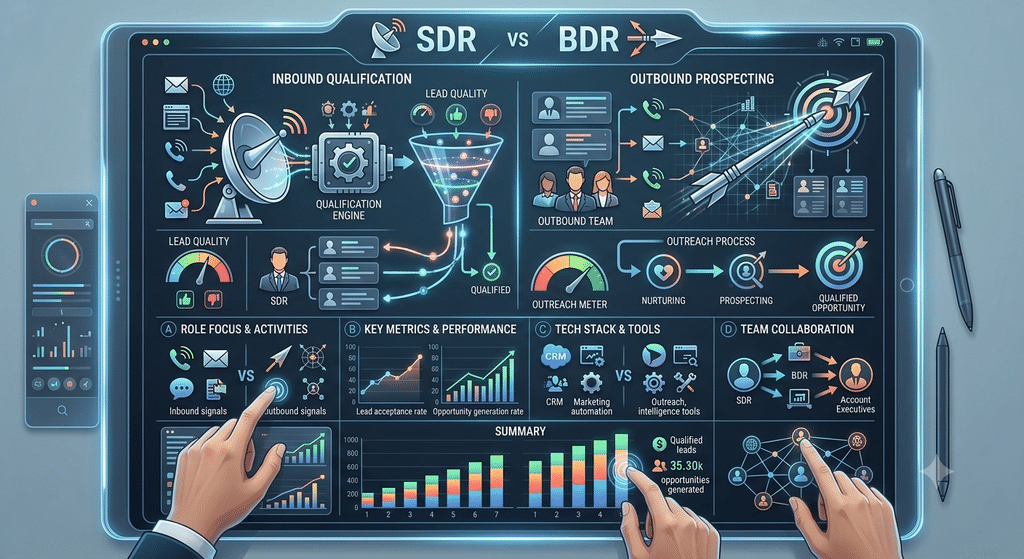
The core difference in SDR vs BDR is direction: SDRs work inbound demand, and BDRs create outbound demand. An SDR follows up on demo requests, content downloads and marketing-qualified leads, checking fit and booking a meeting. A BDR researches target accounts that have never heard of you and opens the conversation cold.
Both hand qualified meetings to an account executive (AE), who owns the close. The title matters less than the ownership. Someone has to own inbound, someone has to own outbound, and the handoff to the AE has to be clear.
Why Does SDR vs BDR Matter for Revenue Teams?
It matters because the seat is expensive to fill and slow to pay back. The Bridge Group’s 2025 study of 351 B2B companies, as summarized by Prospeo, found average ramp time of about 3.0 months and average tenure of about 1.9 years. That leaves roughly 20 months of fully productive time per rep, and then you hire again.
It also matters because buyers have little patience for generic outreach. Gartner’s 2025 sales survey found that 61% of B2B buyers prefer a rep-free buying experience. Reps who reach out need a specific reason to be there, which is what cold-outreach teams that are relevance-first have already learned.
How Do SDR and BDR Roles Compare Side by Side?
SDRs and BDRs differ in lead source, channels and what success looks like, though they share the same end goal of a qualified meeting.
| Dimension | SDR (inbound) | BDR (outbound) |
|---|---|---|
| Primary focus | Qualify leads marketing generates | Create pipeline from cold target accounts |
| Lead source | Forms, demo requests, content downloads | Self-sourced lists, account research, signals |
| Typical channels | Email, phone, chat follow-up | Cold email, calls, LinkedIn |
| Core skill | Speed and qualification | Research, persistence and personalization |
| Success metric | Qualified meetings from inbound leads | Qualified meetings from targeted accounts |
| Average ramp | About 3 months (Bridge Group, 2025 study) | About 3 months (Bridge Group, 2025 study) |
Inbound work lives or dies on speed, which is why how fast vendors reply to inbound leads is such a revealing benchmark.
Which Tools Do SDRs and BDRs Use?
Most teams run a CRM, a sales engagement platform, a data provider and a call or conversation tool. Common choices include Salesforce or HubSpot for CRM, Outreach or Salesloft for sequencing, LinkedIn Sales Navigator and ZoomInfo or Apollo for data, and Gong for call review.
Tooling adoption differs by motion. The Bridge Group data cited by Prospeo reports that 84% of teams running both inbound and outbound use sales engagement platforms, against 72% of inbound-only teams.
When Should You Outsource SDR or BDR Work?
Outsource when you need meetings faster than you can hire and ramp, or when you want to test a motion before committing headcount. Outsource first-wave outbound especially, then reassess. Prospeo’s outreach guide describes a common pattern: teams outsource the first wave, validate messaging and ICP, then bring appointment setting in-house.
Outsourcing tends to fit when:
- You have a clear ICP but no sales development manager or tooling yet.
- Pipeline demand is spiky, or the segment or region is new and unproven.
- You’d rather pay for booked meetings than carry unproductive ramp months.
Keep work in-house when:
- Deals are complex and early conversations need deep product judgment.
- Inbound volume is steady and needs tight alignment with marketing.
- You handle sensitive customer data that you can’t easily share.
Outsourcing also carries risks: brand voice, a loose definition of “qualified,” and handoff leaks to your AEs. Put the definitions in writing before you start.
How Do You Decide? The D3 Outsourcing Test
The D3 Outsourcing Test checks three things in order: Direction, Data and Demand. I built it for this article to turn a vague “should we outsource?” into three yes-or-no questions.
- Direction. Is the gap inbound or outbound? Outbound prospecting is usually the easier piece to outsource. Inbound qualification depends on speed and marketing context, so it’s harder to hand off.
- Data. Do you have a written ICP, a clean CRM and a definition of a qualified meeting? Surfe’s guidance is to hire for the gap, but not before you have an ICP and clean data. Outsourcing on top of messy data just spends money faster.
- Demand. Is volume steady enough to keep a dedicated rep busy? Prospeo cites roughly 300+ inbound leads per month as a rule of thumb for a full-time inbound qualifier. Below that, outsource or combine the roles.
How to read the result: outbound gap, data ready and demand unproven suggests a 90-day outsourced pilot. Steady demand and strong data points toward in-house or a hybrid. A “no” on Data means fix that first, whoever does the work.
FAQ
What is SDR vs BDR and why does it matter for B2B businesses?
SDRs qualify inbound leads and BDRs build outbound pipeline, and both feed meetings to account executives. It matters because ramp averages about 3.0 months and tenure about 1.9 years, per the Bridge Group study, so a mis-scoped hire is costly to correct.
How do I choose the right SDR or BDR outsourcing vendor within my budget?
Decide first whether you need inbound qualification, outbound prospecting or both. Then compare vendors on cost per qualified meeting rather than monthly sticker price, and ask each one to define “qualified” in writing.
What checks should I do before outsourcing SDR or BDR work?
Ask for client references in your industry, sample sequences, who the actual reps will be, and how data and reporting are handled. Confirm compliance practices for calling and email, and agree exit terms before you sign.
How long does SDR vs BDR outsourcing typically take and what does it cost?
Vendor guides describe outsourced programs producing meetings within 2–4 weeks, versus 3–6 months to hire and ramp in-house. Outsourced programs commonly run $3,000 to $15,000 per month depending on scope and channels, per 2026 guides from RevNew and Cleverly.
Turn Sales Development Into Pipeline With MyB2BNetwork
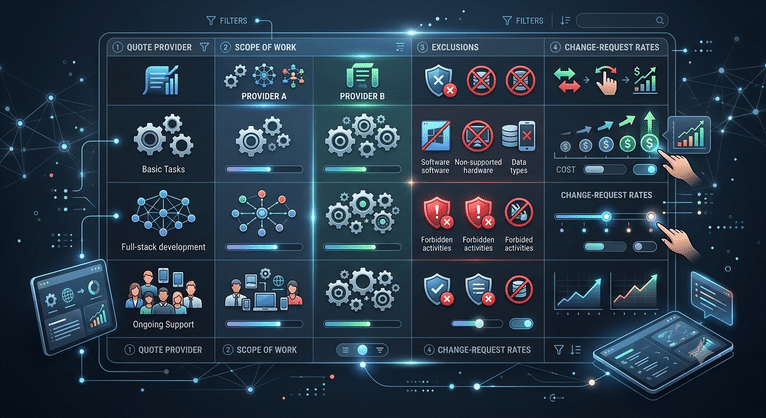
If the D3 test points toward outsourcing, the next challenge is finding a partner that fits your motion. MyB2BNetwork connects sales leaders and founders with vetted SDR and BDR outsourcing providers, and can gather comparable quotations for your exact scope so you’re not comparing sticker prices alone.
Browse the B2B outsourcing marketplace to shortlist providers and see how each one defines a qualified meeting before you commit.
How to Hire, Source, or Outsource SDRs and BDRs in the U.S.
Teams from SaaS startups in Austin to fintech firms in New York and B2B firms in San Francisco weigh the same trade-off: build a sales development team or rent one. Two things matter most.
Choosing a vendor within budget. Benchmarks cited by Sales Focus (drawing on the Bridge Group, SalesHive and AiSDR) put a fully loaded in-house SDR at $102,000 to $160,000 per year, including salary, benefits, tools, management and ramp drag. Outsourced SDR programs commonly run $3,000 to $15,000 per month, often with 3–6 month minimums and setup fees. MyB2BNetwork can get accurate quotations for your scope. Hiring in-house takes 3–6 months before a rep books consistently, while outsourced teams are typically producing in 2–4 weeks, per vendor guides.
Checks before outsourcing. Ask how the vendor handles email under the FTC’s CAN-SPAM rules and calling under the FTC’s Telemarketing Sales Rule, including Do Not Call lists; have counsel confirm how those apply to your outreach. If the vendor touches customer data, ask for SOC 2 or ISO 27001 evidence and check CCPA practices. Request references, named reps, a written definition of a qualified meeting and a cost-per-meeting trend by month four. Red flags include per-meeting pricing with no “qualified” definition, no named team and no exit terms.