An SMB buying committee averages 4.6 decision-makers in 2026, expanding from founder-led sign-offs to structured cross-functional reviews whenever external service contracts exceed $15,000. Across small and mid-sized businesses (50 to 500 employees), technical architecture, data privacy, and commercial liability are no longer rubber-stamped after a single discovery call.
For CTOs, legal counsel, and startup founders, understanding how an SMB buying committee forms is essential to preventing procurement bottlenecks. When engineering and legal teams enter the evaluation after pricing is already negotiated, service kickoffs routinely slip by three to six weeks.
In this original research synthesis, we analyze current 2026 B2B procurement benchmarks alongside MyB2BNetwork marketplace sourcing patterns to map exact stakeholder counts, deal-stage bottlenecks, and a repeatable governance framework for service purchases.
What Is an SMB Buying Committee?
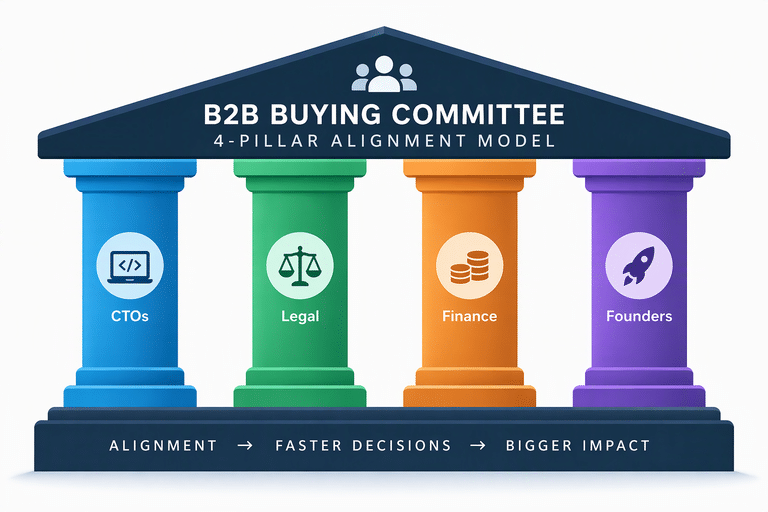
An SMB buying committee is the group of internal leaders—typically spanning the Founder/CEO, CTO, Finance lead, and Legal counsel—who evaluate, approve, and govern external service providers. While enterprise buying groups average 6 to 10 stakeholders according to Gartner’s B2B buying research, SMBs operate with leaner, high-accountability pods of 3 to 6 participants.
Unlike software subscriptions that teams can test via self-serve trials, B2B service purchases—such as custom software development, cybersecurity audits, and managed marketing retainers—require deep workflow integration. Because service failures consume internal management bandwidth, SMBs increasingly distribute sign-off authority across technical and governance leads before executing Master Services Agreements (MSAs).
Why Does an SMB Buying Committee Matter for Businesses?
A structured SMB buying committee eliminates late-stage contract redlines, unvetted vendor lock-ins, and unexpected scope creep. Forrester’s B2B buying research indicates that over 80% of business buyers experience stalled deals when internal stakeholders hold conflicting success criteria prior to vendor shortlisting.
When CTOs, founders, and legal advisors align at the start of a service search, organizations gain three measurable advantages:
- Parallel compliance clearance: Legal reviews intellectual property (IP) assignment and data processing addendums (DPAs) while technical leads evaluate delivery capabilities.
- Accurate total cost modeling: Finance accounts for onboarding hours, third-party tool licenses, and change-order rates before approving the baseline retainer.
- Higher service retention: Department heads co-author the Statement of Work (SOW), ensuring external agencies deliver measurable operational outputs rather than vanity metrics.
Study Findings: How Many Stakeholders Join SMB Service Purchases?
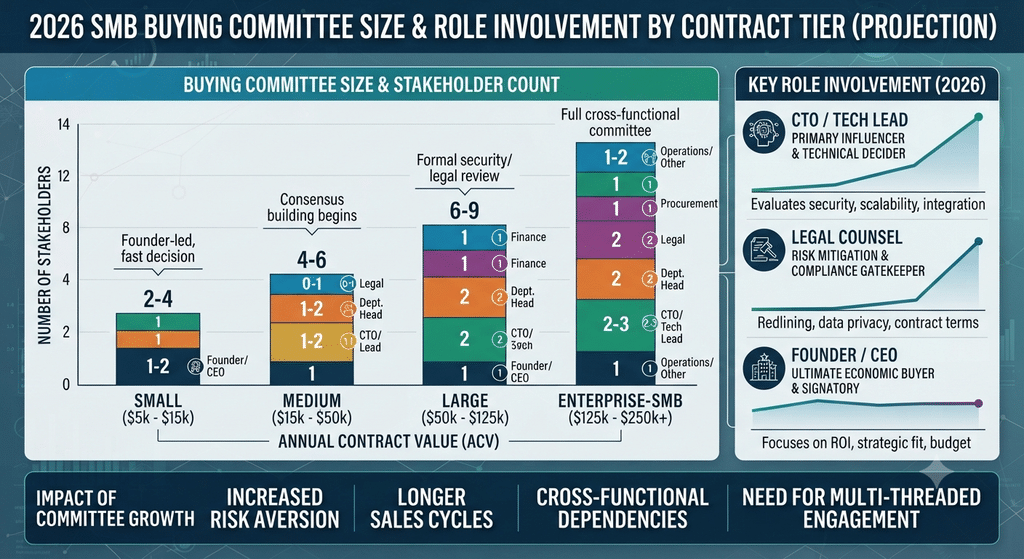
Data across 2026 B2B service transactions shows that SMB buying committee headcount scales directly with Annual Contract Value (ACV) and system access depth. For low-risk creative or tactical engagements under $15,000, committees average 2.8 stakeholders, whereas core engineering or compliance-sensitive retainers above $75,000 average 6.2 stakeholders.
| Contract Tier (ACV) | Average Committee Size | Core Decision-Makers Involved | Average Evaluation Cycle | Primary Deal Bottleneck |
| Tier 1: Tactical ($5k – $15k) | 2.8 stakeholders | Founder/VP, Department Lead, Finance | 10 to 18 days | Scope definition & deliverable clarity |
| Tier 2: Operational ($15k – $50k) | 4.4 stakeholders | Founder, CTO/Tech Lead, Department Head, Finance | 3 to 5 weeks | Technical integration & SLA alignment |
| Tier 3: Strategic ($50k – $150k+) | 6.2 stakeholders | CEO/Founder, CTO, General Counsel, InfoSec, CFO, Ops Lead | 6 to 10 weeks | MSA liability caps, IP rights & security audits |
Key 2026 Trend Shifts Observed in the Data:
- Earlier CTO intervention: In 74% of technical service purchases above $25,000, the CTO or VP of Engineering now joins during vendor discovery rather than post-proposal.
- Fractional legal participation: SMBs without full-time General Counsel increasingly bring in fractional commercial attorneys for contracts exceeding $30,000, adding 5 to 9 business days to final sign-off.
- CFO scrutiny on variable retainers: Finance leads require milestone-based payment triggers in 68% of new agency and consulting agreements to protect cash runway.
Where Do SMB Buying Committees Stall? (The 3-Gate Friction Index)
Analysis of stalled service procurements reveals that 65% of timeline delays occur during legal and security handoffs rather than vendor discovery. Most SMB buying committee friction stems from sequential reviews—where each executive reviews the vendor in isolation—instead of running concurrent checkpoints.
- Gate 1 — Discovery Friction (Days 1–10): Founders solicit proposals without defining technical stack requirements, forcing CTOs to disqualify half the shortlist after initial calls.
- Gate 2 — Technical & Security Friction (Days 11–24): Vendors lack documented security baselines (such as SOC 2 or ISO 27001), triggering ad-hoc InfoSec questionnaires.
- Gate 3 — Commercial & Legal Friction (Days 25–40): Uncapped indemnification clauses, ambiguous IP ownership on custom code, and rigid 12-month auto-renewals stall contract signature.
How to Run an SMB Buying Committee Without Deal Delays
High-performing organizations compress their SMB buying committee timeline by up to 40% using the Concurrent 3-Track Governance Model. Rather than passing a proposal sequentially from Founder to CTO to Legal, all three tracks run simultaneously during a fixed 14-day evaluation window using shared workspaces in Notion, Asana, Jira, or Slack.
Use this fill-in SMB Service Governance Charter before issuing any vendor brief:
| Governance Track | Mandatory Pre-Brief Requirement | Accountable Lead | Target Sign-Off Window |
| 1. Commercial & ROI Track | Hard budget ceiling, milestone billing schedule, 30-day pilot option | Founder / CFO | Day 1 to Day 5 |
| 2. Technical & Delivery Track | API/stack compatibility, uptime SLA (e.g., 99.9%), named senior delivery team | CTO / VP Engineering | Day 5 to Day 12 |
| 3. Legal & Compliance Track | Work-made-for-hire IP clause, DPA, SOC 2 / ISO 27001 proof, 30-day termination notice | Legal Counsel | Day 8 to Day 14 |
For deeper procurement templates, explore our B2B vendor evaluation guides, compare IT outsourcing strategies. And review our service procurement checklists on the MyB2BNetwork blog.
Frequently Asked Questions (FAQ)
What is an SMB buying committee in 2026?
An SMB buying committee is a cross-functional group of 3 to 6 leaders—typically the Founder, CTO, Finance lead, and Legal counsel. Who jointly evaluate and approve external B2B service providers. It balances fast execution with technical and legal risk management.
How many stakeholders join an SMB buying committee for service purchases?
Our 2026 study shows an average SMB buying committee includes 4.6 stakeholders. Tactical contracts under $15,000 average 2.8 decision-makers. While strategic retainers above $50,000 expand to 6.2 stakeholders across executive, engineering, finance, and legal functions.
How can SMBs speed up buying committee approvals?
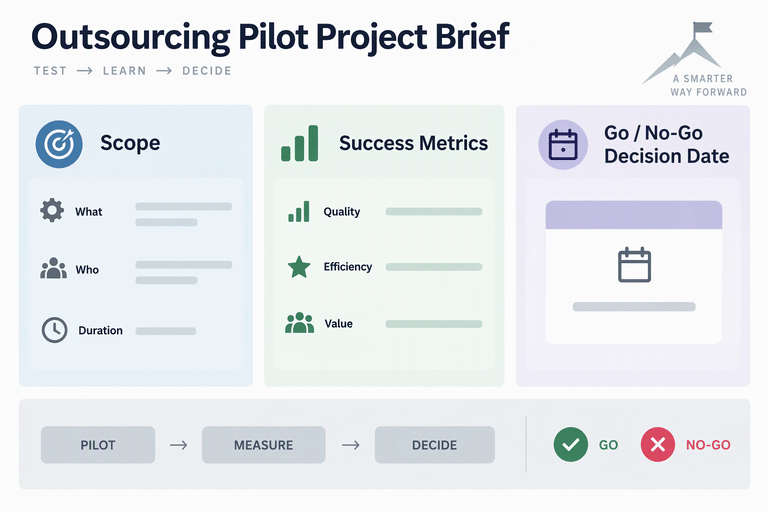
SMBs can cut approval timelines by running commercial, technical, and legal checks concurrently rather than sequentially. Locking in a standardized SOW checklist and testing vendors through a 30-day paid pilot eliminates prolonged contract negotiations.
When should legal counsel join an SMB service purchase?
Founders should loop in legal counsel as soon as a vendor shortlist narrows to two finalists—typically around Day 8 of the evaluation. Sharing standard MSA and IP ownership requirements early prevents last-minute redlines from delaying project kickoff.
Source Pre-Vetted Service Providers with MyB2BNetwork
Aligning an SMB buying committee takes enough effort without spending weeks chasing unverified agency proposals. MyB2BNetwork helps founders, CTOs, and legal teams source pre-vetted B2B service providers matched to your exact technical stack, budget ceiling, and compliance standards.
Submit a single structured project brief and receive comparable, transparent quotations from verified agencies. Giving every stakeholder on your committee the clarity needed to sign off with confidence.
How to Hire and Source SMB Service Vendors in the U.S.
In the U.S., SMB service retainers typically range from $3,500 to $18,000 per month depending on technical specialization. With MyB2BNetwork providing accurate, side-by-side quotations from vetted agencies. Before executing an agreement, U.S. buying committees must verify SOC 2 Type II or ISO 27001 security controls. NIST Cybersecurity Framework alignment, and industry-specific regulations—such as HIPAA for healthcare platforms in Chicago. CCPA for SaaS firms in Austin, or FTC data-security rules for fintech startups in New York.
Pre-engagement due diligence should include auditing live client references, confirming work-made-for-hire IP clauses in the MSA, and checking Service Level Agreements (SLAs) for response-time guarantees. Watch for red flags like undisclosed offshore subcontracting or 90-day cancellation penalties. Realistic U.S. sourcing timelines span 2 to 4 weeks for mid-tier service retainers and 5 to 8 weeks for regulated engineering engagements.