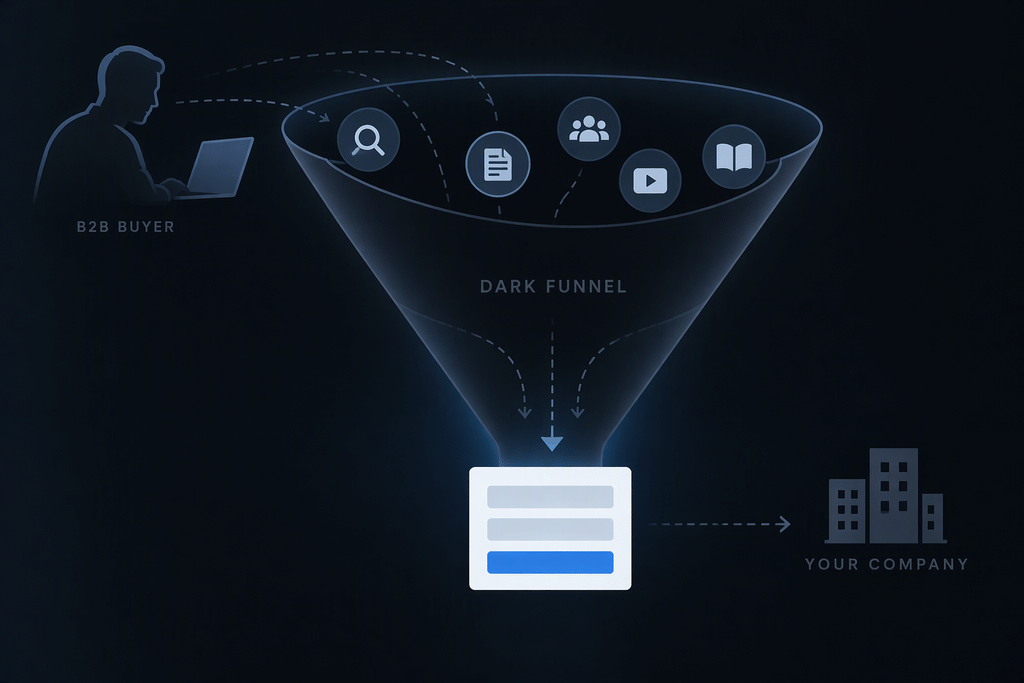
The dark funnel is the part of the B2B buying journey your analytics can’t see: the private research buyers do through peer chats, review sites, analyst reports, communities, and AI assistants before they ever fill in your form. By the time a prospect appears in your CRM, most of the decision may already be made. If you only measure form fills, you are measuring the last step of a much longer process.
The newest large-scale data supports this. 6sense’s 2026 Global B2B Buyer Experience Report finds buyers first engage sellers roughly 59% of the way through an average 10.3-month cycle, after 91.4% have already ranked their shortlist. The vendor they favored before making contact goes on to win 82% of the time.
That changes where founders, CTOs, and legal leads should look. Founders need to be known before the evaluation starts. CTOs need to capture signals analytics can’t collect on its own. Legal needs to make sure the attempt to see into the dark funnel doesn’t create privacy risk.
This report pulls together the most recent published buyer surveys, adds our own framework for measuring and influencing the dark funnel, and gives you a survey you can run yourself to get first-party numbers for your market.
What Is the Dark Funnel?
The dark funnel is the set of buyer research activities and influences that happen outside your tracked channels, so they never appear in web analytics, CRM, or ad platforms. Typical examples include a colleague recommending a vendor in a private Slack, a midnight read of a comparison page, or a question to an AI assistant asking for a vendor shortlist.
The term is a label, not a measurement. It describes a blind spot, and the size of the blind spot varies by survey, which is why the numbers below differ from year to year.
Why Does the Dark Funnel Matter for B2B Businesses?
It matters because it is where shortlists are formed, and shortlists decide most deals. 6sense’s 2025 study of nearly 4,000 buyers found that 95% of winning vendors were on the buyer’s day-one shortlist. If you aren’t in the room at that stage, your sales team is competing for what’s left.
It also explains a frustrating pattern: inbound leads that arrive “ready to buy” with a long list of requirements. Those buyers did their homework privately, and your form fill is the first time you learn about it.
What Do the Latest Surveys Say About Private Buyer Research?
The evidence from independent surveys points the same way, even though the exact percentages differ. Here are the headline findings, each with its source:
- 6sense, 2026 Global B2B Buyer Experience Report: first seller contact at about 59% of a 10.3-month journey, 91.4% had ranked a shortlist beforehand, and the pre-contact favorite won 82% of the time.
- 6sense, 2025 study (nearly 4,000 buyers): first contact came 61% of the way through the journey, down from 69% in 2024, and the average cycle was 10.1 months.
- Gartner, 2025 sales survey: 61% of B2B buyers prefer a rep-free buying experience.
- Gartner, May 2026: 69% of B2B buyers turn to sales reps to validate AI-generated insights, which suggests AI research feeds into, rather than replaces, human conversations.
- G2, April 2025 (1,169 decision-makers): 29% of buyers start research with an AI chatbot instead of Google, as reported by Prospeo’s roundup.
- Forrester, 2024 Buyers’ Journey Survey: 92% of buyers enter a formal purchase with at least one vendor in mind, as reported by Komo’s glossary.
Two cautions apply. 6sense sells intent-data software, so its research serves its market, though the methodology is published. And the 6sense contact-point figure moved from 69% to 61% to 59% across three years, so treat any single number as a snapshot, not a constant.
Where Does Private Buyer Research Actually Happen?
It happens in places you don’t control and often can’t see. Mapping them helps you decide where to be present and what to measure.
| Dark funnel channel | Visible in your analytics? | How to capture it |
|---|---|---|
| Peer chats, Slack and WhatsApp groups | No | Self-reported “how did you hear about us” field |
| AI assistants (ChatGPT, Perplexity, Gemini) | Partly, when a click carries a referrer | Referral filters plus self-reported field |
| Review and comparison sites | Partly, if the buyer clicks through | Profile presence and UTM-tagged links |
| Analyst reports and industry content | No | Win/loss interviews and sales-call notes |
| Podcasts, communities, and events | No | Branded search lift and promo codes |
Notice that most rows depend on asking the buyer, not tracking them. That is the central lesson of the dark funnel.
How Do You Measure and Influence the Dark Funnel? The 3-Layer Dark Funnel Audit
Use what we’ll call the 3-Layer Dark Funnel Audit to turn an invisible problem into a short checklist:
- Observe. Track the proxies analytics can see: branded search volume, direct traffic to deep pages, and AI referral visits. Rising numbers without matching campaigns suggest private influence.
- Ask. Add an open-text “How did you hear about us?” field to forms and log the answer in your CRM. Run a short buyer survey (see below) every quarter.
- Influence. Invest where shortlists are formed: credible third-party reviews, clear public pricing and scope, helpful content that AI tools can cite, and consistent presence in the communities your buyers use.
Each layer covers a gap in the others. Observation shows that something is happening, asking tells you what, and influence is where you act on it.
How Do You Run Your Own Dark Funnel Survey?
The most credible original data is the data you collect from your own buyers. A short survey sent to recent customers and lost deals can answer questions no industry report can. Keep it under five minutes and ask:
- When you first started researching this type of service, where did you look first?
- Roughly how many vendors were on your list before you contacted anyone?
- Which sources did you trust most: peers, reviews, analysts, vendor sites, or AI assistants?
- Did you use an AI assistant at any point, and for what?
- How far into your decision were you when you first contacted us?
- What finally prompted you to fill in a form or book a call?
- Who else was involved in the decision, and which of them researched independently?
- What would have made you contact us sooner?
Aim for responses from both won and lost buyers, and report the sample size and dates alongside every number you publish. That transparency is what makes first-party research believable.
FAQ
What is the dark funnel and why does it matter for B2B businesses?
The dark funnel is the private research buyers do before they contact you, through channels your analytics can’t track. It matters because 6sense’s 2026 report found buyers had ranked a shortlist before first contact in 91.4% of cases, so influence before the form fill often decides the deal.
How do I choose the right vendor to help me measure the dark funnel within my budget?
Match the vendor to the layer you need: analytics setup for observing, survey and interview work for asking, or content and community programs for influencing. Ask for a sample deliverable and be wary of anyone who claims they can fully reveal anonymous buyers.
What checks should I do before outsourcing dark funnel research?
Make sure the vendor works in your own analytics and CRM accounts and that you keep the survey data. Ask how respondents are recruited and how consent and personal data are handled, and get sample sizes and methodology written into the deliverable.
How long does dark funnel research typically take and what does it cost?
A survey project usually takes four to eight weeks from design through analysis, and an analytics and attribution setup commonly takes two to four weeks. Costs range from a small project fee to ongoing retainers or software subscriptions, depending on scope.
See Into the Dark Funnel With MyB2BNetwork
If you know your buyers are researching privately but don’t have the capacity to survey them, fix your attribution, or build shortlist presence, MyB2BNetwork can help. We connect founders, CTOs, and legal teams with vetted research, analytics, and demand-generation partners and help you compare quotes side by side before you commit.
Founders can find partners who run buyer surveys and win/loss interviews. CTOs can get matched with specialists in analytics, CRM fields, and tracking. Legal teams can compare vendors on consent and data handling before any buyer data is collected. You can also reach buyers who are already searching for providers, so you show up earlier in the shortlist.
To go deeper, read how AI referral attribution captures AI-driven visits, why service leads go cold once they finally do appear, and what a good website-to-lead conversion rate looks like for B2B services. Then ask MyB2BNetwork for matched partner quotes.
How to Hire, Source, or Outsource Dark Funnel Research in the U.S.
Companies across the U.S. outsource this work, from SaaS startups in Austin and fintech firms in New York to B2B companies in San Francisco and healthcare technology teams in Chicago. Two things matter most.
Choosing a vendor within budget. Scope drives price. A buyer survey and analysis project commonly runs from a few thousand dollars to the mid-five figures depending on sample size, while attribution and tracking setup typically costs less as a one-time project. Intent-data and account-based platforms are usually priced as annual subscriptions, often in the tens of thousands of dollars or more. These are approximate market ranges, and MyB2BNetwork can get accurate quotations for your scope. Prioritize vendors who publish their methodology and sample sizes.
Checks before outsourcing. Ask how the vendor handles consent and personal data under CCPA and, for EU or UK respondents, GDPR or UK GDPR. Any follow-up email should comply with the FTC’s CAN-SPAM rules, and any public claim you make from the research should be backed by data you can show, in line with FTC rules on substantiation. A SOC 2 report or ISO 27001 certification is a reasonable baseline if the vendor will hold respondent or CRM data. Plan roughly four to eight weeks for a survey project and two to four weeks for an attribution setup.