Most sales teams chase new logos harder than they chase existing accounts. That habit is expensive. Acquiring a new customer typically costs far more than expanding one who already trusts you. Yet expansion revenue is often the least resourced motion inside a B2B company. Account managers feel this gap directly. They watch accounts hit usage ceilings, add new teams, or hint at bigger needs. Without a system to catch those signals, expansion opportunities slip past unnoticed. The account renews at the same size, quarter after quarter, when it could have grown. B2B account expansion isn’t about aggressive upselling. It’s about noticing the moment an account is genuinely ready for more, then acting on it before a competitor or a budget cycle closes the window. That timing is everything.
This piece defines account expansion clearly, explains why it deserves more investment, walks through the signals that predict readiness, and gives account managers a simple checklist to track those signals consistently.
What Is B2B Account Expansion?
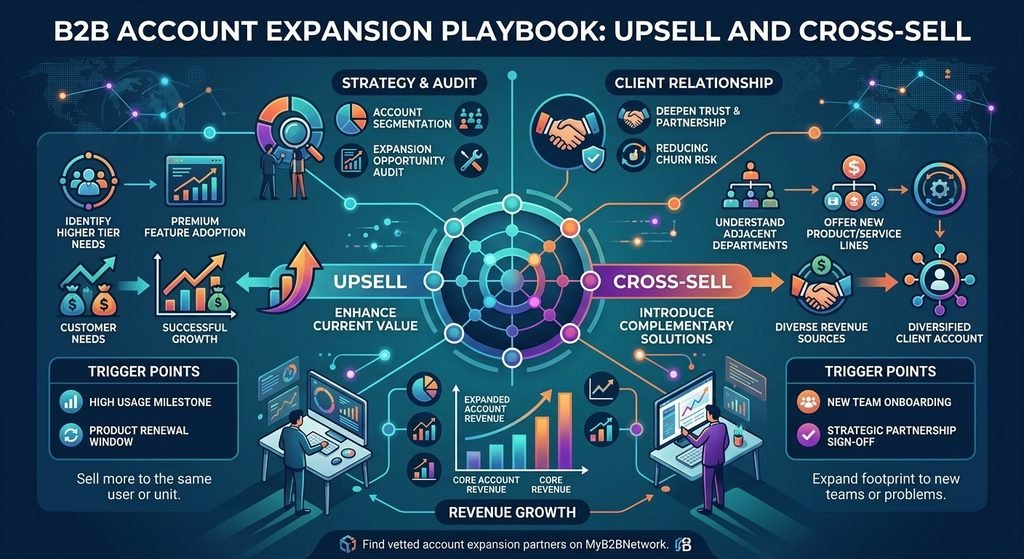
B2B account expansion is the practice of growing revenue from an existing customer through upsells, cross-sells, or added seats, rather than through new customer acquisition. It covers everything from adding a premium tier to introducing a customer to a second product line.
Expansion differs from renewal. Renewal keeps revenue flat. Expansion grows it. A healthy account management motion treats these as two separate goals, tracked with separate metrics, not one blended renewal conversation.
Why Account Expansion Matters for B2B Businesses
Direct answer: expansion matters because it is consistently cheaper and faster than new-logo acquisition, yet most companies underfund the team responsible for spotting it.
A few reasons the math favors expansion:
- Lower cost per dollar of revenue. Expansion revenue typically costs a fraction of new-logo acquisition, since there’s no need to rebuild trust from zero.
- Faster sales cycles. An existing customer already trusts your product, which shortens procurement and legal review compared to a brand-new deal.
- Higher net revenue retention. Gartner’s research on customer success has long tied strong net revenue retention to overall company valuation and growth efficiency.
Despite this, many companies still staff new-logo sales teams far more heavily than expansion-focused account management. That imbalance is where the opportunity sits.
Why Expansion Gets Under-Invested Despite the Upside
Direct answer: expansion gets under-invested because its wins are quieter and harder to attribute than a new-logo deal closing with fanfare.
A new logo shows up cleanly in a sales dashboard. An expansion often starts as a small usage increase, an offhand comment in a check-in call, or a slow creep in support ticket volume. These signals are easy to miss without a defined process for catching them.
Three common reasons expansion stays under-resourced:
- Account managers are measured on retention, not growth, so expansion falls outside their formal goals.
- No shared system exists to flag readiness signals before they go stale.
- Expansion conversations feel riskier than renewal conversations, so reps avoid raising them.
The Signals That Show an Account Is Ready to Expand
Direct answer: readiness usually shows up as a change in behavior, not a change in stated intent, so account managers need to watch usage and context, not just what the customer says.
Common signals worth tracking:
- Usage nearing a limit. Seats, storage, or feature usage approaching a plan’s cap often precede an upgrade request.
- New teams touching the product. When a second department starts using the tool organically, that’s a strong cross-sell signal.
- Champion promotion. A internal champion getting promoted often expands their influence and budget authority inside the account.
- Positive support ticket shift. Tickets shifting from complaints to feature requests usually signal growing reliance on the product.
- Headcount growth at the account. A customer that’s hiring is a customer that will likely need more seats soon.
IDC’s research on customer lifecycle management has repeatedly found that usage-based signals predict expansion far more reliably than satisfaction surveys alone, since satisfaction is self-reported and usage is observed behavior.
Tools and Platforms That Track Expansion Signals
Direct answer: modern account teams pair a product usage analytics tool with a customer success platform, so signals get flagged automatically instead of relying on memory.
Commonly used tools in this stack:
- Product usage analytics — platforms like Pendo and Amplitude surface feature adoption and usage trends inside the product itself.
- Customer success platforms — tools like Gainsight and Totango centralize health scores, renewal dates, and expansion flags in one view.
- CRM-integrated alerts — Salesforce and HubSpot workflows can trigger a task the moment a usage threshold or renewal window is hit.
None of these tools replace human judgment. They just make sure a real signal doesn’t quietly disappear inside a busy account manager’s inbox.
A Framework for Tracking Readiness: The GROWTH Signal Checklist
Rather than relying on memory or gut feel, account managers can run every account through a simple checklist we’ll call GROWTH — six signals worth a monthly check:
- G — Growing usage. Is usage of seats or key features trending upward month over month?
- R — Renewal window near. Is the renewal date within the next ninety days?
- O — Onboarding new teams. Has a new department started using the product without being asked?
- W — Wins being cited. Has the customer referenced a clear ROI result internally or in a review call?
- T — Ticket sentiment shifting. Are support tickets trending toward feature requests instead of complaints?
- H — Headcount growing. Is the account’s own company visibly hiring or expanding its team?
An account showing three or more GROWTH signals is usually ready for an expansion conversation. An account showing none is better served by a straightforward renewal check-in instead.
FAQ
What is B2B account expansion and why does it matter for B2B businesses?
It’s the practice of growing revenue from existing customers through upsells and cross-sells rather than new deals. It matters because expansion revenue is typically far cheaper to generate than new-customer acquisition.
How do I choose the right partner for account expansion support within my budget?
Look for a partner with real case studies showing net revenue retention improvement, not just renewal rate maintenance. Match the engagement type to your gap, whether that’s signal tracking, playbook design, or hands-on account management capacity.
What checks should I do before outsourcing expansion or customer success work?
Review past client retention and expansion metrics, not just satisfaction scores. Confirm the vendor understands your product’s usage data and can integrate with your existing CRM or customer success platform.
How long does expansion program outsourcing typically take, and what does it cost?
Expect four to eight weeks to build a working signal-tracking process, with a fuller embedded account management engagement running three to six months before results become clearly measurable.
Want Help Building an Expansion Motion?
Spotting expansion signals consistently takes process, not just good intentions. MyB2BNetwork connects account management and customer success teams with vetted partners who specialize in retention and expansion strategy. Find expansion and customer success partners on MyB2BNetwork.
Hiring or Outsourcing Account Expansion Support in the U.S.
Two things matter most when a U.S. company brings in outside help for account expansion: budget fit and due diligence on data access.
On budget, a focused signal-tracking and playbook engagement typically runs $3,000–$7,000 per month, while a fuller embedded account management program can land in the mid-five-figures to low-six-figures annually. MyB2BNetwork can help source accurate, vetted quotations instead of relying on a single vendor’s rate card.
On due diligence, confirm the vendor’s data handling practices meet standards like SOC 2 and, where relevant, HIPAA or CCPA, especially if your accounts include regulated industries. This applies whether you’re a SaaS company in Austin, a healthcare business in Chicago, or a fintech firm in New York managing sensitive account-level usage data.