What Is a High-Performing B2B Blog?
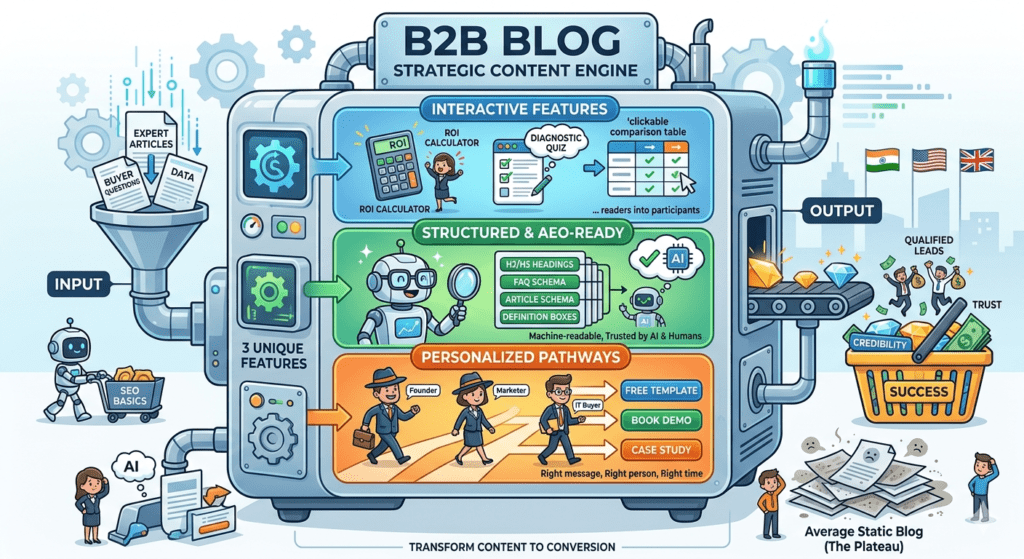
A high-performing B2B blog is more than a collection of articles. It is a strategic content engine that builds credibility, answers buyer questions, and generates qualified leads. The best B2B blogs combine clear expertise, interactive features, and structured content that search engines, answer engines, and real buyers all trust equally.
Here is a scenario most B2B content marketers know too well.
You have published consistently for months. Your articles are well-written. The SEO basics are in place. But the traffic is flat, the bounce rate is stubborn, and the leads are not coming through the way you expected.
Sound familiar?
The problem is rarely the writing. More often, it is the features around the content. The elements that turn a blog from a passive reading experience into an active, lead-generating asset are missing.
According to the Content Marketing Institute, B2B brands that use advanced content features — such as interactive tools, personalised CTAs, and structured data — generate up to 202% more leads than those relying on static content alone.
This blog breaks down the 3 unique features that can take your blog to the next level — and shows how B2B marketers across India, the US, and the UK are already using them to outperform competitors in organic search and buyer engagement.
Why Most B2B Blogs Plateau After the First Few Months
Many mid-level marketers invest heavily in publishing frequency but underinvest in content infrastructure. A blog that lacks interactive depth, structured signals, and personalization quickly becomes invisible in competitive SERPs.
What separates top-performing B2B blogs from average ones is not volume — it is the experience they create for the reader.
The 3 features below fix that problem directly.
Feature 1: Turning Passive Readers Into Active Participants
The first feature that separates a growing blog from a stagnant one is interactivity.
Most B2B blogs present information and then stop. Readers consume it and leave. There is no reason to engage further, no way to personalise the experience, and no trigger to convert.
Interactive features change that completely.
What Interactivity Looks Like in Practice
- Calculators and self-assessment tools — A marketing ROI calculator embedded in a blog post on lead generation strategy keeps readers engaged far longer than text alone.
- Quizzes and diagnostic tools — “Which B2B marketing channel is right for your business?” quizzes generate email sign-ups while delivering genuine value.
- Clickable comparison tables — Filterable tables that let buyers compare vendor options or service tiers make your content genuinely useful, not just informative.
- Embedded polls or micro-surveys — Short, one-question polls embedded mid-post generate first-party data and boost time-on-page significantly.Real-world example: A SaaS company in Bangalore added an interactive “lead scoring readiness” quiz to their pillar blog post on B2B pipeline metrics. Within 60 days, that single page was generating 4x more email captures than their standard CTA at the bottom of the same article.
Interactivity works because it gives the reader something to do, not just something to read. For B2B buyers in particular, who are often evaluating options under time pressure, a tool that helps them think through their own problem is perceived as expertise in action.
If you are exploring social media marketing tools or B2B social platforms to amplify your blog reach, pair that distribution with interactive content on the blog itself. The combination of broad reach and deep engagement is what drives qualified lead generation.
Feature 2: The One Structural Change That Dramatically Improves Search Visibility
The second feature is something many marketers overlook entirely — structured content formatting with schema markup and AEO-ready design.
This is not just about making your blog look clean. It is about making it machine-readable so that Google, AI answer engines, and voice search assistants can extract and surface your content as a direct answer.
Why Structure Matters More Than Ever
Answer engines like Google’s AI Overviews, Perplexity, and Bing Copilot are pulling answers directly from structured content. If your blog is not formatted to be easily parsed, it will not appear in those answers — no matter how good the writing is.
Here is what AEO-ready blog structure looks like:
- Clear H2 and H3 headings that mirror the way buyers phrase questions.
- Bullet-pointed takeaways under every major section.
- FAQ sections at the bottom of each article with five buyer-focused questions.
- Definition boxes or “What Is…” sections at the top of every post.
- Table of contents with anchor links for long-form articles.
- FAQ schema, Article schema, and HowTo schema embedded in your page code.
When your blog content answers a question in a clearly structured way, it becomes eligible for featured snippets, People Also Ask boxes, and AI-generated answer inclusions.
A Concrete Example
A B2B content team in the UK restructured their existing blog posts — no new writing, only structural changes — and saw a 41% increase in organic click-through rate within three months. Simply adding H3 question-style subheadings and a FAQ block to existing content moved several pages into featured snippet positions.
This is why the 3 unique features that can take your blog to the next level always includes structure as a non-negotiable. You can have brilliant ideas, but if the architecture is wrong, search engines will overlook them entirely.
For marketers focused on growing your network online or targeting best channels for B2B marketers, structured blog content is the foundation that makes every other channel work harder. When your articles rank in featured positions, your LinkedIn posts, email newsletters, and paid promotions all benefit from that credibility halo.
Feature 3: Personalized Content Pathways That Keep Buyers Engaged Longer
The third feature is content personalization — the ability to show different CTAs, related articles, or content upgrades based on who the reader is and where they came from.
This might sound complex, but even basic personalization dramatically improves the buyer experience and increases conversion rates.
What Smart Content Personalization Looks Like
- Audience-specific CTAs — A blog post read by a founder deserves a different CTA than the same post read by a mid-level marketer. Showing the right next step to the right person increases click-throughs meaningfully.
- Dynamic related content blocks — Recommending the next article based on the reader’s industry or role (using UTM data or cookie behavior) keeps readers on your blog longer and builds topical authority.
- Content upgrades — Offering a downloadable checklist, template, or guide relevant to the specific article being read converts casual readers into leads. A blog post on B2B content authority might offer a free “Content Audit Template” as a content upgrade.
- Geo-relevant examples and references — A reader in India appreciates case studies from Indian markets. A reader in the US wants US-specific context. Mentioning both signals geographic relevance and makes content feel personally written.Why this works: Studies from HubSpot show that personalised CTAs convert 202% better than generic ones. In B2B, where buying cycles are long and trust is earned slowly, every small improvement in relevance compounds over time.
For B2B marketers experimenting with social commerce strategies or multi-channel distribution, personalization ensures that when a prospect lands on your blog from any channel, they find an experience tailored to them — not a generic page that treats every visitor identically.
How These Three Features Work Together
Used in isolation, each feature lifts performance. Used together, they create a content flywheel.
Interactive content increases time-on-page and captures data. Structural optimization ensures that content gets found through search and answer engines. Personalization ensures that the right message reaches the right buyer at the right time.
Here is how a well-optimized B2B blog post works when all three features are active:
- A marketing head in Chicago finds your article through a Google AI Overview (powered by AEO structure).
- She engages with an embedded ROI calculator (powered by interactivity).
- She sees a CTA offering a downloadable guide relevant to her industry (powered by personalization).
- She submits her email. She becomes a lead.
That sequence is what separates B2B blogs that generate pipeline from those that generate pageviews.
What B2B Marketers in Competitive Markets Are Doing Differently
Top-performing B2B content teams in markets like India, the US, and the UK are not just publishing more frequently. They are investing in content infrastructure.
Hire UX designers to build interactive tools. They train their content teams on schema markup. Use marketing automation to personalize content paths based on CRM data.
The good news for mid-level marketers is that you do not need a large team or a massive budget to start. Each of the 3 unique features that can take your blog to the next level can be implemented incrementally.
Start with structure — it costs nothing but time. Then add one interactive element to your highest-traffic post. Then test one personalized CTA against a generic one. Measure. Iterate.
What B2B Marketers Actually Ask About Blog Optimization
1. What are the most important features for a B2B blog?
The three most impactful features are interactivity (tools, quizzes, calculators), AEO-ready structure (clear headings, FAQ schema, definition blocks), and content personalization (audience-specific CTAs and dynamic content upgrades). Together, they increase both search visibility and lead conversion.
2. How do I make my B2B blog rank in AI-generated answers?
Structure your content with clear H2/H3 headings that mirror buyer questions, add FAQ sections with direct answers, use schema markup, and keep your introductory definitions concise and accurate. AI answer engines prioritize structured, authoritative content over long, unformatted text.
3. Does blog personalization require expensive tools?
Not necessarily. Basic personalization can be achieved with HubSpot, ConvertKit, or even smart use of UTM parameters. Start with personalized CTAs based on traffic source — it is low cost and measurably effective.
4. How often should I update existing blog posts?
High-traffic posts should be reviewed every six months. Updating statistics, improving headings, adding new examples, and refreshing CTAs can significantly increase rankings without creating new content from scratch.
5. What interactive content works best for B2B blogs?
ROI calculators, self-assessment quizzes, vendor comparison tables, and downloadable checklists perform best for B2B audiences. They work because they help buyers think through their own decisions — which builds trust faster than passive content alone.
Your Blog Deserves More Than Good Writing
Great content deserves great execution. If you are ready to implement interactive features, structured formatting, or personalized content pathways — but need specialized support to build them — MyB2BNetwork helps you connect with vetted content marketing, SEO, and marketing automation specialists who can deliver exactly what your blog needs.
Submit one requirement. Receive multiple competitive quotations from pre-vetted providers. Our team scopes your project, validates the offers, schedules meetings, supports negotiations, and ensures secure payments through escrow — so every milestone is protected.
Whether you need a content strategy overhaul, a technical SEO partner, or a full-stack marketing team, we connect you with the right specialists — saving you time, budget, and the guesswork of sourcing on your own.
[Submit your requirement on MyB2BNetwork →] and take your blog from content to conversion.