What Is LinkedIn Video Marketing?
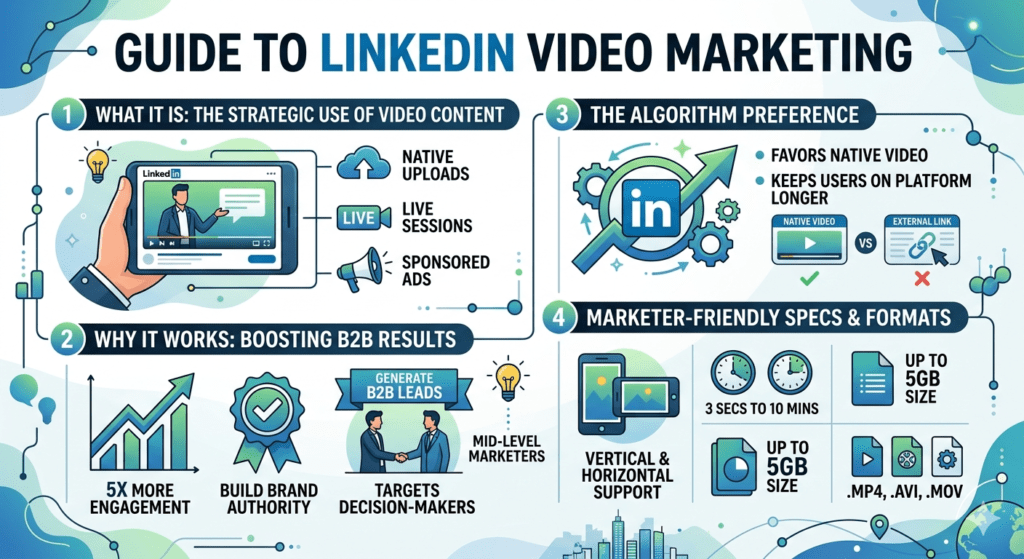
LinkedIn video marketing is the strategic use of video content — native uploads, live sessions, or sponsored ads — on LinkedIn to build brand authority, engage professional audiences, and generate B2B leads. It targets decision-makers, founders, and mid-level marketers in a professional setting where video consistently outperforms every other content format.
Think about the last piece of content that made you stop scrolling.
Chances are, it was a video.
Not a long article. Not a text post with five bullet points. A video — something that showed a face, told a story, or made a point in under sixty seconds that would have taken three paragraphs to explain in writing.
Now imagine that same moment happening inside a platform where your entire target audience — procurement managers, marketing directors, founders, and C-suite decision-makers — is already active, already professional-minded, and already open to business conversations.
That is LinkedIn. And that is exactly why LinkedIn video marketing is making such an impact on B2B brands across India, the US, the UK, and every other market where digital trust drives purchasing decisions.
LinkedIn native video launched in 2017, and the data since then has been impossible to ignore. Video posts on LinkedIn generate five times more engagement than text-based posts, and that gap is only growing as more B2B buyers shift to visual content consumption as their default mode of research and evaluation.
This blog unpacks the why, the how, and the what-to-do-next for mid-level marketers ready to make video a core part of their B2B content engine.
The Quiet Shift That Changed How B2B Buyers Consume Content
A few years ago, LinkedIn was almost entirely text-driven. Thought leadership lived in long-form articles. Engagement came from status updates, industry news, and comment threads.
That world still exists. But it is no longer the dominant one.
B2B buyers — especially those under 45 — now consume content the same way they do in their personal lives. They scroll fast, they skim headlines, and they stop for video. The rise of short-form video on Instagram Reels, YouTube Shorts, and TikTok has fundamentally rewired audience attention. And LinkedIn, aware of this shift, has leaned into video harder than most people realize.
The result? A professional platform now behaving more like a visual-first content channel — and rewarding brands that adapt accordingly.
Why the LinkedIn Algorithm Quietly Favors Video Creators
Here is something many mid-level marketers do not fully appreciate: LinkedIn’s algorithm actively prioritizes video content in the feed.
Native video — content uploaded directly to LinkedIn rather than shared via an external link — gets significantly more organic reach than the same content posted as a link to YouTube or Vimeo. The platform wants users to stay on LinkedIn. Video keeps them there longer. So the algorithm rewards it.
This means that a well-crafted 60-second native video from a mid-level marketer at a growing B2B company can legitimately outreach a polished article from a much larger brand. The playing field is more level than most people assume.
For B2B marketers using social media marketing tools to manage content across multiple platforms, understanding this algorithmic preference is the difference between content that gets seen and content that disappears into the feed.
What Makes LinkedIn’s Video Specs Genuinely Marketer-Friendly
One reason why LinkedIn video marketing is making such an impact is simply that LinkedIn does not make video hard to produce or publish.
Unlike some platforms that restrict duration, impose resolution limits, or penalize non-native formats, LinkedIn’s video specifications are genuinely broad:
- Duration: 3 seconds to 10 minutes for native video.
- File size: 75KB to 5GB.
- Resolution: 256×144 all the way up to 4096×2304 (4K).
- Frame rates: 10 to 60 frames per second.
- Orientation: Both horizontal and vertical supported.
- Formats accepted: MP4, AVI, MOV, MKV, WebM, and many more.
The support for both horizontal and vertical orientation is particularly valuable. With mobile accounting for a growing majority of LinkedIn sessions, vertical video — designed specifically for phone screens — performs exceptionally well for mid-funnel engagement.
This flexibility means a scrappy startup in Jaipur can produce a simple talking-head video on a smartphone and compete for the same feed real estate as a well-funded enterprise brand in London or New York.
Native Video vs. LinkedIn Video Ads: Choosing Your Format
Not all LinkedIn video is created equal. Understanding the difference between native video and video ads helps marketers allocate budget and effort correctly.
| Format | Who Posts It | Cost | Reach | Best For |
|---|---|---|---|---|
| Native Video | Any LinkedIn user | Free | Organic, algorithm-dependent | Thought leadership, brand building |
| LinkedIn Video Ads | Company pages via Campaign Manager | Paid | Targeted, broader reach | Lead generation, product awareness |
| LinkedIn Live | Pages and profiles with access | Free | Real-time, high-engagement | Events, Q&A, product launches |
Native video works best for building trust and establishing expertise. It feels authentic and approachable — two qualities that matter enormously in B2B buying decisions.
Video ads offer precision targeting by industry, job title, company size, and geography. For B2B marketers in competitive markets targeting best channels for B2B marketers in regions like Southeast Asia, the Middle East, or Western Europe, LinkedIn video ads deliver audience specificity that no other platform matches.
LinkedIn Live is still underused and, as a result, still rewards early adopters with outsized organic reach.
The Content Types That Actually Convert for B2B Brands
Knowing that video works is one thing. Knowing what kind of video to produce is where most marketers struggle.
Here are the formats consistently driving results on B2B social platforms like LinkedIn:
Short Insight Videos (Under 60 Seconds)
Quick, value-dense clips that share a single insight, tip, or counterintuitive take. These work because they respect the viewer’s time and deliver a clear payoff fast.
Behind-the-Scenes and Process Videos
Showing how your team works, how your service is delivered, or how a client problem was solved builds a level of authenticity that written content rarely achieves. Buyers in India, the US, and the UK consistently cite transparency as a top trust signal.
Client Testimonial and Case Study Videos
A client speaking about results on camera is worth ten written testimonials. Video testimonials convert because they are harder to fake and easier to relate to. They directly support the Trustworthiness pillar of Google’s E-E-A-T framework.
Educational “How-To” Videos
Teaching something genuinely useful — without immediately pitching — builds authority and keeps viewers coming back. These perform especially well for thought leadership video content in niche B2B verticals.
Event Recap and Conference Highlights
Short clips from industry events, webinars, or panels signal that your brand is active, credible, and embedded in its professional community.
The Psychology Behind Why Video Builds Trust Faster
Here is a question worth sitting with: why does video close the trust gap so much faster than written content?
The answer is partly neurological. Human beings are wired to read faces, body language, and tone of voice as trust signals. When a founder explains their company’s values on video, the viewer is not just processing the words — they are evaluating credibility, sincerity, and competence in a way that text simply cannot replicate.
For B2B buyers making high-value, high-risk purchasing decisions, that subconscious trust evaluation matters enormously. A confident, clear video from a service provider can do in 90 seconds what a 2,000-word service page takes weeks to achieve.
This is a core reason why LinkedIn video marketing is making such an impact specifically in B2B — where trust is the currency that unlocks every deal.
Metrics That Tell You If Your LinkedIn Video Is Actually Working
Posting video without measuring performance is one of the most common mistakes B2B marketers make. LinkedIn’s analytics dashboard provides meaningful data — but only if you know what to look for.
Track these metrics for every video:
- View count — LinkedIn counts a view at 3 seconds, so high views with low completion rates signal weak hooks.
- Video completion rate — The percentage of viewers who watch to the end. Above 25% is strong for B2B video.
- Engagement rate — Reactions, comments, and shares as a percentage of impressions.
- Click-through rate (for video ads) — The percentage of viewers who click through to your landing page or lead form.
- Profile visits post-view — A strong indicator of interest that goes beyond passive consumption.
For teams using social media marketing tools like Hootsuite, Sprout Social, or HubSpot, these metrics can be tracked alongside your broader content performance to understand which video topics and formats drive the most pipeline activity.
How Marketers in India, the US, and UK Are Using LinkedIn Video Differently
Geographic context matters when building a LinkedIn video strategy. Audiences in different markets engage with content in subtly different ways.
In India, LinkedIn video content focusing on career growth, industry insights, and founder journeys tends to generate the highest engagement. The platform’s rapid user growth in Tier 1 and Tier 2 cities means there is significant organic reach available for early movers.
In the US, thought leadership and data-driven insight videos perform strongly. American B2B audiences respond well to confident, direct content that leads with a clear point of view.
In the UK, tone matters. British professional audiences tend to prefer understated, evidence-led content over aggressive self-promotion. Case study videos and educational breakdowns consistently outperform hype-driven content.
Understanding these nuances helps mid-level marketers tailor their LinkedIn engagement strategy by geography — a key differentiator for brands operating across multiple markets.
The Compounding Effect Most Marketers Miss
Here is the insight that separates LinkedIn video beginners from those who build lasting authority: video compounds.
A single insightful video published today can continue generating views, profile visits, and connection requests for months. Unlike a LinkedIn text post — which typically peaks within 48 hours and then disappears — a native video indexed by LinkedIn’s search algorithm keeps working long after publication.
When you combine that long-tail reach with the engagement advantages of video, the compounding effect becomes a serious competitive advantage. Brands that grow your network online through consistent LinkedIn video presence do not just see better engagement — they see a gradual shift in how their industry perceives them.
That shift — from vendor to authority — is what makes LinkedIn video marketing a strategic investment, not just a content tactic.
What Stops Most B2B Marketers From Starting (And Why It Doesn’t Matter)
The most common objection to LinkedIn video marketing is not budget or platform knowledge. It is camera confidence.
Most mid-level marketers know video works. They have seen the data. They believe the strategy. But they hesitate because being on camera feels uncomfortable, or because they do not have a professional studio, or because they are not sure what to say.
Here is the truth: authenticity outperforms production value on LinkedIn every single time.
A genuine, slightly imperfect video from a real person sharing a real perspective will outperform a polished, over-produced corporate video in almost every engagement metric. LinkedIn users are professionals — they have strong radar for content that feels scripted or performative.
Start simple. A smartphone, good natural light, and a clear 60-second point of view is enough to begin. The confidence comes from doing, not from waiting until everything is perfect.
Stop Waiting for the Perfect Moment to Start
The B2B brands generating pipeline through LinkedIn video today did not wait until they had a studio, a professional editor, or a 10-video series planned. They started with one clear message, one genuine perspective, and one upload.
If you are ready to build a LinkedIn video strategy but need specialist support — from video production and scriptwriting to social media management and marketing automation — MyB2BNetwork connects you with vetted marketing service providers who can deliver exactly what your brand needs.
Submit one requirement. Receive multiple competitive quotations from pre-screened specialists. We scope your project, validate the offers, schedule meetings, support negotiations, and protect your investment through secure escrow payments.
Whether you need a video content team, a LinkedIn ad specialist, or a full-service digital marketing partner, we find the right fit — faster and with far less risk than sourcing alone.
[Submit your LinkedIn video marketing requirement on MyB2BNetwork →] and start turning professional content into qualified pipeline.