What Is a Blog Content Plan?
A blog content plan is a structured framework that defines what topics you will cover, who you are writing for, how often you will publish, and how each piece supports your business goals. It removes guesswork from content creation and ensures every article serves a clear purpose — from attracting organic traffic to converting leads.
Let’s be honest about something most content marketers quietly know but rarely say out loud.
Most B2B blogs do not fail because of bad writing. They fail because there was never a real plan behind them.
A founder in Bengaluru decides to “start blogging” for SEO. A mid-level marketer in Manchester gets assigned to “produce more content.” A growth team in Austin starts publishing because a competitor is ranking and they want a piece of it.
Three months later, the blog has eight articles with no connecting thread, no keyword strategy, and no clear audience in mind. Traffic is flat. Leads are zero. The team moves on.
Sound familiar?
The solution is not more content. It is a smarter plan. According to the Content Marketing Institute, B2B organisations with a documented content strategy are 3x more likely to report success than those without one. Yet fewer than 40% of B2B teams have a written plan in place.
This blog walks you through the 3 steps for creating a blog content plan that actually works — for B2B teams in India, the US, the UK, and every other market where organic content drives pipeline.
Why Most B2B Content Plans Fall Apart Before They Start
The biggest mistake mid-level marketers make is confusing a content calendar with a content plan.
A calendar tells you when to publish. A content plan tells you why, for whom, and how it fits together. Without the strategy behind the schedule, a calendar is just a list of deadlines attached to random topics.
A real content plan begins with clarity — about your audience, your goals, and the competitive landscape you are entering. Everything else flows from that foundation.
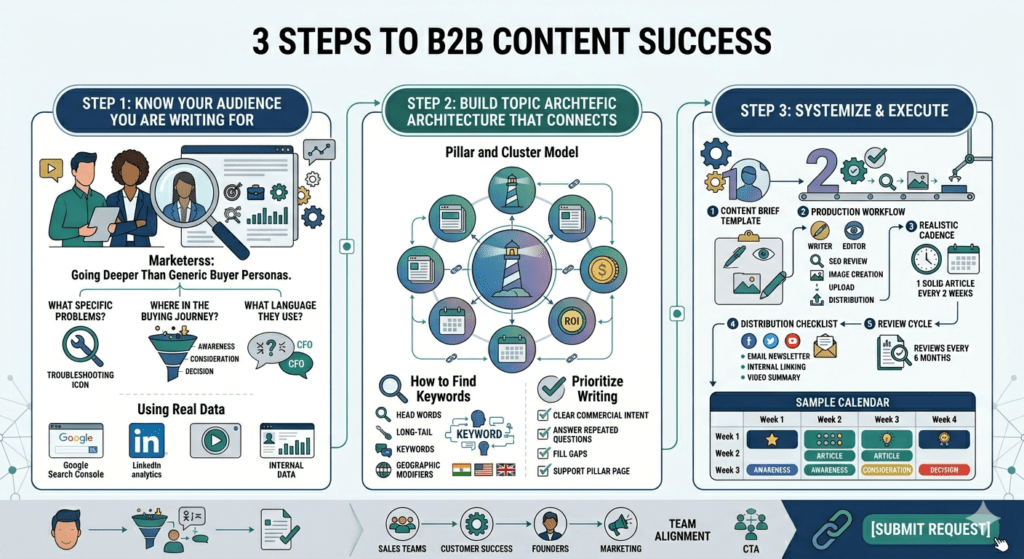
Step 1: Know Exactly Who You Are Writing For — Before You Write Anything
The first of the 3 steps for creating a blog content plan is the one most teams rush past. They want to get to the writing. But without a precise understanding of your reader, even the best-written content misses.
Going Deeper Than a Generic Buyer Persona
Most B2B teams already have buyer personas. The problem is that most of those personas are too vague to be useful for content planning. “Marketing Manager, 30–45, interested in growth” tells you almost nothing about what that person needs to read next week.
For a content plan to work, you need to understand:
- What specific problems your reader is trying to solve right now — not in general, but this month, this quarter.
- Where they are in the buying journey — are they just becoming aware of a problem, actively researching solutions, or close to making a decision?
- What language they use to describe their challenges — the exact phrases they type into Google, the questions they ask in LinkedIn comments, the objections they raise on sales calls.
- What they already know — mid-level marketers in India searching for B2B content marketing plan tips have different knowledge levels than a first-time founder in the US trying to understand why their blog is not ranking.
Using Real Data to Define Your Audience
Do not guess. Pull audience data from:
- Google Search Console — what queries are already bringing people to your site?
- LinkedIn analytics — which of your organic posts generated the most professional engagement?
- Sales call recordings — what questions do prospects ask repeatedly before they commit?
- Competitor comment sections — what are readers asking on competitor blog posts that is not being answered well?
This research takes a day or two. But it transforms everything that follows.
Real-world example: A B2B SaaS company in London spent two hours reviewing their top 20 sales call transcripts and identified that their prospects consistently asked, “How do I justify this investment to my CFO?” They built an entire content cluster around that single question — and it became their highest-converting traffic source within four months.
For teams using social media marketing tools to distribute content, this audience clarity also makes your social strategy sharper. You stop broadcasting and start targeting.
Step 2: Build a Keyword and Topic Architecture That Connects
Once you know your audience deeply, the second step is building the keyword and topic architecture that structures your entire content plan.
This is where most B2B blogs go wrong. They pick topics randomly — based on what the CEO finds interesting, or what a competitor just published, or whatever the team brainstorms in a Friday meeting. The result is a blog full of disconnected articles that never build authority in any single area.
A strong content architecture does the opposite. It clusters related topics together to signal deep expertise to search engines and to guide readers naturally from one article to the next.
The Pillar and Cluster Model
The most effective B2B content architecture follows a pillar and cluster model:
- Pillar content — A comprehensive, authoritative guide on a broad topic (e.g., “The Complete Guide to B2B Content Marketing”).
- Cluster content — Shorter, more specific articles that go deep on subtopics within the pillar (e.g., “How to Build a B2B Content Calendar,” “B2B Blog SEO Best Practices,” “How to Measure Content Marketing ROI”).
- Internal links — Every cluster article links back to the pillar, and the pillar links out to each cluster. This creates a web of authority that search engines reward with higher rankings across the entire topic area.
How to Find the Right Keywords
Use a mix of:
- Head keywords — high-volume, competitive terms that define your niche (e.g., “B2B content strategy”).
- Long-tail keywords — lower volume but higher intent phrases that reflect specific buyer questions (e.g., “how to create a B2B blog content plan from scratch”).
- Question-based keywords — phrases that match how buyers actually search and how AI answer engines surface results (e.g., “what is the best way to plan B2B blog content?”).
- Geographic modifiers — for teams targeting specific markets, include phrases like “content marketing strategy for B2B companies in India” or “blog content planning for UK marketers” to capture local search intent.
Prioritising What to Write First
Not all topics are equal. Prioritise articles that:
- Target keywords with clear commercial intent.
- Answer questions your sales team hears repeatedly.
- Fill gaps that competitors have not addressed well.
- Support a pillar page you are building toward.
For marketers managing B2B social platforms alongside blog content, this keyword architecture also informs your social content themes — ensuring your LinkedIn posts, newsletters, and blog articles all reinforce the same topical authority.
Step 3: Build a Realistic Publishing System — Not Just a Calendar
The third and final step of the 3 steps for creating a blog content plan is the one that determines whether your plan actually gets executed.
Ideas are cheap. Consistent execution is rare. And in B2B content marketing, consistency is everything. Search engines reward regular, high-quality publishing. Audiences build habits around content they can rely on. A blog that publishes one brilliant article every six months is categorically less effective than one that publishes one solid article every two weeks, consistently, over twelve months.
The Elements of a Real Publishing System
A publishing system is not just a calendar. It includes:
1. A Content Brief Template
Every article should start with a brief that includes the target keyword, the intended audience segment, the article goal (awareness, consideration, or conversion), the word count range, the internal links to include, and the CTA.
2. A Production Workflow
Define who does what — keyword research, brief creation, writing, editing, SEO review, image creation, upload, and distribution. Even a two-person team benefits from a documented workflow.
3. A Realistic Cadence
Be honest about your team’s capacity. One high-quality article per week is better than three rushed ones. Quality signals — depth, accuracy, original insight, clear structure — are what E-E-A-T demands. Quantity alone will not move the needle.
4. A Distribution Checklist
Every published article should trigger a distribution sequence: LinkedIn post, email newsletter mention, internal linking update on related existing articles, and — where relevant — a short-form video summary for LinkedIn video marketing or social commerce strategies.
5. A Review Cycle
Plan to audit your content every six months. Remove or update articles with declining traffic, refresh statistics, improve headings for AEO, and add new internal links to recently published related content.
What a Smart Content Calendar Actually Looks Like
| Week | Content Type | Topic | Stage | Keyword Target |
|---|---|---|---|---|
| 1 | Pillar article | B2B Content Marketing Guide | Awareness | B2B content strategy |
| 2 | Cluster article | Blog content plan in 3 steps | Consideration | blog content planning |
| 3 | Cluster article | B2B keyword research guide | Awareness | keyword research B2B |
| 4 | Case study | Client result spotlight | Decision | B2B content ROI |
This kind of structured variety ensures you are building topical authority, supporting every stage of the buyer journey, and giving search engines consistent signals of expertise over time.
The Hidden Advantage of a Documented Content Plan
Here is something that rarely gets discussed: a written content plan does more than improve your SEO. It transforms how your entire team relates to content.
When everyone — from the CEO to the junior marketer — can see the plan, the rationale behind each article, and how it connects to business goals, content stops being “the marketing team’s job” and starts becoming a shared business asset.
Sales teams start using blog articles in their outreach. Customer success teams share relevant posts with onboarding clients. Founders reference content in media interviews. The content plan becomes the content culture.
For B2B teams in competitive markets — whether you are growing your network online in Mumbai, building pipeline in Manchester, or targeting enterprise buyers in Austin — that cultural shift is often what separates brands that break through from those that stay stuck.
What Separates Good Plans From Great Ones
A good content plan covers the three steps above. A great one adds two more layers that most teams overlook.
Competitor gap analysis — Identify the topics your direct competitors rank for that you do not. These represent the fastest path to traffic gains with the least resistance.
Content repurposing strategy — Plan from the start how each article will be repurposed. A 1,500-word blog post can become a LinkedIn carousel, a short video script, an email newsletter section, and a podcast talking point. Building this into the plan from day one multiplies your content ROI without multiplying your workload.
For teams using best channels for B2B marketers across multiple platforms, this repurposing layer is what makes a content plan genuinely sustainable at scale.
Your Content Plan Deserves the Right Team Behind It
A smart content plan is only as powerful as the team executing it. If you are ready to build a consistent B2B content engine but need specialist support — from SEO content writers and content strategists to marketing automation experts — MyB2BNetwork connects you with vetted content marketing service providers who deliver exactly what your plan requires.
Submit one requirement. Receive multiple competitive quotations from pre-screened specialists. We scope your project, validate the offers, schedule meetings, support negotiations, and protect every payment through secure escrow — so your content investment is always in safe hands.
Whether you need a full content strategy overhaul or a reliable writing team to execute your plan month after month, we find the right fit — faster and with far less risk than searching alone.
[Submit your content marketing requirement on MyB2BNetwork →] and turn your blog from a good idea into a real growth channel.