What Is the Digital Marketing and Social Media Relationship?
Digital marketing is the umbrella of all online strategies used to promote a business — including SEO, email, content, and paid advertising. Social media is one of its most powerful channels. Together, digital marketing & Social media amplify reach, deepen engagement, and build the brand trust that modern B2B buyers demand before making any purchasing decision.
Every strong partnership has a moment you can point to — the moment two things came together and everything changed.
For the business world, that moment happened sometime in the early 2000s.
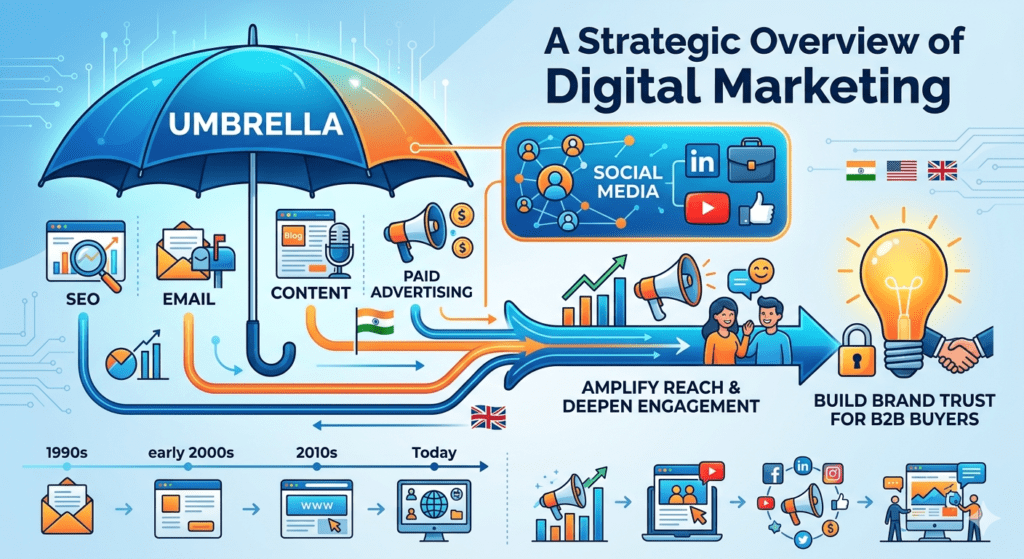
Digital marketing had already been quietly growing since the 1990s. Email clients like Hotmail and Yahoo were making direct communication scalable. Google launched in 1998 and was slowly rewiring how people found information. Businesses were beginning to understand that the internet was not a trend — it was the future of commerce.
Then social media arrived.
LinkedIn launched in 2002. MySpace in 2003. Facebook in 2004. YouTube in 2005. Twitter in 2006. Within four years, the digital landscape had been completely transformed. Billions of people were spending hours every day on platforms designed for connection, entertainment, and community.
It did not take long for marketers to see what was happening. And when digital marketing met social media, the combination proved more powerful than either channel had been alone.
That is precisely why digital marketing and social media are the perfect match — and why understanding that relationship is now essential for every B2B marketer looking to generate leads, build authority, and grow their pipeline in competitive markets across India, the US, the UK, and beyond.
According to DataReportal, there are now more than 5.2 billion active social media users globally — spending an average of 2 hours and 19 minutes per day across platforms. For B2B marketers, that is not a statistic. It is an opportunity of staggering scale.
How Two Separate Worlds Became One Unstoppable Force
Digital marketing and social media did not start out as allies. They grew up separately and came from very different places.
Digital marketing was born out of business necessity. As the internet became mainstream, brands needed new ways to reach customers, generate leads, and drive sales online. Email, search, banner advertising, and early content marketing were the tools of the trade. It was strategic, data-driven, and commercial from the start.
Social media, by contrast, was born out of human connection. The early platforms were built for people — not brands. Users wanted to share photos, message friends, and follow interests. Commerce was not part of the original vision.
But human attention is the raw material of marketing. And once billions of people were spending significant time on social platforms, the commercial opportunity became impossible to ignore.
Brands followed the audience. Platforms built advertising infrastructure. Targeting became precise. Creative formats evolved. And gradually, what had been two separate disciplines became one integrated strategy.
Today, asking whether a B2B digital marketing campaign should include social media is like asking whether a recipe needs heat. The answer is self-evident.
The Landscape That Made Integration Inevitable
Understanding why digital marketing and social media are the perfect match requires looking at the broader digital landscape that made their convergence not just possible — but inevitable.
Three forces drove this integration:
1. Audience concentration
By the mid-2010s, the major social platforms had achieved a scale that no individual marketing channel could ignore. Facebook had over a billion users. LinkedIn had become the professional standard for B2B networking. YouTube had become the world’s second-largest search engine. Wherever your target audience was, social media was where they were spending time.
2. Platform-level advertising infrastructure
Every major social platform built sophisticated advertising tools that gave marketers capabilities they had never had before — hyper-precise audience targeting by industry, job title, location, behavior, and interest. For B2B marketers, LinkedIn’s ability to target by company size, seniority level, and specific job function was transformational.
3. Content consumption habits
As mobile usage surpassed desktop, social media became the primary way people discovered new content. A blog post shared on LinkedIn, a product video on Instagram, a thought leadership thread on Twitter — social media became the distribution engine that amplified every other form of digital marketing content.
These three forces combined to make social media not just a component of digital marketing — but arguably its most dynamic and measurable channel.
Why Each Platform Brings a Different Superpower to Your Strategy
One of the most common mistakes mid-level marketers make is treating all social platforms the same. They publish identical content across every channel and wonder why results vary so dramatically.
The reality is that digital marketing and social media are the perfect match precisely because different platforms serve different purposes — and great marketers use each one intentionally.
Here is how the major platforms fit into a B2B digital marketing strategy:
| Platform | Primary Strength | Best B2B Use Case |
|---|---|---|
| Professional targeting | Thought leadership, lead generation, B2B ads | |
| YouTube | Long-form video authority | Product demos, educational content, brand building |
| Visual storytelling | Brand awareness, behind-the-scenes, case studies | |
| Community and retargeting | Remarketing campaigns, interest-based audiences | |
| X (Twitter) | Real-time conversation | Industry commentary, trend engagement, PR |
| TikTok | Short-form video reach | Brand awareness, younger professional audiences |
For B2B marketers in India, the US, and the UK, LinkedIn remains the highest-converting platform for direct lead generation. But YouTube and Instagram are increasingly important for top-of-funnel brand building — especially as younger decision-makers move into buying roles.
The key insight: which channel you use depends on what you are trying to achieve, not on which platform is most popular overall.
Organic Social: The Long Game That Builds Unshakeable Authority
Paid advertising gets the spotlight. But organic social media is the foundation that makes everything else work better.
When a B2B brand consistently shares valuable, relevant content — insights, case studies, expert opinions, industry commentary — it builds something that paid ads simply cannot buy: genuine authority and audience trust.
Here is what a strong organic social strategy looks like for B2B brands:
- Consistent publishing cadence — Posting regularly signals to both algorithms and audiences that your brand is active and credible.
- Platform-native content formats — LinkedIn carousels, YouTube Shorts, Instagram Reels. Each platform rewards content designed specifically for it, not repurposed from elsewhere.
- Employee and founder voices — Personal profiles almost always outperform brand pages on organic reach. Encourage team members to share company content and build their own professional authority.
- Community engagement — Responding to comments, joining relevant conversations, and sharing other people’s valuable content builds reciprocal relationships that amplify organic reach.
- Hashtag and keyword strategy — Using relevant professional hashtags on LinkedIn and keyword-optimized descriptions on YouTube helps content reach beyond your existing followers.
For teams focused on growing your network online, organic social is the channel that compounds most powerfully over time. Every piece of content you publish today can continue generating profile visits, connection requests, and inbound enquiries months or even years from now.
When Paid Social Becomes the Accelerator You Cannot Afford to Skip
Organic social builds authority. Paid social builds pipeline — faster.
For B2B brands with a clear target audience and a proven offer, paid social advertising on LinkedIn, Facebook, or YouTube can deliver qualified leads at scale with a precision and speed that organic content cannot match.
The most effective paid social formats for B2B marketers include:
LinkedIn Lead Gen Forms
These allow prospects to submit their contact details directly within the LinkedIn platform — no landing page required. Pre-filled with their LinkedIn profile data, these forms dramatically reduce friction and consistently outperform standard link-click ads for B2B lead generation.
LinkedIn Sponsored Content
Boosting high-performing organic posts to reach lookalike audiences or targeted prospect lists amplifies the content that is already resonating — without starting from scratch.
YouTube Pre-Roll and In-Stream Ads
Video ads shown before relevant content can generate strong brand awareness among specific professional demographics. The ability to skip after five seconds forces creative discipline — and the best B2B video ads deliver their core message in those first five seconds.
Facebook Retargeting
Showing ads to website visitors, email subscribers, or video viewers on Facebook keeps your brand visible to warm audiences across the buyer journey — often at a lower cost per impression than LinkedIn.
For teams managing social media marketing tools and paid campaigns alongside organic content, the combination of both approaches creates a compounding effect. Organic builds trust. Paid generates reach. Together, they cover the full buyer journey.
The SEO and Social Media Connection Most Marketers Underestimate
Here is a relationship that often gets overlooked: the indirect but powerful connection between social media activity and search engine rankings.
Social media does not directly affect SEO rankings in the traditional sense. A LinkedIn post does not generate a backlink that Google counts. But the relationship is more nuanced — and more impactful — than most people realize.
When your content gets shared widely on social media, it reaches journalists, bloggers, and industry publications. Some of them link to it. Those backlinks do directly improve your domain authority and organic rankings.
When your branded content appears consistently on social media, it increases branded search volume — the number of people Googling your company name directly. Branded search is a strong positive signal to search algorithms.
When your blog content gets distributed via LinkedIn or email and drives traffic to your site, it improves engagement metrics — time on page, pages per session, return visits — that search engines factor into quality assessments.
This is one more reason why digital marketing and social media are the perfect match — they do not just work well together on the surface. They reinforce each other’s performance in ways that are measurable, compounding, and often underappreciated.
For B2B marketers building B2B content authority through blogs and thought leadership, social media is not just a distribution channel. It is an SEO amplifier.
What Smart B2B Brands Do Differently With Social Integration
The most successful B2B digital marketing teams do not treat social media as a separate department or afterthought. They integrate it into every stage of the marketing process — from campaign planning to content creation to lead nurturing.
Here is what that integration looks like in practice:
Campaign-level integration
Every digital marketing campaign — whether email, content, or paid search — has a social component built in from the start. Blog content becomes LinkedIn posts. Email newsletters are teased on social. Webinars are promoted across multiple platforms simultaneously.
Content repurposing systems
A single piece of pillar content — a comprehensive guide, a research report, a case study — gets broken into multiple platform-native formats. This multiplies content ROI without multiplying the production workload.
Social listening as market intelligence
The comment sections, hashtag conversations, and LinkedIn threads where your target audience is active are a goldmine of buyer insight. The best marketers treat social listening as a continuous research tool — identifying emerging questions, objections, and trends that inform future content and campaign strategy.
Cross-channel retargeting
Someone who reads your blog gets retargeted on LinkedIn. Someone who watches your YouTube video gets followed up via email. The integration of social data with CRM and marketing automation platforms creates buyer journeys that feel cohesive and personalized — regardless of which channel the prospect first encountered your brand on.
For mid-level marketers managing B2B social platforms alongside other digital channels, building these integration systems is what separates high-performing teams from those stuck in siloed, channel-by-channel thinking.
How Geographic Context Shapes Your Social and Digital Strategy
The same campaign that works brilliantly for a B2B brand in the US may need significant adaptation for markets in India or the UK.
In India, WhatsApp and YouTube dominate mobile engagement alongside LinkedIn. B2B marketers targeting decision-makers in Tier 1 and Tier 2 cities benefit from vernacular content strategies and platform combinations that Western campaigns often overlook. The sheer scale of India’s growing professional class makes it one of the highest-opportunity B2B markets for social-driven lead generation.
In the US, LinkedIn and email remain the dominant B2B channels, but YouTube is increasingly important as buyers prefer video-first research. American B2B audiences respond to data-driven content, direct positioning, and clear ROI messaging.
In the UK, professional audiences tend to favor understated, evidence-led content over aggressive promotional messaging. LinkedIn thought leadership and organic content authority perform strongly, while overly sales-heavy paid ads often underperform compared to US benchmarks.
Understanding these geographic nuances is a core part of why digital marketing and social media are the perfect match globally — the combination is universal, but the execution is always local.
The Emerging Frontier: Social Commerce and AI-Powered Campaigns
The relationship between digital marketing and social media is not static. It continues to evolve — and the most important developments right now are social commerce and AI-powered campaign management.
Social commerce — the ability to complete a purchase directly within a social platform without leaving — is growing rapidly. While it started in B2C, B2B brands are beginning to explore how native LinkedIn lead forms, in-platform booking tools, and social-integrated CRM systems can shorten the B2B buying cycle significantly.
For B2B marketers exploring social commerce strategies, the opportunity is to reduce friction at every stage — from discovery to enquiry to conversation — using native platform features rather than redirecting prospects through multiple off-platform steps.
Ready to Make Your Digital and Social Strategy Work Harder?
A powerful digital marketing and social media strategy requires the right execution team behind it. If you are ready to scale your B2B marketing but need specialist support — from social media management and content marketing to marketing automation and digital advertising — MyB2BNetwork connects you with vetted marketing service providers who deliver exactly what your growth requires.
Whether you need a full-service digital marketing team or a specialist social media agency, we find the right fit — faster, safer, and with far less effort than sourcing on your own.
[Submit your digital marketing requirement on MyB2BNetwork →] and turn your social presence into a real B2B growth engine.