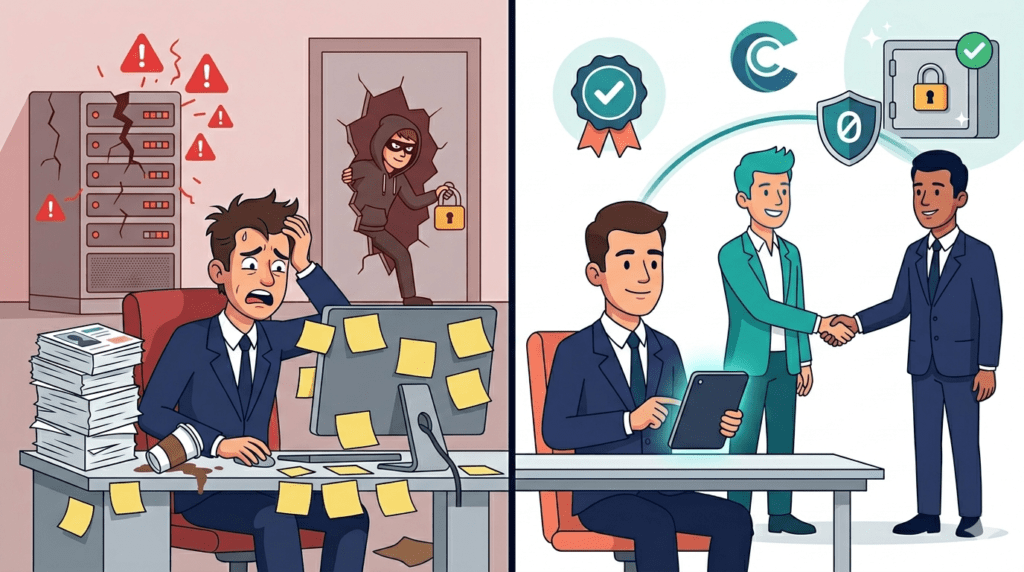
Identity managers and security teams across the U.S. are under siege. Credential stuffing, phishing-based account takeovers, and centralized database breaches cost enterprises billions every year — and traditional password-based authentication is no longer defensible. Decentralized identity verification, powered by DID wallets, verifiable credentials (VCs), and zero-knowledge proofs (ZKPs), offers a structurally superior alternative that password less architectures have shown can reduce fraud by up to 50%.
What Is Decentralized Identity Verification?
Decentralized identity verification (also called DCI or Self-Sovereign Identity / SSI) is a framework that lets users own, store, and share their identity credentials without relying on any central authority or database. Instead of trusting a single provider (like a SaaS IdP) to validate “who you are,” DCI shifts control to the user and uses cryptographic proof to validate claims.
Three core components power it:
- Decentralized Identifiers (DIDs): Unique, user-controlled identifiers anchored on a distributed ledger — no single point of failure
- Verifiable Credentials (VCs): Cryptographically signed digital credentials issued by trusted entities (governments, universities, employers) and stored in the user’s identity wallet
- Zero-Knowledge Proofs (ZKPs): Cryptographic protocols that let users prove a claim (e.g., “I am over 18” or “I hold an active business license”) without revealing the underlying data
- The DID Trust Triangle: Issuer → Holder (DID Wallet) → Verifier — governed by W3C DID Core Specification v1.0 and the W3C Verifiable Credentials Data Model.
Why Decentralized Identity Verification Matters for U.S. Businesses
The problem with centralized identity is architectural: one breached database exposes every user. By eliminating the central data store, DCI removes the most common attack surface.
Regulatory alignment is equally critical. U.S. enterprises operating under NIST SP 800-63 (Digital Identity Guidelines)wc, SOC 2 Type II, HIPAA (healthcare providers in Chicago and Boston), CCPA (California SaaS firms), and FTC Safeguards Rule (fintech lenders in New York) are increasingly finding that DCI satisfies multiple compliance requirements in a single implementation. For global operations, ISO/IEC 27001, GDPR, and the EU’s eIDAS 2.0 regulation now explicitly recognize W3C Verifiable Credentials as a valid digital identity standard.
Key business outcomes from adopting DCI:
- Up to 50% reduction in credential-based fraud through passwordless, cryptographic authentication
- Faster B2B onboarding — Skype cut fraudulent account creation by 90% using verifiable credentials
- Reduced KYC/AML overhead for regulated industries — fintechs in New York and logistics platforms in Atlanta eliminate repetitive document re-collection
- NIST AAL3-compliant phishing-resistant MFA without hardware tokens
- Privacy by design — ZKPs satisfy GDPR’s data minimization principle and CCPA’s consent mandates
The DCI Technology Stack: How It Works in B2B Environments
In a B2B context, decentralized identity verification replaces the traditional username/password or federated SSO model. When a vendor, partner, or employee authenticates, they present cryptographically signed credentials from their DID wallet — not a password.
Example workflow for a SaaS platform in Austin, TX onboarding a new enterprise client:
- The enterprise submits a business identity credential (e.g., verified via Secretary of State records) issued as a VC to their DID wallet
- The SaaS platform sends a presentation request specifying which VCs it needs (e.g., business registration + authorized signatory credential)
- The holder’s wallet responds with a ZKP-backed proof — disclosing only what’s required
- The verifier cryptographically validates the proof against the issuer’s DID on the distributed ledger — no database lookup, no centralized storage
Leading platforms and frameworks you should evaluate:
| Platform | Type | Best For | Standards |
| Microsoft Entra Verified ID | Enterprise | Azure-native B2B orgs | W3C VC, DID:ion |
| Okta Identity | IAM + DCI | SaaS and mid-market | OpenID4VC, FIDO2 |
| Ping Identity | Enterprise IAM | Banking, healthcare | SAML, FIDO2, VCs |
| Dock.io | Blockchain DID | Startups, Web3 firms | W3C DID, JSON-LD |
| Hyperledger Indy/Aries | Open-source | Gov, consortium use cases | AnonCreds, ZKP |
How to Outsource Decentralized Identity Verification in the U.S.
Outsourcing DCI implementation is the fastest path to production for most U.S. enterprises — especially identity managers at manufacturing firms in Ohio or mid-sized healthcare providers in Chicago who lack an in-house blockchain or cryptography team.
Step 1 — Define Your Use Case and Compliance Scope
Before you engage any vendor, document:
- Which identity flows need to be replaced (employee onboarding, B2B partner auth, customer KYC)?
- Which regulatory frameworks apply: NIST SP 800-63B, SOC 2, HIPAA, CCPA, FTC Safeguards, ISO 27001?
- What integrations are required (Azure AD, Okta, Salesforce, SAP)?
Step 2 — Build Your Vendor Shortlist
Target vendors with demonstrable experience in W3C DID/VC standards. Key checks:
- ✅ W3C Verifiable Credentials conformance tested and publicly documented
- ✅ SOC 2 Type II audit report (ask for it — not just a claim)
- ✅ ISO/IEC 27001 or ISO 27701 (privacy) certification
- ✅ Reference clients in your industry — fintech in New York, healthcare in Chicago, or logistics in Atlanta
- ✅ Clear SLA terms: uptime SLA ≥ 99.9%, incident response < 4 hours, data residency within the U.S. if required
- ✅ FIDO Alliance membership or FIDO2 certification for the passwordless layer
- ✅ Interoperability with existing IdP (Okta, Azure AD, Ping) — ask for a proof of concept within 2 weeks
Step 3 — Due Diligence Checklist
Ask every shortlisted vendor these questions pre-engagement:
- Which distributed ledger do you use, and how is it governed? (Public permissioned vs. private)
- How do you handle key recovery if a user loses their DID wallet?
- What is your data breach notification SLA and does it comply with FTC Breach Notification Rules?
- Can you demonstrate ZKP-based selective disclosure in a sandbox before we contract?
- What happens to our data if we terminate the contract? (Portability + deletion SLA)
- Do you carry Cyber Liability Insurance with coverage ≥ $5M?
- What NIST CSF or CIS Controls framework do you align to?
🚩 Red Flags to Watch For
- No publicly available SOC 2 report
- Uses a non-standard or proprietary “DID method” not listed in the W3C DID Method Registry
- Cannot name specific compliance frameworks supported
- No escrow or data portability clause in the contract
- Vague SLAs written as “best effort”
Budget and Timeline Estimates
Typical DCI outsourcing engagements in the U.S. run:
| Scope | Timeline | Estimated Budget |
| Pilot (1 use case, 500 users) | 6–10 weeks | $25,000–$60,000 |
| Mid-scale B2B rollout | 3–6 months | $80,000–$250,000 |
| Enterprise-wide DCI transformation | 9–18 months | $300,000–$1M+ |
These are realistic ranges — not minimums — based on typical IAM project complexity in the U.S. market. Costs vary significantly based on IdP complexity, compliance scope, and wallet infrastructure choices.
The VERIFY Framework — A Named Model for DCI Vendor Evaluation
This article introduces the VERIFY Framework™ for evaluating DCI vendors:
- V — Verified Standards (W3C, FIDO2, NIST)
- E — Evidence of Past Deployments (reference clients, case studies)
- R — Regulatory Coverage (SOC 2, ISO 27001, HIPAA, CCPA alignment)
- I — Interoperability (existing IdP, SIEM, HRMS integrations)
- F — Flexibility (cloud-agnostic, multi-DID method support)
- Y — Your SLAs and Contract Protections (uptime, data portability, cyber liability)
Use this as a scoring rubric (1–5 per dimension) to compare vendors objectively before signing any contract.
FAQ: Decentralized Identity Verification for B2B Security Teams
Q: What’s the difference between DID wallets and traditional SSO?
A: SSO relies on a central identity provider that stores or brokers user data — a breach there affects everyone. DID wallets store credentials locally on the user’s device or a controlled cloud wallet, and authentication is cryptographic proof-based, not lookup-based.
Q: How do zero-knowledge proofs protect B2B data during verification?
A: ZKPs allow a party to prove a claim is true (e.g., “our company is SOC 2 certified”) without revealing the underlying certificate, audit details, or any PII. This satisfies GDPR’s data minimization principle and CCPA’s consent requirements in a single transaction.
Q: Which industries in the U.S. benefit most from DCI right now?
A: Fintech firms in New York (KYC/AML), healthcare providers in Chicago (HIPAA-compliant patient identity), SaaS platforms in Austin (B2B partner onboarding), logistics companies in Atlanta (supplier credentialing), and manufacturing firms in Ohio are the highest-priority adopters today.
Q: How do I choose a DCI vendor within my budget?
A: Start with a pilot scoped to one identity use case. Request fixed-fee pricing for the POC phase (typically $15,000–$30,000). Use the VERIFY Framework™ above to score vendors, then negotiate performance-tied SLAs before scaling. Platforms like MyB2BNetwork allow you to submit a single requirement form and receive summarized, competitive quotations from pre-vetted DCI vendors.
Q: Can small and mid-sized B2B firms afford decentralized identity solutions?
A: Yes — cloud-hosted DCI platforms like Microsoft Entra Verified ID and Dock.io offer consumption-based pricing that makes pilot programs accessible at under $30,000.
Q: What should be in the outsourcing contract?
A: Insist on: clear data residency clauses, a 90-day data portability window post-termination, defined breach notification SLAs (≤ 72 hours per GDPR/FTC standards), cyber liability insurance minimums ($5M for mid-market), performance penalties for SLA breaches.
Get Accurate Vendor Quotations with MyB2BNetwork
Sourcing and shortlisting DCI vendors — especially for specialized implementations involving ZKPs, W3C-compliant wallets, or HIPAA/SOC 2-scoped deployments — is time-consuming. Identity managers and security teams often spend 6–8 weeks just getting comparable quotes.
MyB2BNetwork solves this in one step. Submit a single form describing your decentralized identity verification requirements — use case, compliance framework, user scale, and budget range — and receive summarized, competitive quotations from pre-vetted B2B vendors. Whether you’re a fintech startup in New York building KYC infrastructure or a healthcare network in Chicago upgrading to HIPAA-compliant passwordless auth, MyB2BNetwork connects you with the right vendor at the right price — fast.